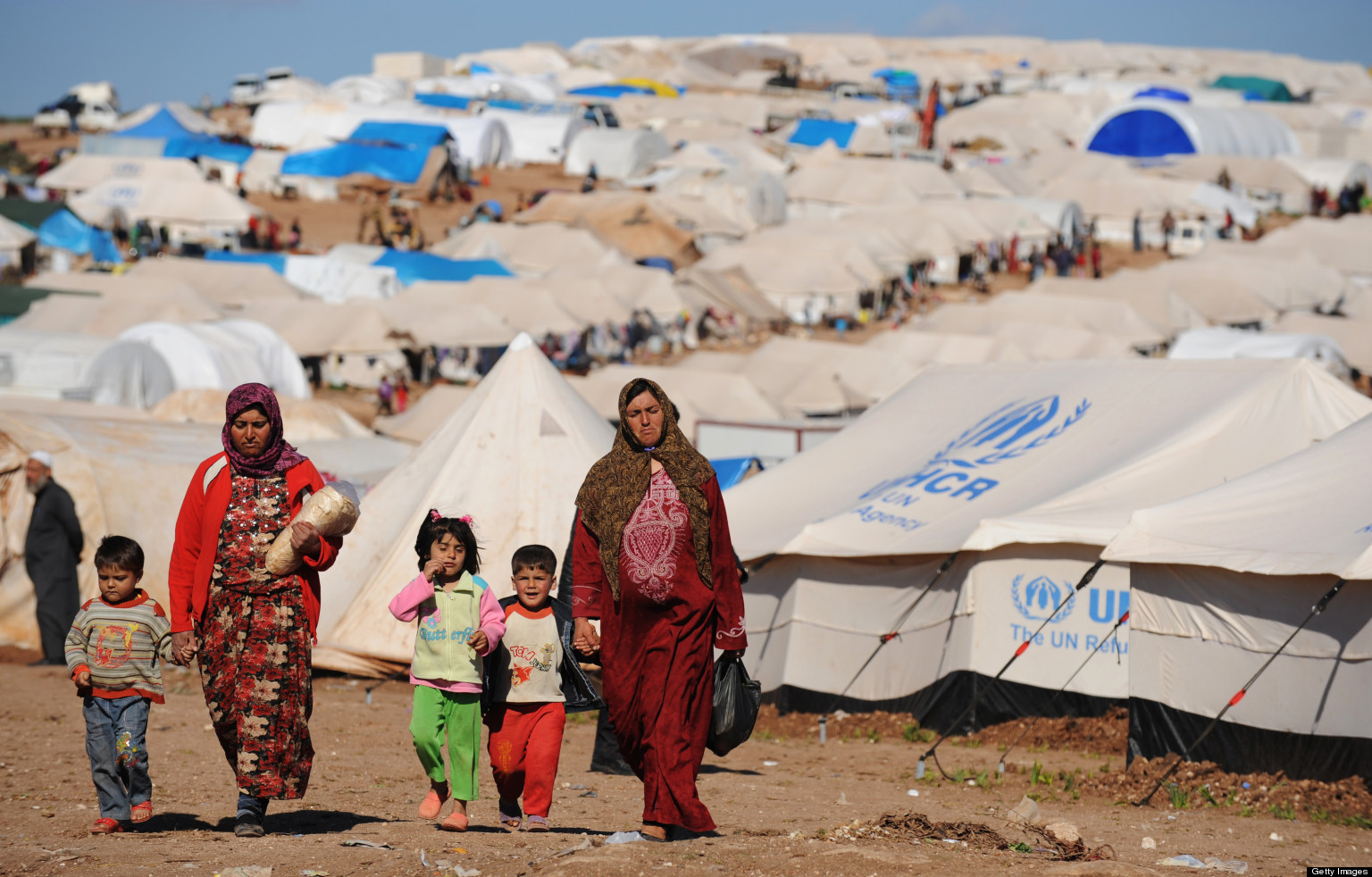
According to latest numbers, 60 million people have been displaced due to violence and inhumane poverty.
In recent months, a major humanitarian catastrophe has made its way into the news—tens of millions, the largest ever recorded by the United Nations, have been forced to take part in a life-threatening journey across land and sea.
While members of the establishment media have used terms such as “swarms” or “tide”, as though they were describing animals or pests, to describe these men, women, and children refugees continue to struggle so that they may gain access to basic human rights, such as stable shelter and food. Islamophobia has also crept its way into reports and into the mouths of politicians, some of whom are refusing to accept Muslim refugees.
Further burdening refugees who are making their way across Europe is the growing right wing. Germany’s National Democratic Party, a neo-Nazi organization, has been responsible for organizing arson at homes of refugees, and leading massive anti-immigrant and anti-Muslim protests. If this wasn’t frightening enough, the NDP is also gaining footholds in the government.
Abby Martin takes us inside the refugee crisis, humanizing the victims, and exposing the parties and people who are using this humanitarian catastrophe in order to push a right wing agenda.
MEDIA ROOTS — With governments,
citizens, and activists worldwide increasingly relying on the internet, the environment the
internet fosters is a hotly contested issue.
Last summer, the United Nations declared that disconnecting people from
the internet was a human
rights violation and against international law. Considering internet access as a human right
and witnessing the vital contribution it has played in the Arab Spring and Occupy Movements,
the sanctity of preserving a free and open internet, or net neutrality, can’t
be understated. Even the U.S. military
recently acknowledged the critical role of cyberspace by including the digital
domain in its latest concept of “full spectrum dominance.”
As humanity’s relationship with the
burgeoning information age matures, threats to a free and open internet
continue to proliferate. Indeed, when the
printed press, radio, TV, and every other technological innovation, which have promised
to revolutionize public access to a diversity of information, were developed, they’ve
faced consolidation, monopolization, and the resultant transferences of power
and control into few hands. Now, potential
predators stalk the digital realm; and they have been revealed as SOPA, PIPA
and ACTA.
SOPA, PIPA and
ACTA all generally share the same goals which are to ostensibly protect
trademarks and intellectual property, while fending off counterfeiting and
pirating. SOPA and PIPA are U.S. pieces
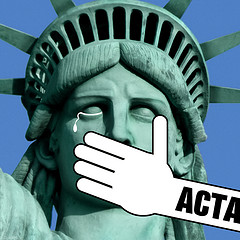
of legislation, while ACTA is a transnational agreement. After recent public outcries, internet users
defeated an attempt to pass SOPA and PIPA on Capitol Hill. However, SOPA will be resurrected soon. Meanwhile, countries around the world
vigorously protest the enactment of ACTA.
What’s the significance of these acronyms on our digital routines? Let’s break each one down individually and
have a closer look.
PIPA: Protect IP Act – Preventing
Real Online Threats to Economic Creativity and Theft of Intellectual Property
PIPA’s stated
goal would have given the U.S. government and copyright holders additional
capabilities to restrict access to websites involved in copyright infringement
and the distribution of counterfeit goods.
Senator Patrick Leahy (D-VT) originally introduced Senate Bill 968 on May
12, 2011, but the motion to proceed with the legislation was withdrawn January
23, 2011.
The most controversial
aspect of the bill would have enabled Domain Name System (DNS) blocking and
redirection. DNS serves as the virtual
yellow pages of the internet. By
blocking and redirecting DNS, this essentially tears entire pages out of the
phone book, creating an incomplete version, no longer compatible with the rest
of the world. In this scenario, a simple
search for a site would yield a message stating the site no longer exists.
SOPA: Stop Online Piracy
Act
SOPA (H.R. 3261) is the
sister bill to PIPA in the House of Representatives. SOPA was introduced by U.S. Representative
Lamar Smith (R-TX). Its legal aim was to
provide law enforcement agencies greater online jurisdiction to prevent
violation of copyrighted intellectual property and the creation of counterfeit
goods.
“This bill would
establish a system for taking down websites that the Justice Department
[DoJ] determines to be dedicated to copyright infringement. The DoJ or the copyright
owner would be able to commence a legal action against any site they deem to
have ‘only limited purpose or use other than infringement,’ and the DoJ would
be allowed to demand that search engines, social networking sites and domain
name services block access to the targeted site. It would also make
unauthorized web streaming of copyrighted content a felony with a possible penalty
up to five years in prison.”
The bill’s
inherent dangers would have allowed the U.S. government and private companies to
arbitrarily incapacitate websites, thus threatening freedom of speech. Furthermore, thousands of websites would have
been jeopardized based on their user-generated content, which in turn,
frequently relies on copyrighted material.
Following the SOPA Blackout Day on January 18th, Senate
Majority Leader Harry Reid (D-NV) rescinded
H.R. 3261’s vote on January 24, 2012.
This brief video offers a concise explanation of SOPA.
The battle for
online freedom plows ahead, in light of a new bill
originating in the Senate Homeland Security and Government Affairs
Committee. Senator Joe Lieberman (I-CT),
who chairs the Committee, is engineering the latest attempt to widely expand
authority by Executive Branch departments over the internet. The debut of this new cybersecurity bill is
expected today, February 16, 2012.
Details of the cybersecurity bill have not been revealed, a result of
the legislation’s crafters meeting behind closed doors. Theories
abound that the bill, which has benefited
from bipartisan support, would grant the Department of Homeland Security
expansive new powers to regulate and stake out the internet under the pretext
of cybersecurity. However, the
persistent attempts to pass such legislation adversely impacting free speech and
the flow of information must be questioned.
Large amounts of financial contributions to politicians, as well as dubious connections, may indicate that a broader agenda is at work.
Supporters of
SOPA and PIPA will likely vigorously lobby for the new cybersecurity bill to be
passed. Backers of this type of
legislation read like a who’s who
list of Hollywood industry bosses. From
the MPAA (Motion Picture Association of America) to the RIAA (Recording Industry
Association of America), major Hollywood power brokers angle to protect their
interests. A total of 161
entities have stumped for the passage of
SOPA and PIPA. Besides the MPAA and
RIAA, they include the AFL-CIO, the International Brotherhood of Teamsters,
Comcast, Disney, and Sony. Based on some
of the groups in favor, the entire matter appears to be a pet project of the
Democrat Party. This comes as no
surprise when considering who the vanguard of Hollywood intellectual property has historically been.
Chris Dodd has made it his mission to crusade in Washington D.C. on
behalf of Hollywood under the pretext of copyright protection legislation. Dodd is the perfect bridge between Hollywood
and the Beltway. On March 1, 2011, Dodd
was chosen as chairman
of the MPAA. On the side, he also lobbies for an
organization called Creative America.
“…everyone in
the community recognizes what a grave threat content theft poses to our
livelihood and creativity – that thieves are making millions of dollars
trafficking in stolen film and television while our jobs, pensions and
residuals continue to decline.”
Some of the
groups involved with Creative America
include the CBS Corporation, NBC Universal, the Screen Actors Guild, Twentieth
Century Fox, Viacom, and Warner Bros. Entertainment. A simple search into Dodd’s previous career
uncovers much cozier ties to D.C.
Dodd has enjoyed
over three decades as a senator and has the distinction of being Connecticut’s
longest serving senate member. He’s one of the
most recognizable Democratic senators of years past, with posts on the Committee
on Foreign Relations, the Committee on Banking, Housing and Urban Affairs, and
the Committee on Health, Education, Labor and Pensions. However, his post-political career has proven
quite lucrative. According to sources,
Dodd rakes in a $1.5 million salary as chairman of the MPAA. The appointment of Dodd to head the MPAA
might be the biggest coup Hollywood has had in years.
Further evidence
from Dodd himself reinforces this as he
threatened to cut off financial contributions from Hollywood to politicians who
did not support SOPA and PIPA. The
pipeline of sizeable contributions from Hollywood going to politicians is a
healthy one most on Capitol Hill would prefer to preserve.
Democrat Senator Harry
Reid has also asserted himself a champion of SOPA and PIPA legislation. He has brought various versions of the bill
to the Senate floor and may be bound to three and half million vested interests
to pass the legislation; Reid was the beneficiary
of $3.5 million from SOPA and PIPA
advocates during the last campaign cycle. Although donations to Reid stand out by far,
other elected officials supporting the legislation have received contributions,
too: Democrat Chuck Schumer ($2.6 million), Democrat Kirsten
Gillibrand ($2 million), Democrat Barbara Boxer ($1.4 million), and Republican Michael Bennet ($1
million). Clearly, millions of reasons
jeopardize maintaining a free and open internet. One of those reasons is another piece of
little known legislation, called ACTA.
ACTA:
Anti-Counterfeiting Trade Agreement
ACTA protests
have flashed across Europe over recent weeks.
Anti-ACTAvists have sprung up
from the Netherlands to Germany to Poland and many other countries throughout
Europe. The contentious nature of ACTA attempts
to normalize an international legal framework that enforces intellectual
property rights, but also endeavors to target counterfeit goods and even generic
medications. On October 1st,
2011, Australia, Japan, Canada, Morocco, New Zealand, Singapore, South Korea,
and the United States signed the agreement.
At the start of 2012, the European Union and 22 of its member states
ratified ACTA, bringing the total signatories to 31.
Battle lines
have been drawn and two organizations are standing toe to toe—the MPAA and the Electronic
Frontier Foundation (EFF). According to
the EFF, “[…] copyright industry rightsholder groups have sought stronger
powers to enforce their intellectual property rights […] to preserve their
business models.” This sentiment
essentially drives to the heart of the debate, one which also includes SOPA and
PIPA. Those opposed to restricting the
internet view these efforts as a veiled and desperate attempt at trying to
preserve an atrophying business model, being rendered obsolete by the age of digital
file sharing. This sentiment has
galvanized many who sense that the true reason the public digital domain is under
siege is in attempts to undermine free speech and democracy. Due to what’s at stake, emotions have run
high. U.S. Rep. Darrell Issa (R-CA) has called it
“more dangerous than SOPA.” Popular
opinion likely agrees with Issa, but is the truth harder to discern?
A lot of misinformation
swirls around ACTA. The hacktivist group Anonymous shares some
of the blame. A popular video
produced by the amorphous, hacktivist collective shines light on ACTA’s
pitfalls. But is the hit piece video
accurate? According to ArsTechnica.com,
there are four dubious claims that Anonymous makes: ISPs will monitor all your data packets, ACTA
obliges its member countries to assent to the worst features of SOPA and PIPA, generic
drugs will be banned and seeds will be controlled via patents, and ISPs will be
constantly required to scour their servers for even the smallest bits of
copyrighted material. The Anonymous
video, which includes a qualifying disclaimer at the outset, has been widely
embedded in articles online and reached nearly one million views. Anonymous noted, “This video may not reflect
the recent changes within the ACTA text.
However, it will give you an idea of what ACTA is about and why the
internet should fight it.” And, of
course, after sorting any conflicting claims, ACTA still deserves a thumbs-down
verdict. We also bear in mind internet
censorship, freedom of speech restrictions, loss of net neutrality, domestic
surveillance, and civil rights erosions and police state repression have already
been ongoing issues plaguing the U.S. ACTA
would simply codify existing repressive policies for people in the U.S. under
the pretext of opposing counterfeiting.
ACTA is a poorly
crafted agreement and simply bad. ACTA’s
basic criticisms are threefold: the agreement’s designers are not
democratically elected nor accountable, the ACTA negotiations were held in secret, and there was no discussion held in a public forum. ReadWrite
Enterprise does a fine job laying
out ten reasons why ACTA fails.
Furthermore, even though ACTA probably won’t change U.S. law, it would
lock us into a constrictive legal space in an area of law that changes
rapidly. Much like activists around the
world can now respond more quickly to police brutality and government tactics
of repression thanks to the internet, file sharing enthusiasts are finding new ways to
circumvent internet censorship just as quickly.
The Internet Can’t Be
Bound and Gagged
Already the hive
mind of the internet has developed a solution to undercut potential censorship
attempts. Many people are unaware the
internet exists similarly to an iceberg; only a small portion of it is visible
to the average user. A significant
amount of the internet lies hidden in an area called the deep web. The deep web lies
obfuscated to the armchair web surfer due to an inability to access it by simply
typing it into a search engine and accessing it.
For example, the deep web does not employ the use of meta tags or DNS
and blocks search engines, among other characteristics, making navigation there
challenging. In this secretive
environment, hackers have been diligently working on a new protocol calledTribler.
Tribler
works in a similar fashion to other BitTorrent clients except that when search
results are produced, they aren’t procured from a central index, rather they
are directly produced from other peers.
According to TorrentFreak,
“Downloading a
torrent is also totally decentralized. When a user clicks on one of the search
results, the meta-data is pulled in from another peer and the download starts
immediately. Tribler is based on the standard BitTorrent protocol and uses
regular BitTorrent trackers to communicate with other peers. But, it can also
continue downloading when a central tracker goes down.”
This type of
decentralized structure would allow users to create ‘channels’ amongst
themselves and make Tribler an
indomitable force, making neutralization by censors extremely difficult. Tribler
will make it “impossible
to shut down unless the whole Internet goes down with it.” This will come as excellent news to millions
of people witnessing attempts to stifle internet freedom with ACTA, SOPA, PIPA,
and ongoing attacks on net neutrality.
The race to control
the internet rages on, but developments like this beg the question: Does the
internet adapt and evolve too quickly for elected officials to harness it? This brings to mind Wile E. Coyote and the Roadrunner. Some things can just never be
caught. However, U.S. voters continue
to support the two-party system, which continually abandons them whilst
representing corporate interests. Time
will tell.
MEDIA ROOTS- As the pro-democracy ‘Arab Spring’
movement spread across North Africa and beyond, Euroamerican imperialists sent a stern message by responding with draconian violence. In Libya, US-NATO forces perpetrated crimes against humanity under the pretext of combating alleged crimes against humanity.
President Obama gloated as NATO advanced in Libya, then cheered the brutal assassination of Gaddafi, who was sodomised with a
knife before being extrajudicially executed. Soon thereafter, the U.S. corporate propaganda machine launched its coinciding media blitz
selling the triumphalism of ‘humanitarian intervention’ in the country.
In a recent article, “NATO’s War Crimes in Libya,” James Petras describes how Libya’s standing with the U.S. and U.K. suddenly soured without provocation. In fact, Euroamerican imperialists were Gaddafi supporters up until the ‘Arab Spring’ revolution toward democratic,
anti-imperialist, and independent governance became contagious.
To reassert its muscle and send a warning shot to other nations aspiring independence, Euroamerican imperialists,
via the proxy rubric of NATO, claimed to support ‘rebels’ fighting against the Gaddafi
government. And, of course, support is an
understatement– NATO brutally devastated Libyan infrastructure through sea
and air attacks paving the way for the so-called ‘rebels,’ which otherwise wouldn’t have
stood a chance.
These ‘rebels’ could scarcely claim popular support. As Petras
notes, the “casting of the rag-tag collection of monarchists, Islamist fundamentalists,
London and
Washington-based ex-pats and disaffected Gaddafi officials as ‘rebels’
is a pure case of mass media propaganda.”
Libya was made an example of by Euroamerican imperialists for many reasons. Gaddafi pursued plans for a ‘Bank of Africa,’ alternative
communication systems, and long supported African unity. Under Gaddafi, despite any demagoguery, Libya maintained the highest standard of living for any African nation. However, now smouldering after NATO’s devastation, it’s projected Libya faces a decade of reconstruction to undo the damage of being bombed back to the Stone Age.
To be
certain, Gaddafi was a complex political figure, developing from a
revolutionary to a self-styled symbolic figurehead. But
one simply needs to ask why NATO forces
haven’t targeted nations such as Saudi Arabia or Yemen for similar
‘humanitarian intervention’ to see through the glaring hypocrisy.
“Democracy
is totally irrelevant to this. This is a cynical imperialist attack aiming at
the two things that the US, the British, and the French value. On the one hand
the oil and on the other hand the water. And the water may turn out to be more
valuable than the oil… Libya will
be under IMF conditionality and that will mean the Washington consensus,
deregulation, privatization, the destruction of any state-sector that remains,
the destruction of any social welfare system, or social safety net, and the destruction of all
of those positive things that Gaddafi had done in his regime to distribute the
oil revenue to increase the general welfare.”
As
in Iraq, Euroamerican imperialists stand to benefit from ‘ruin and rule’
devastation, disaster capitalism, and the years of inevitable reconstruction contracts and continued obstruction of autonomous governance.
Messina
***
JAMES PETRAS— The NATO assault formed part of a general
counter-attack designed to contain and reverse the popular democratic and
anti-imperialist movements which had ousted or were on the verge of
overthrowing US-client dictators.
What caused the NATO countries to shift abruptly from a policy of embracing
Gaddafi to launching a brutal scorched-earth invasion of Libya in a matter of
months? The key is the popular uprisings, which threatened Euro-US
domination. The near total destruction of Libya, a secular regime with the highest
standard of living in Africa, was meant to be a lesson, a message from
the imperialists to the newly aroused masses of North Africa, Asia and Latin
America: The fate of Libya awaits any regime which aspires to greater
independence and questions the ascendancy of Euro-American power.
NATO’s savage six-month blitz – over 30,000 air and missile assaults on
Libyan civil and military institutions – was a response to those who claimed
that the US and the EU were on the “decline” and that the “empire was in decay”.
The radical Islamist and monarchist-led “uprising” in Benghazi during March
2011 was backed by and served as a pretext for the NATO imperial powers to
extend their counter-offensive on the road to neo-colonial restoration.
For all the ruling class and mass media euphoria, the ‘win’ over Libya,
grotesque and criminal in the destruction of Libyan secular society and the
ongoing brutalization of black Libyans, does not solve the profound economic
crises in the EU-US. It does not affect China’s growing competitive advantages
over its western competitors. It does not end US-Israeli isolation faced with
an imminent world-wide recognition of Palestine as an independent state. The
absence of left-wing western intellectual solidarity for independent Third World
nations, evident in their support for the imperial-based mercenary “rebels” is
more than compensated by the emergence of a radical new generation of left-wing
activists in South Africa, Chile, Greece, Spain, Egypt, Pakistan and elsewhere.
These are youth, whose solidarity with anti-colonial regimes is based on their
own experience with exploitation, “marginalization” (unemployment) and
repression at home.
THE GUARDIAN— As the most hopeful offshoot of the “Arab spring” so far
flowered this week in successful elections in Tunisia, its ugliest underside has
been laid bare in Libya. That’s not only, or even mainly, about the YouTube
lynching of Gaddafi, courtesy of a Nato attack on his convoy.
For the western powers, of course, the Libyan war has
allowed them to regain ground lost in Tunisia and Egypt, put themselves at the
heart of the upheaval sweeping the most strategically sensitive region in the
world, and secure valuable new commercial advantages in an oil-rich state whose
previous leadership was at best unreliable. No wonder the new British defence
secretary is telling businessmen to “pack their bags” for Libya, and
the US ambassador in Tripoli insists American companies are needed on a
“big scale”.
But for Libyans, it has meant a loss of ownership of their
own future and the effective imposition of a western-picked administration of
Gaddafi defectors and US and British intelligence assets. Probably the greatest
challenge to that takeover will now come from Islamist military leaders on the
ground, such as the Tripoli commander Abdel Hakim Belhaj – kidnapped by MI6 to
be tortured in Libya in 2004 – who have already made clear they will not be
taking orders from the NTC.
What the Libyan tragedy has brutally hammered home is that
foreign intervention doesn’t only strangle national freedom and self-determination
– it doesn’t protect lives either.
THE RAW STORY– The opposition in Belarus on Monday criticised a parliamentary bill that would give Alexander Lukashenko’s regime the legal right to crack down on protesters engaging publicly in “non-actions”.
The bill — submitted by top ministers to the lower house of parliament last week — proposes a ban on “previously-agreed actions or non-actions.”
This is apparently aimed at the numerous “silent” protests the opposition has held in recent months, where protesters chanted no slogans and merely stood clapping their hands.
Under existing legislation, the regime can act against protesters engaged in “hooliganism”, while the new bill also covers “the mass gathering of people at a previously-agreed location — including in the open air — at an agreed time to conduct previously-agreed actions or non-actions”.
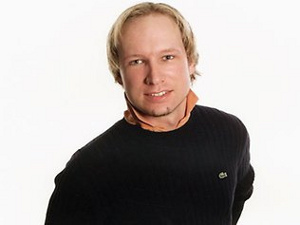
GLOBAL RESEARCH– Watching the international media on the web
and TV change gears Friday, as information started to fasten to the fact
that the worst terrorist act in Scandinavia since the 3rd Reich was
perpetrated by a right-wing Christian zealot, was fascinating. This,
rather than what Pam Geller, Steve Emerson, Daniel Pipes, Dennis Prager, David Horowitz, CNN, Fox News and many others were touting for hours as most likely an act of Muslim Jihad in a country that is way, way too liberal.
I was keyed into paying attention to how this meme might have to morph fairly early in the afternoon, by an item carried by Michael Rivero at What Really Happened, about the major event at the youth camp the day before the massacre:
During the second day of Labour Youth League summer
camp at Utøya got the Labour Party’s young hopefuls visit by Foreign
Minister Jonas Gahr Store.
Together with the Norwegian Broadcasting Corporation correspondent
Sidsel Wold and Norwegian People’s Aid Kirsten Belck-Olsen, discussed
the Foreign Minister of the deadlock between Israel and the Palestinian
Authority.
As foreign minister arrived Utøya he was met with a demand from the AUF that Norway must recognize a Palestinian state.
– The Palestinians must have their own state, the occupation must
end, the wall must be demolished and it must happen now, said the
Foreign Minister to cheers from the audience. [automatically translated
from Norwegian by Google translate]
That was an event held Thursday at the summer camp for the children of Norwegian liberals.
As the story developed Friday, almost every news outlet was quick to
provide experts on Muslim terrorism and how that might have a growing
negative impact on Norway and Europe. On Anderson Cooper, Friday
afternoon, as he had his experts on Jihadism on camera, he was being
told by another person – a CNN reporter – that the shooter,
possibly the bomber, was a blond Norwegian. Cooper seemed to be taken
aback, turning back to his Jihad experts, who were dismissive of the new
information.
The bombing-shootings took up enormous bandwidth in our media machine
until it came out that the alleged perpetrator has more in common with
Sarah Palin and Alan Dershowitz than with Rachel Corrie or Furkan Do?an,
both of whom have been labelled terrorists by Dershowitz.
As the end-of-the-week-in-midsummer stupor overtakes the media on a
hot Friday evening in the USA, will they get around to trying to find
out what set Anders Behring off?
The bombing had to be pre-planned, probably for some time. Was the
pro-Palestinian event Thursday at the camp where over 70 were killed
published on the web, facebook, twitter or somewhere else? Most likely.
That may be what pushed this guy’s last button.
The ‘Helpers of Global Jihad’ group, of which al-Nasser
is a member, made the claims in an email circular issued to various
sources. The group does not appear to have any past history.
It is thought that the bombings are a belated response to Norwegian
newspapers and magazines republishing cartoons of Mohammed originally
published by Jyllands-Posten of Denmark.
I’m not about to go all conspiracy theory on this story. I am
bothered, though, that the media was extremely rapid to ramp up the
radical Islam run amok meme, yet so unready to deal with what is
increasingly appearing to be possible – that the Christian gunman was
impelled to kill liberals he may have felt were too sympathetic to
Palestinians.
Glenn Greenwald devoted his Saturday column to yesterday’s pathetic media coverage. His second update links to an Electronic Intifada article
that shows how the false meme developed soon after the bomb went off in
downtown Oslo. Essentially, it appears one dubious “expert” pushed the
global media “over the edge”:
The source is Will McCants, adjunct faculty at Johns Hopkins University. On his website he describes himself
as formerly “Senior Adviser for Countering Violent Extremism at the
U.S. Department of State, program manager of the Minerva Initiative at
the Department of Defense, and fellow at West Point’s Combating
Terrorism Center.” This morning, he posted “Alleged Claim for Oslo Attacks” on his blog Jihadica:
This was posted by Abu Sulayman al-Nasir to
the Arabic jihadi forum, Shmukh, around 10:30am EST (thread 118187).
Shmukh is the main forum for Arabic-speaking jihadis who support
al-Qaeda. Since the thread is now inaccessible (either locked or taken
down), I am posting it here. I don’t have time at the moment to
translate the whole thing but I translated the most important bits on twitter.
The Shmukh web site is not accessible to just anyone, so he
is the primary source for this claim. McCants stated from the beginning
that the claim had been removed or hidden, and on Twitter he even cast
doubt on whether it was a claim of responsibility at all.
snip – EI posted screenshots of several tweets by McCants, then this:
McCants later reported that the claim of responsibility
was retracted by the author “Abu Sulayman al-Nasir.” Furthermore,
according to McCants, the moderator of this forum declared that
speculation about the attack would be prohibited because the contents of
the forum were appearing in mainstream media. It does seem more than a
little bit odd that genuine “jihadis” would post on a closed forum that a
former US official and “counterterrorism expert” openly writes about
infiltrating.
EI is highly critical about how easily McCants’ dubious information was spread:
The media also failed. They
reported on the claims McCants disseminated because his position and
perceived expertise gave these claims credibility. Would The New York Times
have required multiple sources and independent confirmation of the
existence of the posting and its contents if it had not come from
someone with McCants’ supposedly solid credentials?
For hours after McCants posted the update that the claim of responsibility was retracted, BBC, the New York Times, The Guardian, The Washington Post
were still promoting information originally sourced from him. The news
was carried around the world and became the main story line in much of
the initial coverage.
The threshold for a terrorism expert must be very low. This whole
rush to disseminate a false, unverifiable and flimsily sourced claim
strikes me as a case of an elite fanboy wanting to be the first to pass
on leaked gadget specs.



 According to latest numbers, 60 million people have been displaced due to violence and inhumane poverty.
 MEDIA ROOTS — With governments,
citizens, and activists worldwide increasingly relying on the internet, the environment the
internet fosters is a hotly contested issue.
Last summer, the United Nations declared that disconnecting people from
the internet was a
MEDIA ROOTS — With governments,
citizens, and activists worldwide increasingly relying on the internet, the environment the
internet fosters is a hotly contested issue.
Last summer, the United Nations declared that disconnecting people from
the internet was a 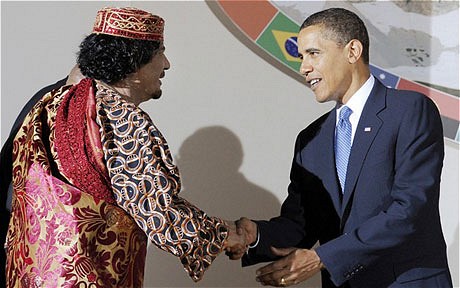 MEDIA ROOTS- As the pro-democracy ‘Arab Spring’
movement spread across North Africa and beyond, Euroamerican imperialists sent a stern message by responding with draconian violence. In Libya, US-NATO forces perpetrated crimes against humanity under the pretext of combating alleged crimes against humanity.
MEDIA ROOTS- As the pro-democracy ‘Arab Spring’
movement spread across North Africa and beyond, Euroamerican imperialists sent a stern message by responding with draconian violence. In Libya, US-NATO forces perpetrated crimes against humanity under the pretext of combating alleged crimes against humanity. 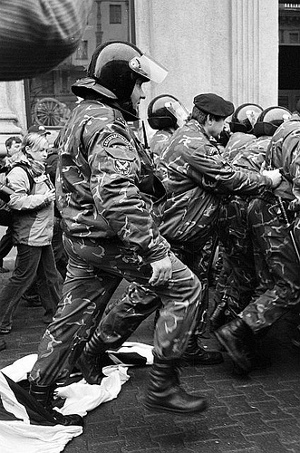 THE RAW STORY
 GLOBAL RESEARCH