RAW STORY– Bolivia is preparing to pass a new law that could lead to citizens challenging environmental destruction in court.
A Ley de Derechos de la Madre Tierra (The Law of Mother Earth) would grant nature the same rights as humans, according to The Guardian.
The country will establish 11 new rights for nature, including: the
right to exist, the right to continue natural cycles, the right to clean
water and air, the right to be free of pollution, and the right not to
have cellular structures altered or genetically modified.
The law will also give nature the right “to not be affected by
mega-infrastructure and development projects that affect the balance of
ecosystems and the local inhabitant communities.”
“It makes world history,” Bolivian Vice-President Alvaro García Linera said. “Earth is the mother of all.”
“It establishes a new relationship between man and nature, the
harmony of which must be preserved as a guarantee of its regeneration.”
The law enjoys the support of Bolivian President Evo Morales and his
Move Toward Socialism party. Not coincidentally, he is Latin America’s
first indigenous president.
NATURAL NEWS– The battle to save the Fukushima nuclear power plant now appears
lost as the radioactive core from Reactor No. 2 has melted through the
containment vessel and dropped into the concrete basement of the
reactor structure. This is “raising fears of a major release of
radiation at the site,” reports The Guardian, which broke the story. A former General Electric nuclear expert told The Guardian that Japan appears to have “lost the race” to save the reactor.
The only feasible interpretation from this analysis is that radiation emissions from Fukushima could suddenly become much greater. It is also now obvious that the radioactive fallout from Fukushima will last for decades, if not centuries.
Japan’s Prime Minister Naoto Kan last night admitted the situation
at Fukushima remains “unpredictable.” Meanwhile, the presence of
plutonium in soil samples is proof that the nuclear fuel rods have been compromised and are releasing material into the open atmosphere.
SHAREABLE– Biology is destiny, declared Sigmund Freud.
But if Freud were around today, he might say “design is destiny”—especially after taking a stroll through most American cities.
The way we design our communities plays a huge role in how we
experience our lives. Neighborhoods built without sidewalks, for
instance, mean that people walk less and therefore experience fewer
spontaneous encounters, which is what instills a spirit of community to a
place. That’s a chief cause of the social isolation so rampant in the
modern world that contributes to depression, distrust and other
maladies.
You don’t have to be a therapist to realize all this creates lasting
psychological effects. It thwarts the connections between people that
encourage us to congregate, cooperate and work for the common good. We
retreat into ever more privatized existences.
Of course, this is no startling revelation. Over the past 40 years,
the shrinking sense of community across America has been widely
discussed, and many proposals outlined about how to bring us back
together.
One of the notable solutions being put into practice to combat this problem is New Urbanism,
an architectural movement to build new communities (and revitalize
existing ones) by maximizing opportunities for social exchange: public
plazas, front porches, corner stores, coffee shops, neighborhood
schools, narrow streets and, yes, sidewalks.
This line of thinking has transformed many communities, including my
own World War I-era neighborhood in Minneapolis, which thankfully has
sidewalks but was once bereft of the inviting public places that animate
a community. Now I marvel at all the choices I have to mingle with the
neighbors over a cappuccino, Pabst Blue Ribbon, juevos rancheros, artwork at a gallery opening or head of lettuce at the farmer’s market.
But while New Urbanism is making strides at the level of the
neighborhood, we still spend most of our time at home, which today means
seeing no one other than our nuclear family. How could we widen that
circle just a bit? Not a ‘60s commune (“pass the brown rice, comrade,
and don’t forget your shift cleaning the toilet ”), but good neighbors
with whom we share more than a property line.
He believes that groupings of four to twelve households make an ideal
community “where meaningful ‘neighborly’ relationships are fostered.”
But even here, design shapes our destiny. Chapin explains that strong
connections between neighbors develop most fully and organically when
everyone shares some “common ground”.
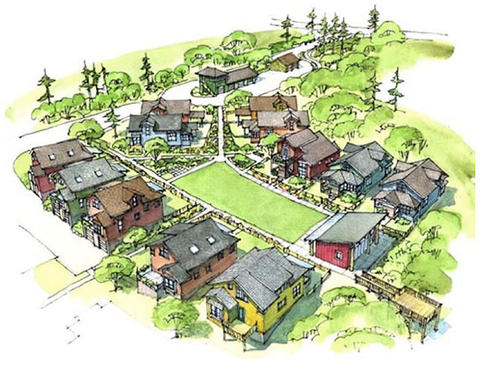
That can be a semi-private square, as in the pocket neighborhoods
Chapin designed in the Seattle area. In the book’s bright photographs,
they look like grassy patches of paradise, where kids scamper, flowers
bloom, and neighbors stop to chat.
But Chapin points out these commons can take many different forms—an
apartment building in Cambridge with a shared backyard, a group of
neighbors in Oakland who tore down their backyard fences to create a
commons, a block in Baltimore that turned their alley into a pubic
commons, or the residential pedestrian streets found in Manhattan Beach,
California, and all around Europe.
The benefits of a living in a pocket neighborhood go farther than you
might imagine. I lived in one while in graduate school, a rundown 1886 rowhouse with
its own courtyard near the University of Minnesota campus. At no other
time in my life have I become such close friends with my neighbors. We
shared impromptu afternoon conversations at the picnic table and parties
that went into the early hours of the morning under Italian lights we
strung from the trees.
When the property was sold to an ambitious young man who jacked up
the rents to raise capital for the eventual demolition of the building
to make way for an ugly new one, we organized a rent strike. And we won,
which would never have happened if we had not already forged strong
bonds with each other. Because the judged ruled that the landlord could
not raise our rents until he fixed up the building, he abandoned plans
to knock it down. It still stands today, and I remain friends with some
of the old gang that partied in the courtyard.
This work is licensed under a Creative Commons License. Photo of Conover
Commons in Redmond, Washington, designed by Ross Chapin, author of the
book Pocket Neighborhoods: Creating Small-Scale Community in a
Large-Scale World.
LA TIMES– How did Japanese workers at the crippled Fukushima nuclear plant
jury-rig fire hoses to cool damaged reactors? Is contaminated water from
waste pools overflowing into the Pacific Ocean? Exactly who is the
national incident commander?
The answers to these and many other
questions are unclear to U.S. nuclear scientists and policy experts, who
say the quality and quantity of information coming out of Japan has
left gaping holes in their understanding of the disaster nearly two
weeks after it began.
At the same time, they say, the depth of the crisis has clearly been
growing, judging by releases of radioactivity that by some measures have
reached half the level of those released in the Chernobyl accident of
1986, according to new analysis by European and American scientists.
REUTERS– Japanese engineers struggled on
Sunday to pump radioactive water from a crippled nuclear power
station after radiation levels soared in seawater near the plant
more than two weeks after it was battered by a huge earthquake
and a tsunami.
Tests on Friday showed iodine 131 levels in seawater 30 km
(19 miles) from the coastal nuclear complex had spiked 1,250
times higher than normal but it was not considered a threat to
marine life or food safety, the Nuclear and Industrial Safety
Agency said.
“Ocean currents will disperse radiation particles and so it
will be very diluted by the time it gets consumed by fish and
seaweed,” said Hidehiko Nishiyama, a senior agency official.
Fresh radiation
fears have emerged in reactor 2 of the Fukushima nuclear plant, as the radioactivity levels are reported to be 100,000 times the normal level.
COMMON DREAMS– What will it take for our world to recognize the dangers that nuclear
scientists and even Albert Einstein were warning about at the “dawn” of
the nuclear age?
Amy Goodman reminds us of the prophetic statement by Australian
journalist Wilfred Burchett who tried to find words to describe the
horror he was seeing in Hiroshima in 1945 after the bomb fell.
“It looks as if a monster steamroller had passed over it
and squashed it out of existence. I write these facts … as a warning to
the world.”
The world heard his warning, but seems to have ignored it. In fact,
what followed has been decades of nuclear proliferation, the spread of
nuclear power plants and the escalation of the arms race with new higher
tech weaponry.
As Hiroshima becomes yesterday’s distant memory and Fukishima the
current threat, the full extent of the casualties and body count are not
yet in, partly because the Japanese government and the power companies
don’t want to alarm the public.
Years earlier, a similar cover-up was in effect at Thee Mile Island
complex in Pennsylvania where reports of the damage people suffered from
a serious accident was minimized, never examined in depth by some of
the very same media outlets who are today criticizing Japan for a lack
of transparency.
On August, 6, 2008, the anniversary of the dropping of the first
nuclear bomb, Alternet.org reported that the government and media were
complicit in minimizing public awareness of the extensive suffering that
did take place:
“But the word never crossed the conceptual chasm between
the “mainstream” media and the “alternative.” Despite a federal class
action lawsuit filed by 2400 Pennsylvania families claiming damages from
the accident, despite at least $15 million quietly paid to parents
children with birth defects, despite three decades of official
admissions that nobody knows how much radiation escaped from TMI, where
it went or who it affected, not a mention of the fact that people might
have been killed there made its way into a corporate report”
Was this just accidental or is there a deeper pattern of denial? The
great expert on psycho history, Robert J. Lifton, wrote a book,
Hiroshima In America, with journalist Greg Mitchell about the aftermath
of Hiroshima in America exploring what they call “50 years of denial.”
One reviewer explained,
“The authors examine what they perceive to be a
conspiracy by the government to mislead and suppress information about
the actual bombing, Truman’s decision to drop the bomb, and the birth
and mismanagement of the beginning of the nuclear age. The authors claim
that Americans then, and now, are haunted by the devastating
psychological effects of the bomb.”
Lifton and Mitchell are evidence-based writers, not
conspiratologists, but they could find no other explanation for how such
a seminal event could have been distorted and misrepresented for a half
century.
Nuclear power and nuclear weapons have been sold to the public
relentlessly, in the first instance as necessary, and the second, as
safe. Rory O’ Connor and Richard Bell coined the term “Nuke Speak” to
describe the Orwellian methods deployed by the nuclear industry’s PR
offensive in a book length analysis of a well funded campaign that
continues to this day using euphemistic language to mask its real
agenda.
And today, as the world watches the dreadful and even Darwinian
struggle for survival by the earthquake and tsunami victims in Japan, as
information about the extent of the nuclear danger trickles out,
President Obama has reaffirmed his commitment to build new nuclear
plants.
Others stress more parochial concerns. The TV production community
fears a shortage in Japanese made magnetic and recording tape. Consumers
are being told that they may face a delay in ordering new iPads so get
your orders in now. And, the Israeli new service YNET says people there
worry about a sushi shortage.
Meanwhile, in Germany, more than 50,000 activists took to the streets
in protest, but, so far, there has been no organized outcry here in the
U.S. At the Left Forum in New York, the issue was barely addressed in
the opening plenary.
On the right, flamboyant talking head/provocateur Ann Coulter
defended the imagined health benefits of a release of radiation to
counter what she calls the alarmism of the environmentalists. She calls
it a “cancer vaccine.”
In a talk during a recent visit to Iran, which insists it is not
making nuclear weapons, I raised questions about what their government
said they want to do: expand their nuclear power plants. When I
questioned the wisdom of that approach, I was jeered because they felt I
was challenging their “right” to have what other countries have, their
right to “progress.” The thought that the plants could be dangerous was
dismissed,
What they don’t seem to know and what millions in Japan are finding
out is this technology—with spent rods that are never “spent” and the
nuclear waste that will outlive us all– is inherently unsafe. Jonathan
Schell makes this point well in a recent essay in the Nation:
“The chain of events at the reactors now running out of control
provides a case history of the underlying mismatch between human nature
and the force we imagine we can control. Nuclear power is a complex,
high technology. But the things that endemically malfunction are of a
humble kind.
The art of nuclear power is to boil water with the incredible heat
generated by a nuclear chain reaction. But such temperatures necessitate
continuous cooling. Cooling requires pumps. Pumps require conventional
power. These are the things that habitually go wrong—and have gone wrong
in Japan. A backup generator shuts down. A battery runs out. The pump
grinds to a halt. You might suppose that it is easy to pump water into a
big container, and that is usually true, but the best-laid plans go
awry from time to time. Sometimes the problem is a tsunami, and
sometimes it is an operator asleep at the switch.”
As the “incident” records of our own Nuclear Regulatory Agency make
clear, these are not just Japanese problems. The Christian Science
Minitor reports, “The Nuclear Regulatory Commission failed to resolve
known safety problems, leading to 14 ‘near-misses’ in US nuclear power
plants in 2009 and 2010, according to a new report from a nuclear
watchdog group.”
We don’t even know the full of the extent of the accidents,
unintentional releases of radiation and other problems in this country
much less in others with fewer rules and less oversight. No one expected
Chenobyl to explode, claiming so many lives; no one knows where the
next disaster will occur.
Bernie Sandeers is calling for a full investigation of nuclear safety here. Ralph Nader writes,
“The unfolding multiple nuclear reactor catastrophe in
Japan is prompting overdue attention to the 104 nuclear plants in the
United States — many of them aging, many of them near earthquake faults,
some on the west coast exposed to potential tsunamis.”
The global nuclear roulette game goes on. Even moderate and
restrained criticisms are dismissed until there is an “event” that
cannot be denied. Nuclear energy supporters promise that “Gen 4,” the
next generation of reactors, will be much safer.
Problem solved? Not everyone thinks so. The Bulletin of Atomic
Scientists carries an assessment by Hugh Gusterson on “The Lessons of
Fukishima.”
“To this anthropologist, then, the lesson of Fukushima is
not that we now know what we need to know to design the perfectly safe
reactor, but that the perfectly safe reactor is always just around the
corner. It is technoscientific hubris to think otherwise.
This leaves us with a choice between walking back from a technology
that we decide is too dangerous or normalizing the risks of nuclear
energy and accepting that an occasional Fukushima is the price we have
to pay for a world with less carbon dioxide. It is wishful thinking to
believe there is a third choice of nuclear energy without nuclear
accidents.”
We are still debating if nuclear power is worth the risk as
irradiated clouds float over Los Angeles and there is a panicked run in
the public to buy iodine pills. The industry’s marketing machine is in
crisis response mode and hasn’t missed a beat, while many of us look on
with a sense of impotence as we are told, once again, what’s in our best
interest.
Former presidential candidate and longtime consumer advocate and nuclear
critic Ralph Nader strongly advocates phasing out nuclear power in the
United States by calling for public hearings on the status of every
single nuclear power plant in an interview with Democracy Now! March 18.



 RAW STORY– Bolivia is preparing to pass a new law that could lead to citizens challenging environmental destruction in court.
 NATURAL NEWS
 SHAREABLE