Space Junk At Tipping Point, Says Report

MEDIA ROOTS- This is a disturbing story that exemplifies the throw-away mentality propagated by so many institutions on the planet. It’s something that isn’t thought about often, but the garbage being produced by humans on the planet is also affecting space.

Aside from the fact that there are two swirling trash islands in both the Atlantic and Pacific Ocean, there is now a ring of trash consisting mostly of minute fragments and debris from exploded satellites surrounding the planet that is so dense, experts are saying it is already a detriment to space exploration. Unfortunately, because of the shortsightedness of many, there is no clear plan on how this debris will be cleared or prevented from causing fatal destruction in future space ventures.

Abby

***

BBC– A report by the National Research Council says the debris could cause fatal leaks in spaceships or destroy valuable satellites.

It calls for international regulations to limit the junk and more research into the possible use of launching large magnetic nets or giant umbrellas.

The debris includes clouds of minuscule fragments, old boosters and satellites.

Some computer models show the amount of orbital rubbish “has reached a tipping point, with enough currently in orbit to continually collide and create even more debris, raising the risk of spacecraft failures,” the research council said in a statement on Thursday.

Situation ‘critical’

Hopes of limiting the amount of space junk in orbit suffered two major setbacks in recent years.

In 2007, China conducted an anti-satellite weapon test which destroyed a decommissioned weather satellite, smashing the object into 150,000 pieces larger than 1cm.

Two years later, two satellites – one defunct and one active – crashed in orbit, creating even more debris.

“Those two single events doubled the amount of fragments in Earth orbit and completely wiped out what we had done in the last 25 years,” said Donald Kessler, who led the research.

The International Space Station must occasionally dodge some of the junk, which flies around the Earth at speeds of up to 17,500 mph (28,164 km/h).

In June, some debris narrowly missed the space station, forcing its six crew to go to their escape capsules and prepare for an emergency evacuation back to Earth.

The situation is critical, said Mr Kessler, a retired Nasa scientist, because colliding debris creates even more of the junk.

“We’ve lost control of the environment,” he said.

A report by the National Research Council says the debris could cause fatal leaks in spaceships or destroy valuable satellites.
It calls for international regulations to limit the junk and more research into the possible use of launching large magnetic nets or giant umbrellas.
The debris includes clouds of minuscule fragments, old boosters and satellites.
Some computer models show the amount of orbital rubbish “has reached a tipping point, with enough currently in orbit to continually collide and create even more debris, raising the risk of spacecraft failures,” the research council said in a statement on Thursday.
Situation ‘critical’
Hopes of limiting the amount of space junk in orbit suffered two major setbacks in recent years.
In 2007, China conducted an anti-satellite weapon test which destroyed a decommissioned weather satellite, smashing the object into 150,000 pieces larger than 1cm.
Two years later, two satellites – one defunct and one active – crashed in orbit, creating even more debris.
“Those two single events doubled the amount of fragments in Earth orbit and completely wiped out what we had done in the last 25 years,” said Donald Kessler, who led the research.
The International Space Station must occasionally dodge some of the junk, which flies around the Earth at speeds of up to 17,500 mph (28,164 km/h).
In June, some debris narrowly missed the space station, forcing its six crew to go to their escape capsules and prepare for an emergency evacuation back to Earth.
The situation is critical, said Mr Kessler, a retired Nasa scientist, because colliding debris creates even more of the junk.
“We’ve lost control of the environment,” he said.
The report makes no recommendations about how to clean up the field of debris.
But it refers to an earlier study for the Pentagon’s science think-tank, the Defence Advanced Research Projects Agency (Darpa).

Read more about Space Junk At Tipping Point, Says Report

© 2011 British Brodcasting Company

Photo by Flickr user inter-
Posted in Uncategorized | 1 Reply

Monsanto Corn Plant Losing Bug Resistance

MEDIA ROOTS- If there is one thing that’s been constant over the course of this planet’s evolution, it’s nature’s resilience. Even if a pesticide is designed to eradicate a weed or insect species native to a particular area, nature will eventually bounce back and become resistant to the poison.

Similar to the heavy use of antibiotics leading to supergerms, a recent epidemic of super weeds have started to take over farmers’ lands that have been spraying crops with Monsanto’s Roundup Ready weedkiller. According to the president of the Arkansas Association of Conservation Districts, the built up resistance to these pesticides is “the single largest threat to production agriculture that we have ever seen.”

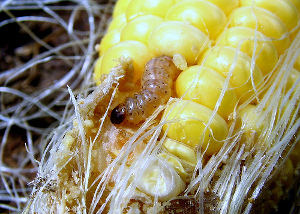
For the first time, Monsanto’s BT corn crops in Iowa are now falling prey to the very bug they’re engineered to resist: the rootworm.

This could be very bad news for Monsanto, a company that has monopolized both the pesticide and genetically modified food industry for more than a decade. Since Monsanto’s Roundup Ready GM seeds are engineered to withstand their Roundup Ready pesticide, American farmers have gotten accustomed to using both products hand in hand. However, if Monsanto’s seeds are deemed useless, what incentive will farmers have to spend the extra money for seeds that no longer kill weeds or bugs?

Monsanto is a monolithic and ruthless corporation that will do anything to meet their bottom line of profit maximization. Hopefully this is the beginning of Monsanto’s disintegration into irrelevancy. For more about Monsanto’s callous domination over the global food market read Media Roots Original – Monsanto’s Global Food Domination.

Abby Martin

***

WALL STREET JOURNAL– Iowa State University entomologist Aaron Gassmann’s discovery that western corn rootworms in four northeast Iowa fields have evolved to resist the natural pesticide made by Monsanto’s corn plant could encourage some farmers to switch to insect-proof seeds sold by competitors of the St. Louis crop biotechnology giant, and to return to spraying harsher synthetic insecticides on their fields.

“These are isolated cases, and it isn’t clear how widespread the problem will become,” said Dr. Gassmann in an interview. “But it is an early warning that management practices need to change.”

The finding adds fuel to the race among crop biotechnology rivals to locate the next generation of genes that can protect plants from insects. Scientists at Monsanto and Syngenta AG of Basel, Switzerland, are already researching how to use a medical breakthrough called RNA interference to, among other things, make crops deadly for insects to eat. If this works, a bug munching on such a plant could ingest genetic code that turns off one of its essential genes.

Monsanto said its rootworm-resistant corn seed lines are working as it expected “on more than 99% of the acres planted with this technology” and that it is too early to know what the Iowa State University study means for farmers.

Read more about Monsanto Corn Plant Losing Bug Resistance.

© 2011 Wall Street Journal

Photo by Flickr user Hadie

Fukushima in Meltdown Before Tsunami Hit

MEDIA ROOTS- Every time I read an article about TEPCO, the Japanese government and their handling of the Fukushima nuclear plant, the situation appears progressively more bleak. For months, Japanese officials refused to admit that any meltdowns were occurring. Finally, they admitted that all three reactors incurred full meltdowns in the immediate wake of the earthquake and subsequent tsunami.

The levels of radiation have also been substantially downplayed by corporate news outlets and government officials worldwide, putting millions at risk of radiation poisoning. The lack of accurate coverage might be due to the fact that General Electric (GE), the company that built the failed reactors, also owns 23 (near identical) sister reactors in the United States. GE also owns NBC news, which could explain why there is such little discussion in the corporate media about the extraordinarily dangerous risks involved with nuclear energy.

Disturbingly, the operator of the TEPCO plant has admitted to deliberately falsifying safety records to prevent the inspection of faulty components within the reactors at the Daiichi facility for the last decade. Just nine days before the devastating meltdown, the Nuclear Industrial Safety Industry warned TEPCO of its continued failure to inspect the critical pieces of equipment, and urged immediate repairs. Moreover, new testimony and evidence reveals that the plant’s reactors were so faulty that a meltdown was imminent regardless of whether or not the earthquake and tsunami hit.

Abby

***

RT– Workers at Japan’s Fukushima plant say the ground under the facility is cracking and radioactive steam is escaping through the fissures. They also say pipes and at least one reactor were seriously damaged before the tsunami hit the area in March.

­The allegations raise concerns that the facility was doomed even before the earthquake triggered the disaster. Problems with deteriorating pipes at the plant had been reported for years. The cooling system failed to stop reactors going into meltdown after it was hit by the 40-metre-high waves. The plant has been leaking radioactive material ever since, despite efforts to clean it up.

Robert Jacobs of the Hiroshima Peace Institute says that the evidence calls into question Japan’s nuclear safety.

“There’s certainly a great deal of evidence that appears to suggest that the first reactor, reactor number one, was melting down by the time the tsunami hit,” he told RT. “So, if that’s the case that the reactor was melting down as a result of the earthquake, and not as a result of the tsunami, a nine-point earthquake is something that has the potential to happen throughout Japan, and that would put the reliability and the design safety of all of these reactors in question,” he said. 

Reports of decreasing levels of radiation at the facility, Dr. Jacobs went on to explain, are no reason for optimism. It is more likely to mean that the radioactive material is moving away, making its way through the building structures:

“When you have a fragile structure that’s already suffered a great deal of damage and when you have continual aftershocks at the level of six-point, or there’s been some even higher, what we have now is we have the radioactive core that has melted down into the basement, into the bottom of the containment vessel of these reactors, and if the radiation level is going down, where it’s been monitored inside the buildings, and if the water pressure is going down, and the temperature is going down, it’s not that the radiation is just suddenly going away, it means that the radioactive material, the melted core, is simply moving further away from where it’s been measured,” he explained.

Watch the video:

Read the full article about Fukushima in Meltdown Before Tsunami Hit.

© 2011 RT

Photo by Flickr user 3StepsCrew

Tequila Gives New Biofuel Crops A Shot

GUARDIAN– The desert plants used to distil tequila could cut emissions from transport by providing an important new biofuel crop, according to new research.

“Agave has a huge advantage, as it can grow in marginal or desert land, not on arable land,” and therefore would not displace food crops, said Oliver Inderwildi, at the University of Oxford.

Much of the ethanol used as a substitute for petrol is currently produced from corn, especially in the US, and has been criticised for driving up grain prices to record levels. A recent inquiry found that laws mandating the addition of biofuels to petrol and diesel had backfired badly and were unethical because biofuel production often violated human rights and damaged the environment.

But the new study found that agave-derived ethanol could produce good yields on hot, dry land and with relatively little environmental impact. The agave plant, large rosettes of fleshy leaves, produces high levels of sugar and the scientists modeled a hypothetical facility in the tequila state of Jalisco in Mexico which converts the sugars to alcohol for use as a fuel.

Inderwildi said the research, published in the journal Energy and Environmental Science, is the first comprehensive life-cycle analysis of the energy and greenhouse gas balance for agave-derived ethanol. The team found the production of agave-ethanol led to the net emission of 35g of carbon dioxide for each megajoule of energy, far lower than the 85g/MJ estimated for corn ethanol. In comparison, burning petrol emits about 100g/MJ and some estimates of corn ethanol suggest it is worse than petrol.

Read more about Tequila Gives New Biofuel Crops A Shot.

© 2011 The Guardian

Photo by flickr user kretyen

US Eco-Activist Jailed For Two Years

GUARDIAN– An activist who became a hero to campaigners for disrupting a Bush administration auction for the oil and gas industry with $1.8m (£1.1m) in bogus bids was sentenced to two years in prison on Tuesday.

Tim DeChristopher was immediately ordered into custody, and fined $10,000. He had been facing a potential sentence of up to 10 years and a $750,000 fine.

Environmental and leftwing campaigners, from actress Daryl Hannah to film maker Michael Moore and writer Naomi Klein, immediately denounced the sentence as excessive.

At a vigil outside the Salt Lake City courtroom where sentencing took place, supporters of DeChristopher’s Peaceful Uprising civil disobedience movement shouted: “Justice is not found here.”

As Bidder No 70, DeChristopher disrupted what was seen as a last giveaway to the oil and gas industry by the Bush administration by bidding $1.8m (£1.1m) he did not have for the right to drill in remote areas of Utah. He was convicted of defrauding the government last March.

In a phone conversation with The Guardian, a day ahead of sentencing, he said he was expecting jail time: “I do think I will serve some time in prison. That is what I think will be the next chapter in my life.”

DeChristopher’s lawyers had argued that his actions in December 2008 were a one-off, and that the judge should show leniency. They argued DeChristopher had not intended to cause harm.

However, Judge Dee Benson said DeChristopher’s political beliefs did not excuse his actions.

Read more about US Eco-Activist Jailed For Two Years

© 2011 The Guardian

Photo by Flickr user 350.org