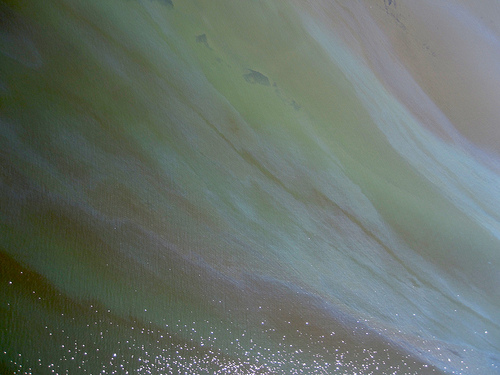
 COMMON DREAMS– The view from space indicates that the oil may be leaking at a rate of
25,000 barrels a day, dwarfing the figure of 5,000 barrels that US officials
and the British oil giant BP have used in recent days.
COMMON DREAMS– The view from space indicates that the oil may be leaking at a rate of
25,000 barrels a day, dwarfing the figure of 5,000 barrels that US officials
and the British oil giant BP have used in recent days.
A Northern Gannet bird, which is covered in oil from a
massive spill in the Gulf of Mexico, pokes its head out
from under a towel as members of Tri-State Bird Rescue and Research and the International
Bird Research Center
prepare to hydrate it in Fort Jackson, La.,
Saturday, May 1, 2010.
That would mean that some nine million gallons may already
have escaped from the underwater well following the April 20 explosion that
killed 11 rig workers. It suggests the disaster will almost certainly prove
greater than the Exxon Valdez tanker spill off Alaska
in 1989, which released 11 million gallons and was the worst previous spill at
sea.
President Barack Obama will visit the region on Sunday morning, aides have
announced. The trip comes amid mounting criticism that the White House has been
slow to react to the crisis.
His predecessor, George W Bush, faced similar anger over the federal
government’s handling of Hurricane Katrina in 2005. But the government has
emphasised that responsibility for the clean-up rests with BP, which leased the
rig and initially played down the scale of the leak.
As the administration steps up its operations, the Pentagon will spray the
slick with chemical dispersants from military C-130 planes, although
environmental groups warned that these could also seriously damage the
eco-system.
Menwhile Eric Holder, the country’s attorney general, is dispatching a team
of lawyers to New Orleans to assess
whether any laws have been broken. BP, which leased the rig and owned the oil
rights, had downplayed the possible danger of any spill – predicting “no
significant adverse impact” – when it submitted its exploration plan last
year.
The scale of the looming catastrophe was still unclear yesterday as strong
winds hampered an emergency operation to mop up the 2,200 sq mile slick being
blown towards the coast of five US
states.
Even BP has acknowledged that the 5,000-barrels-a-day figure for the leak –
already a five-fold increase on the 1,000 barrels that it initially gave – is
only a “guesstimate”. The Coastguard has also said that that leak
rate could turn out to be much greater than 5,000 barrels.
The implications of the higher figures for the fishing waters, wildlife and
beaches of the Gulf – and the residents whose livelihoods depend upon them –
are potentially devastating.
John Amos, director of SkyTruth, a satellite data monitoring outfit that
supplies analysis to environmental groups, told The Sunday Telegraph
that the images and information made public by BP indicated that the slick was
made up of at least six million gallons of oil.
“That is a conservative estimate and it would mean that oil is leaking
at a rate of 20,000 barrels a day,” he said. “That’s a real eye-opener.
And I believe the true figure is significantly higher.”
Ian MacDonald, a Florida
professor of oceanography who tracks maritime oil seepage, estimated that more
than nine million gallons may already have escaped into the sea on the basis of
higher industry estimates of the rate of leakage. BP engineers have been
desperately and unsuccessfully trying to use unmanned submarines to initiate a
failed switch-off device on the well about a mile beneath the surface of the
water.
In the absence of such a quick-fix solution, the company is pursuing two
other remedies to stop the leak, but both will take weeks or months.
In the medium-term, the company is hoping to cover the leaks with 100-ton
steel domes that would capture the escaping oil and funnel it back to a ship at
the surface through pipes. The technology has been deployed for leaks at much
shallower depths but has never been used for a deep-sea spill.
It has also dispatched a drill ship to the area to begin digging a relief
well that would intercept the oil from the existing pipes at about 18,000 feet below the surface.
This will allow the company to close off the leaking well, but the process will
take at least three months and possibly much longer.
At the same time, investigations have been launched into the two crucial
failures – why the rig exploded and then why the automatic switch-off device
did not then activate. Oil industry analysts believe the explosion was caused
by a “blow-back” when a pressure surge thrust natural gas up to the
rig platform. One area under focus is a recently-completed cementing operation
by the company Haliburton, which was intended to prevent oil and gas from
escaping by filling gaps between the outside of pipes and the inside of the
hole drilled into the ocean floor into which they fitted.
According to a 2007 US
government report, cementing was a factor in 18 of 39 well blow-outs in the Gulf
of Mexico over a 14-year period. And investigators have also been
told that cementing was a likely cause of a major 10-week blow-out in the Timor
Sea off Australia
last year.
Haliburton has declined to comment while the cause of the accident is being
investigated and lawsuits are pending.
The second disastrous failure occurred when the rig’s “blowout
preventer” – equipment that should have automatically blocked the well
when the explosion occurred – failed to work. It has since emerged that the
device did not have a remote-control shut-off mechanism – these are commonly
required in most offshore oil producing nations, but not the US.
Fifty miles away, on the Louisiana
coastline, communities that rely on the sea for their existence are now braced
for the worst. Oyster beds could take 20 years to recover and world shrimp
supplies will plummet as the Gulf waters are the largest source of the seafood.
There is widespread anger, not just at BP but also the federal government
for what is perceived as a hopelessly tardy response. Locals have expressed
disbelief that the deployment of booms – special floating barriers – to protect
the coast only began nine days after the explosion.
Continue reading about how the Oil Spill May Be Five Times Bigger Than Expected.
© COPYRIGHT COMMON DREAMS, 2010
Photo by flickr user jeferonix.



 THE GUARDIAN– Disturbing evidence that honeybees are in terminal decline has emerged from
the United States
where, for the fourth year in a row, more than a third of colonies have failed
to survive the winter.
THE GUARDIAN– Disturbing evidence that honeybees are in terminal decline has emerged from
the United States
where, for the fourth year in a row, more than a third of colonies have failed
to survive the winter. COMMON DREAMS