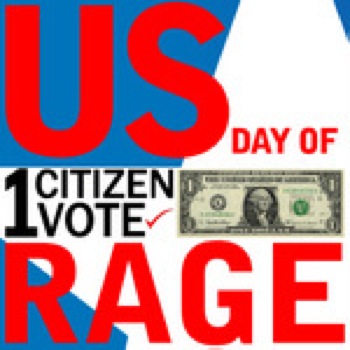
MEDIA ROOTS – Felipe Messina of Media Roots speaks with Alexa O’Brien of US Day of Rage and Co-Organiser of Occupy Wall Street to ask her about the origins of the Occupy Wall Street movement and its looming interface with MoveOn and the Democratic Party, our broken U.S. electoral system, the false left/right paradigm of our U.S. two-party dictatorship, and what we can do about all of this through collective action and the taking of the public square, physically and digitally.
***
MR: “Alexa O’Brien, with US Day of Rage, is co-organiser at the Liberty Square Occupy Wall Street sit-ins, protests, and encampment, begun on September 17, 2011. Alexa, thank you very much for your time.”
USDOR: “Oh, thank you for inviting me.”
MR: “US Day of Rage organised simultaneous actions across the United States with other groups to raise awareness of the growing inequality facing the working-class in the United States (and globally). Um, can you talk about how the organisations came together in the beginning, at the outset?”
USDOR: “This is a really interesting story. And, um, you know, US Day of Rage started on March 10th. That’s when the profile US Day of Rage and the profile #USDOR, which is a hashtag that we also used on Twitter, um, in the subsequent weeks, were parked, essentially. Um, and, you know, one night I had been covering Bahrain and Egypt, but Bahrain very intimately for several months. Um, and, you know, we’d be at work, ‘cos I work a full-time job and having, you know, friends of mine on Twitter emailing me pictures of, you know, heads blown open. And, sort of, understanding that, you know, my own country had a Fifth Fleet there and that this was sort of at the, um, a couple months into Cablegate. Sort of, seeing those revolutions sort of unfold and, um. And, so, you know, watching the activity in Wisconsin on March 10th, you know, what I saw was, essentially, a really dangerous level of cynicism towards government. And, really, actually, also the complete blockade of political engagement by what are, essentially, corporate interests. Um, and so, you know, we started the profile and, much like many things this year, this year has been like a magical year. It’s, it’s been a very bizarre year. We got a thousand followers within a week. It was very weird. And we knew at that point, US Day of Rage knew that we had, we had a responsibility because we had the kind of, um, what we believed was, sort of, level-headedness and ability to, sort of, get to core problems. Um, so we wanted to create a space for Americans to be able to voice their grievances against government without the ideological clap-trap that you find in the corporate media. You know, these, sort of, like, spectacles of arguments.”
MR: “Right. I’ve heard David Graeber speak on programmes like Democracy Now! talking about Adbusters, um, kind of initiating a lot of the Occupy Wall Street actions. Was that similar to your experience? Was that someone that, uh, did you work with David Graeber and Adbusters and those folks?”
USDOR: “Well, Adbusters is a magazine and, you know, uh, the, saving our nation from becoming a totalitarian nightmare isn’t a competition and it’s not a sporting event. So, certainly, many people have played a role in Occupy Wall Street. And Occupy Wall Street at this point is, you can be parents, but once your children, you know, you give birth to your children and they, they hit a certain age, you know, they become autonomous creatures. And that’s what Occupy Wall Street is now. And we respect it as such. Um, I’m not sure I, I understand what Mr. Graeber’s role was in, I don’t know much about him. I did see him at General Assembly meetings. It’s my own experience that, um, you know, I look at Occupy Wall Street from this perspective: there were a few people within the General Assembly that acted in an independent fashion, except for the Food Committee, um, headed by Chris Underscore and, um, also the Tactical Committee, um, that, basically, you know, combed Lower Manhattan, sort of, trying to, uh, ascertain logistics. Um, there were mostly independent people who took it upon themselves to organise things so that the protest was safe. For one thing, you know, the General Assembly, prior to September 17th, didn’t have any consensus on whether or not it was violent or non-violent in ideology. You know, we, at US Day of Rage, organised all the non-violent civil disobedience actions. We made sure in early August that there were actually, uh, videos of civil disobedience talks. Um, so that people who we reached through digital outreach, um, were able to understand, at least, de-escalation tactics or the idea of non-violent civil disobedience. The Arts & Culture Committee, Lorenzo and, uh, you know, Jez Bold, I mean, there’s so many people in the Arts & Culture Committee, they were just, and the Outreach Committee, they were phenomenal. I think what ended up happening, and this is my understanding, I mean, there’s a lot of untold stories and, perhaps, they should remain untold because it doesn’t really matter. But, if you look at what digital did for this, digital, essentially, magnified the outreach of this particular action of people in New York. You know, the act of Take the Square, Antibanks, US Day of Rage, WL Central, ROAR Magazine, I mean, all of these, uh, magnified the, and created an exponential awareness and outreach for this action, so that it became what it was.”
MR: “What I’m interested in is this further magnification of the entire Occupy Wall Street, um, and as MoveOn.org, for example, seems to, uh, begin, uh, its involvement. Um, well, I understand Occupy Wall Street as an umbrella brand, uh, basically for the organic, grassroots, uh, the one thing in common is the horizontalist philosophy of the General Assemblies of everyday people participating in, uh, this Wall Street Occupation. Um, and I understand the OccupyWallStreet.org as a, basically, an unofficial de facto online resource. And that website lists various links, um, from the NYC General Assembly to the We Are the 99% to, your organisation, US Day of Rage. Um, what impressed me about the interviews that I’ve heard from you, Alexa, are the, um, the critique of the electoral system and, uh, the need for electoral reform, which, since the Occupy Wall Street protests have been magnified, it seems to have largely been absent. Is this something that I’m missing? Or is this, uh, how do you see this playing out?”
USDOR: “Well, you know, one of the things I always say, and, you know, and I quite mean it, you know, I’m a nobody. And I’m not master of the universe, you know? To me this—”
MR: “Sure.”
USDOR: “—act is an act of conscience. I can’t see into the future. I do know that it’s my moral responsibility, as a citizen, and especially someone who, you know, while I did raise children, I don’t have any children that I’m responsible for, at present. And, therefore, I have much more, I feel like I have more responsibility, you know, myself, because I can take the risk of sticking my neck out and not having to worry about feeding babies. You know?”
MR: “Sure.”
USDOR: “So, to say this like really specifically, um, US Day of Rage has always had one demand, right? You know, free and fair elections essentially remedy a myriad ills and abuses of a government that preys on the resources and the spirits of citizens. Why were Americans so afraid before September 17th? One of the most beautiful parts of this whole Occupation Movement across the country is that Americans are starting to lose the fear. You know, what is the public square? There are several institutions to democratic society and, you know, we don’t have an opinion on the Left or the Right in any kind of sense. Like, really, frankly, the ideological bitchfest, excuse my language, of corporate media is really, actually, not the Left or the Right. It’s, it’s a corporate spectacle. It doesn’t really represent the hearts and minds of millions of Americans about what’s really in their self-interest.”
MR: “Right.”
USDOR: “So, the public square, the press, our elections, these are institutions that underpin the stability and the justness of a society, especially, a democratic society. So, when you have protests that are conducted like photo opportunities for stars and celebrities where you’re kettled into, essentially, cattle cages and you, you know, hoist your rubber bracelet and say, you know, your piece, it does nothing.”
MR: “Right.”
USDOR: “And we knew that. We knew that. So, in order to reform our elections we knew we had to start at the most basic, uh, point of the citizen, which is the public square. You know, I was joking around with one of the founders of Take the Square like, probably, in maybe April and saying, you know, he was like, ‘well, what about take the square in America.’ And I was like, ‘are you talking about Take the Walmart? Like, what? Which squares are you talking about? Because civic space in the United States is completely fiscalised.”
MR: “Right, you were talking about that in an interview on The Morning Mix with Davey D and, uh, that was something that gave him pause. Can you talk more about that?”
USDOR: “You know we look at problems, like, structurally and in terms of how, what gives people, what enfranchises people? ‘Cos people always say, ‘well, Americans are apathetic.’ And I don’t doubt that there aren’t apathetic citizens in different countries across the globe. But it’s really, Americans are demoralised because they know, that on some level, that their elections are a farce. They know that the legislation that we put out there is a gross aberration of the will of the citizens. And, you know, it’s like a bad marriage, you know, you don’t have to even get too complicated about it. If my spouse is off stealing money from our bank account, cheating at, you know, with 15 other people, you know, I’m not gonna be emotionally engaged. I might stay married. But I’m not gonna engage in the marriage in an authentic, full-bodied way. Well, similarly, with Americans in government. You know, if our government is out there cheating on us, you know, lying to us, spending our money without talking to us, and then giving us some kind of excuse. Americans disengage ‘cos it’s a lie.”
MR: “Right. You know, I’ve seen images from the Occupy Wall Street protests in New York and elsewhere indicating people are tired of the two-party system. Yet, it’s st-, the, uh, that disaffection with the two-party system or the false left/right paradigm is not really something that I hear on the media and not even on the progressive media. Mostly, of course, there’s gonna be, uh, discussion and illuminating complaints with the war, you know, anti-war messages and, uh, with economic inequality, anti-Wall Street messages, but the electoral process seems to be something that’s kind of taboo. It’s not really discussed. And as we move towards, uh, the 2012 Election year, it just seems like we’re heading towards another year where, uh, we might end up with the same type of, uh, leaders in power. Is this something that you see? Does US Day of Rage address this?”
USDOR: “Well, we do. I mean we have a plan. Basically, we are basically taking, firstly, we took a couple weeks, just simply getting grounded again, um, into phase two. I mean, phase two for us, just to be clear, I mean we called the Occupation of, we endorsed the call for the Occupation of Wall Street because when we talk about taking the money out of politics you wanna go right to the source. And, like, let’s be honest. Who are, you know, let’s talk about the pseudo-Left, so to speak. You know the Democratic Party, I mean, who are their backers? It’s Wall Street.”
MR: “Right.”
USDOR: “You know the Republican Party. Who are their backers? It’s Wall Street. I mean, these are fickle interests. You know, they don’t really care about the Left or the Right. They just care about themselves. So, second to that, you know, we are basically organising now for a call to an Article V Constitutional Convention. And what that means is, most Americans don’t know this, ‘cos we’ve never done one. But the framers created a method for escaping from what they called ‘captured government.’ And that’s what we have now is a government captured by factions. Okay, so, think about government. Right?”
MR: “M-hm.”
USDOR: “Think about the Constitution. You and I could sit here and pretend we’re on Crossfire and we—”
MR: “Right.”
USDOR: “—could talk about the difference between Executive power, which is the power to fight wars, versus Legislative. But, really, is there any difference when both are owned by Goldman Sachs?”
MR: “Not much.”
USDOR: “No, there isn’t. So, it, it’s a breakdown of checks and balances. So, they created this Article V Constitutional Convention capability, which means that if 34 States pass resolutions, at the state level, calling for a Convention, all sides would have the opportunity to talk about the changes they believe would restore democracy. And, so, we could bypass Congress and the Senate and the Executive and the Judicial branch and just get this done. You know, overturn corporate personhood, you know, overturn Citizens United. Or, you know, it’ll, it can happen in one amendment. The point is that, the Department of Homeland Security, the FBI, the NYPD, in conjunction with the CIA, whom they work with, they all defend, look, Wall Street’s still blockaded. You know, on September 17th the NYPD occupied Wall Street. You know, it’s pro-, they will protect banks and corporations’ First Amendment rights under Citizens United. But they’ll Mace a girl on a sidewalk who’s peaceably standing there in dissent against the system that doesn’t represent her and gawd knows what else. You know?”
MR: “Exactly. That’s right. This reminds me of, you know, I’ve heard, earlier this year, Ralph Nader talk about, um, I think he talked about a Constitutional Convention for, um, revoking the, uh, corporate personhood. Is this the same, is this same process that, are you aware of Ralph Nader’s approach that he’s mentioned earlier this year?”
USDOR: “I’m not aware of Mr. Nader’s approach with regards to a Constitutional Convention. I do know that he has, sort of, nine points for electoral reform. Those are, as far as I understand, you know, I’m a human being, I don’t know everything, so hopefully, I’m not getting this wrong, but, you know a lot of them have to do with, like, getting rid of earmarks, open ballot access, holiday voting for working people, so that they can actually vote, uh, honest and open debates, you know, full and balanced representation. I mean, there’s a lo-, tightly drawn districts. You know, those are all very honourable suggestions. I mean, part of the reason and, I’m gonna take a deep breath, so I don’t completely talk your ear off here. Um, we really wanna just cut to the chase. You know, like, let’s just make it so that corporations are not people in the eyes of the law. Or if they are that they are liable for the same things that people are.”
MR: “Right. And, uh, kind of going over the point that I mentioned earlier about us living in a kind of a false left/right paradigm, where people perceive the Republicans as the bad guys and the Democrats as the good guys and, uh, the choices being limited to those two and with this opportunity for consciousness-raising with the whole Wall Street occupations spreading across the country, it seems like a really good opportunity for people to, kind of, look beyond that. And, yet, we’re still, most people are still gonna vote, so it just seems kind of logical to expand the two-party system. Is that, would that be a half-measure, in your view? Or is that something that US Day of Rage looks at?
USDOR: “It’s not a half-measure. I mean, any kind of political engagement that restores democracy we don’t consider a half-measure. I mean, listen, we’re human beings. A lot of us are working people who are just normal, average everyday citizens. And so, you know, we support and we engage with the larger discussions from other groups, other Constitutional Convention groups, other people who wanna reform our elections, even, you know, the General Assembly at New York City. I mean, we’re individual members of that body. So, no, I mean, I hope that any group that wants to engage in electoral reform approach us and we will approach them because united, you know, we can actually get this done.”
MR: “Yes, so—“
USDOR: “And the other thing, too, is that we have a way of getting it done.”
MR: “Yeah, that’s exactly right. And with the whole Occupation Wall Street spreading across the country and, if the Occupations persist, it seems like the Article V Constitutional Convention can seem like a very likely possibility.”
USDOR: “It’s true. And also, you know, social media has also done wonders in many, many areas and sectors of America’s political conscience. You know, take, for example, an American I have great respect for, Brandon Neely, a former Gitmo guard, who found his, people who he was a prison guard and detained at Guantanamo. He reached out to them several years ago and made direct amends to them over Facebook.”
MR: “Oh, wow.”
USDOR: “So, the reality of social media, which I think some, the press is just beginning to understand is, you shouldn’t torture people. But you cannot torture people today because we will find you and we will see your face on Twitter and Facebook. Now, Neely is a, a vanguard. I mean, he’s spoken out about Gitmo, so I’m not talking about Mr. Neely per se. But I’m saying, you know this, earlier on in the year, um, WL Central and myself and on the media, the Senator from Hawaii Tweeted me to confirm that a Republican had placed the anonymous hold on the Whistleblower Protection Act. So, there are a lot of things that you could do with social media that we couldn’t do before. And we’re, we just can’t wait to get to it when it comes to the Article V Constitutional Convention.”
MR: “So, you don’t have any fears that a large organisation like MoveOn.org might subvert the more grassroots, radical, message of the, um, loosely collective Occupy Wall Street folks?”
USDOR: “What I’ve learned strategically with things like this is that, you know, it wouldn’t surprise me if the American, you know, I’m talking in a general way. Right?”
MR: “Right.”
USDOR: “If the American brain, it needs to unravel from the partisan, you know, the culture war is over, everybody lost. Right?”
MR: “Right.”
USDOR: “The culture war they’ve grown up with. But the reality of it is that the game generation, the internet generation, does not trust traditional forms of organised politics. You know, we have learned how to engage with each other through weak social ties online and that has also transferred into our lifestyle. So, we might lose a few more rounds. Hopefully, the U.S. government won’t take drastic action. Um, I think with this movement into the political sq-, into the civic square we have started to change the game. But it’s like the traditional media. It’s like, I’m not worried whether or not they’re covering us because they are becoming obsolete.”
MR: “M-hm.”
USDOR: “We are getting our information from Davey D on Twitter and then listening to his radio show, or our friends in Bahrain, or our friends in Egypt. So, more will be revealed.”
MR: “Yeah, that’s interesting that, well, I heard the input from Egyptians into the original organising for the Occupy Wall Street protests.”
USDOR: “Yeah, well, it was really funny because right when we were starting to go viral in Egypt there was like a billion Arabic comments on our Facebook profile. And it was really hilarious because it was appealing to all the racism against Muslims, like, in certain parts of the United States. So, we were sitting here, we were like, we’re like, ‘we’re an American organisation.’ They’re like, the Egyptians found us and they’re like giving us all this advice. It was really funny. Um, but it’s all good, you know? It’s all good.”
 MR:
“They held, I was gonna say they held out for a long time in Egypt.”
MR:
“They held, I was gonna say they held out for a long time in Egypt.”
USDOR: “Yeah.”
MR: “ I’m hoping that the Occupy Wall Street Assemblies will hold out as long as possible. I know it’s gonna start getting very cold soon in New York and the East Coast.”
USDOR: “Well, something to keep in mind, too, is that digital, the internet is a civic space. I mean, although it’s, in the United States, it’s surveilled and commercialised and there’s no privacy. You know, there’s no privacy in the centre square either. Did you see that large, um, monitoring station that the NYPD set up? It’s like East Germany. You know?”
MR: “That’s right.”
USDOR: “Before the wall came down. So, you know, the bottom line is this is really about Americans, whether they’re afraid or not. You know?”
MR: “M-hm.”
USDOR: “As long as we’re not afraid we have nothing to worry about. You know, if we, so I, I’m not worried in a certain sense, like, I trust the good, um, the good people of our country, as the more connected they get, the less afraid they get.”
MR: “That’s right.”
USDOR: “You know, we might have a cold winter on the internet or out on the squares, but everything’s gonna be okay if we just keep plugging forward.”
MR: “Yeah, it seems like that’s the case. The police tactics of repression of the right to assemble and protest, to dissent, seem to be responded to very quickly, uh, with social media, the illegal arrests, police brutality involving that pepper spraying, and the kettling, of course, what looked like entrapment on the Brooklyn Bridge and so forth. It seemed to be responded to by the people very quickly and, uh, they seem to be trying to, the police seem to have to adapt to that quick response from the people.”
USDOR: “Yeah. I mean, one of the discussions that we had early on because we endorsed, basically, the occupation of public sidewalks early on because at the time, and the situation with Zuccotti has become more sophisticated because a lot of civil rights attorneys have come in and talked about easement laws. But originally we endorsed a call to occupy public sidewalks because we thought it was the clearest assertion of First Amendment rights. You know, the NYPD is a para-, one of the largest paramilitary forces in the world. They have helicopters that can see a cigarette from a mile away. They have trucks, I’ve been told, that can see through walls. And they photograph New Yorkers on a daily basis and keep those, you know, facial recognition software. So, we’re talking about a serious force here.”
MR: “Yeah. That’s something to keep in mind. Well, as I wrap up here do you have any final comments that you’d like to add?”
USDOR: “Yeah. I wanna say that, you know, free and fair elections inspire good citizenship and public service because they engage the intelligence and the genuine good will of the American people. You know, they produce the kind of stewardship our nation desperately needs right now because they insure that citizens can influence their destiny and make genuine contributions to society. It’s now or never. Either we do this now or wait a hundred years and have our children grow up in a totalitarian nightmare.”
MR: “I agree. Alexa O’Brien with US Day of Rage is co-organiser at the Liberty Square Occupy Wall Street Occupation. Alexa, thank you very much for your time.”
USDOR: “Thank you so much. Have a wonderful evening.”
***
Interview and transcript by Felipe Messina for Media Roots
Photo by flickr user Sasha Y Kimel
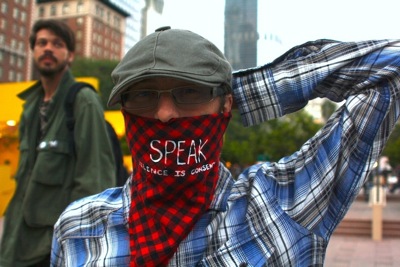 MEDIA ROOTS- Who are these Occupy Wall Street people? What is this “99%”? The question is being asked many times over around the nation, even now as you’re reading this. Perhaps in providing answers, it’s best we start with the One Percent and work our way up.
 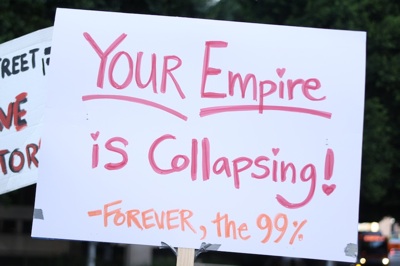 We are those who feel that the elected leaders of America have forgotten us among the ranting political rhetoric and opposition demonization by politicians who longer represent us at all.
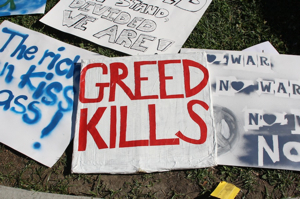 Teachers and nurses associations are aligning themselves as well. Neighbors are stopping by with food and supplies. Just yesterday afternoon at City Hall in Los Angeles, dozens of pizzas and various other food and drink as well as medical and clothing supplies were being distributed freely by the people. For the people. I’m hardly a religious man, but the collective thousands at OccupyLA caring for one another without parasitic motive was the closest thing to truly Christ-like behavior among a large mass of people that I’ve seen in my 33 years.
 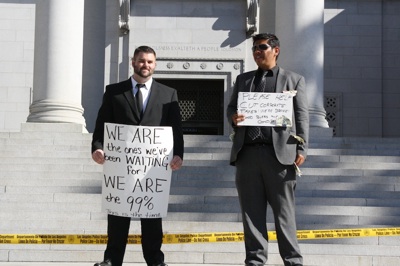 Yet despite constant evidence to the contrary, we trust that politicians – who truly no longer represent the people – will turn away from the staggering amounts of money that corporations offer for favorable legislation and the power-wealth’s demands.
 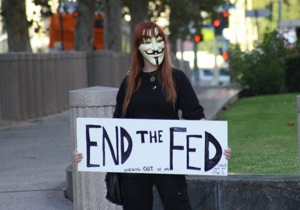 For just about every vocal movement throughout history, there has been a countermeasure, an opposition that speaks with equal passion and dissent from the idea. Yet with the Occupy movement, the only opposing assailants are the champagne-toasting core of the problem sneering down at protestors on Wall St., and the likes of Ann Coulter and Alex Jones who are feebly trying to “expose” the movement as a veiled operation for the Democratic party (which it most assuredly is not). Where are the picketers defending the multi-millionaires and the multinational corporations?