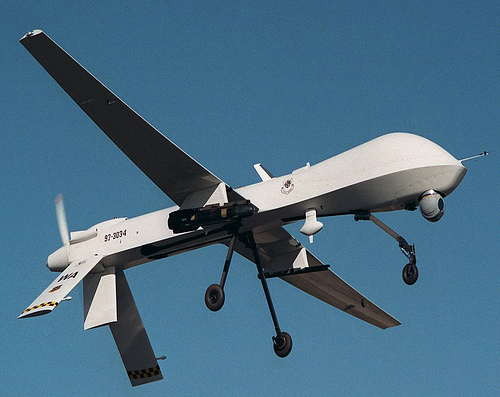
 MEDIA ROOTS — Obama’s Chief Counterterrorism Advisor, or, as Jeremy Scahill puts it, “for all practical purposes, President Obama’s hit man or assassination czar,” John Brennan has been exposed by the declassification of a 30-page document, wherein he’s asked about drone strikes and targeted killings in the US.
Brennan did not rule out the possibility, and began to lay the groundwork for setting legal language precedent and codification of targeted assassinations of US citizens. As Scahill points out, there is little to no push-back from Congress when Brennan’s responses approach the absurd.
Messina
***
TRUTH OUT — According to the Wall Street Journal (in a February 15 article), Obama’s nominee to head the CIA, John Brennan, ambiguously left open the possibility that US citizens could be targeted for assassination in the United States:
John Brennan, President Barack Obama’s nominee to be director of the Central Intelligence Agency, didn’t rule out the use of unmanned drones in the U.S. when quizzed about the matter.
Mr. Brennan’s written answer came in response to questions from the Senate intelligence committee following his confirmation hearing last week. The Senate intelligence committee released a declassified version of Mr. Brennan’s responses in a 30-page document Friday.
Mr. Brennan, the White House’s counterterrorism chief, was asked, “Could the Administration carry out drone strikes inside the United States?” His reply was: “This Administration has not carried out drone strikes inside the United States and has no intention of doing so.”
A few days back, Democracy Now analyzed excerpts from the Brennan Senate Intelligence Committee hearing on his nomination, including this one:
SEN. RON WYDEN: Let me ask you several other questions with respect to the president’s authority to kill Americans. I’ve asked you how much evidence the president needs to decide that a particular American can be lawfully killed and whether the administration believes that the president can use this authority inside the United States. In my judgment, both the Congress and the public need to understand the answers to these kind of fundamental questions. What do you think needs to be done to ensure that members of the public understand more about when the government thinks it’s allowed to kill them, particularly with respect to those two issues, the question of evidence and the authority to use this power within the United States?
JOHN BRENNAN: I have been a strong proponent of trying to be as open as possible with these programs, as far as our explaining what we’re doing. What we need to do is optimize transparency on these issues, but at the same time optimize secrecy and the protection of our national security. I don’t think that it’s one or the other. It’s trying to optimize both of them. And so, what we need to do is make sure we explain to the American people what are the thresholds for action, what are the procedures, the practices, the processes, the approvals, the reviews. The Office of Legal Counsel advice establishes the legal boundaries within which we can operate. It doesn’t mean that we operate at those out of boundaries. And, in fact, I think the American people will be quite pleased to know that we’ve been very disciplined, very judicious, and we only use these authorities and these capabilities as a last resort.
If ever there was the epitome of obfuscating bureaucratic blather, Brennan achieved it in pointedly not ruling out the killing of US citizens on US soil.
Jeremy Scahill, author of the best selling “Blackwater: The Rise of the World’s Most Powerful Mercenary Army,” commented about the exchange posted above at Brennan’s confirmation:
Well, you know, if you listen to John Brennan, I mean, it’s like he’s talking about buying a used car and what, you know, sort of little gadgets and whistles it has on it. He used “optimize”? Ron Wyden was asking him about whether—about the extent of the CIA’s lethal authority against U.S. citizens, on U.S. soil and abroad. And, see, the problem is that while some questions were asked that are central questions, there was almost no follow-up. People wouldn’t push—senators wouldn’t push Brennan back when he would float things that were nonsensical or just gibberish, you know, or using terms like “we need to optimize this, we need to optimize that.” There was no sense that—I mean, remember, this is a guy who is, for all practical purposes, President Obama’s hit man or assassination czar.
Read more about John Brennan Doesn’t Rule Out Targeting Americans for Assassination in the United States.
***
THE GUARDIAN — Prior to President Obama’s first inauguration in 2009, a controversy erupted over reports that he intended to appoint John Brennan as CIA director. That controversy, in which I participated, centered around the fact that Brennan, as a Bush-era CIA official, had expressly endorsed Bush’s programs of torture (other than waterboarding) and rendition and also was a vocal advocate of immunizing lawbreaking telecoms for their role in the illegal Bush NSA eavesdropping program. As a result, Brennan withdrew his name from consideration, issuing a bitter letter blaming “strong criticism in some quarters prompted by [his] previous service with the” CIA.
This “victory” of forcing Brennan’s withdrawal proved somewhat Pyrrhic, as Obama then appointed him as his top counter-terrorism adviser, where he exerted at least as much influence as he would have had as CIA Director, if not more. In that position, Brennan last year got caught outright lying when he claimed Obama’s drone program caused no civilian deaths in Pakistan over the prior year. He also spouted complete though highly influential falsehoods to the world in the immediate aftermath of the Osama bin Laden killing, including claiming that bin Laden “engaged in a firefight” with Navy SEALS and had “used his wife as a human shield”. Brennan has also been in charge of many of Obama’s most controversial and radical policies, including “signature strikes” in Yemen – targeting people without even knowing who they are – and generally seizing the power to determine who will be marked for execution without any due process, oversight or transparency.
Read more about John Brennan’s extremism and dishonesty rewarded with CIA Director nomination.
***
Image by Flicker user JimNTexas
 MEDIA ROOTS – On this episode of Breaking the Set: Abby Martin talks about Obama’s kill list, which one official has called a macabre “baseball card” set of alleged “terrorists”; Andy Roth, Associate Director of Project Censored, talks about the danger of Obama’s drone wars on the year anniversary of the drone assassination that killed Anwar al-Aulaqi and his teenage son, both of which were American citizens.