
Third-Party Challenge to Unconstitutional Prop 14

VoteThirdPartyFlickr_ryenskiMEDIA ROOTS — On Monday, KPFA Radio’s The Morning Mix spoke with representatives from California’s third-parties about their legal challenge to Proposition 14, Rubin v. Bowen, which created the new statewide ‘Top Two’ electoral system.  Under this system, the rigged de facto two-party system has now been virtually codified in California.  Given the obscene amounts of corporate funding expended by the pro-1% Democrat and Republican parties, third-party voters are now, essentially, disenfranchised under this clearly unconstitutional legislation.

“After two months of delays,” wrote RestoreVoterChoice.org prior to the hearing, “a lawsuit challenging the constitutionality of California’s new ‘Top Two’ election scheme will be heard in Alameda County Superior Court on Tuesday, 10 April [2012].

“The plaintiffs encourage supporters in the [S.F.] Bay Area to attend this important court hearing.

“The hearing is scheduled for 9:00am on April 10 in Department 16 of the court, located at 1221 Oak Street in Oakland, before Judge Lawrence John Appel. If there are last minute changes in the schedule, they will be posted here.”

Messina

***

THE MORNING MIX — “Today, we are talking to California’s third-parties about their challenge to Proposition 14.  This is the proposition that created the new statewide ‘Top Two’ electoral system.  People as different on the political spectrum as Ralph Nader and Meg Whitman oppose this system.  And we’ll be telling you why. 

“We’re also going to tackle something most of us don’t think about until we, literally, have no choice—end of life issues.  Long-time hospice nurse Elaine McGee will be in and taking your calls. 

“And, last week, the Center for Biological Diversity challenged the Obama Administration to save the oceans before it’s too late.  We’ll talk to wildlife biologist and attorney Emily Jeffers about why the Center believes this crisis demands immediate attention and the international strategy that could lead us back from the brink. 

“But we begin with the third-party challenge to California’s ‘Top Two’ law.

Adrienne Lauby (c. 9:07):  “Now, our [2012 California] Primary Election will be held on June 5th, less than two months from now.  And this year’s election will be very different than in the previous years.  Owing to Proposition 14, a ballot measure that was passed two years ago, California is scheduled to deploy a new system where all candidates for a given office will appear on one ballot.  However, representatives from several third-parties are going to court to challenge the law.”

Anthony Fest“Under the new system, instead of a separate primary ballot for each party, all candidates for state and congressional office will be listed on the same ballot and every voter can choose from among all those candidates.  The top two finishers in the June election, regardless of their party affiliation will then appear on the November General Election ballot, essentially, making November a run-off election.  This is due to Prop 14, the measure that passed in June of 2010.  It’s informally called the ‘Top Two’ law.

“The Green, Peace and Freedom, and Libertarian parties say the measure is unconstitutional.  Last November, they filed a suit to block it and there will be a hearing on the case tomorrow morning in Alameda County Superior Court, 1221 Oak Street in Oakland.  Joining us this morning to discuss the ‘Top Two’ law and the challenges to it are representatives of the three parties that filed suit. 

Marsha Feinland is with the Peace and Freedom Party.  She’s run for the U.S. Senate, representing Peace and Freedom and plans to do so again.  Welcome, Marsha.”

Marsha Feinland (c. 10:32):  “Good morning.”

Anthony Fest“Mike Rubin is with the Green Party.  And, along with Marsha, he’s also an individual plaintiff in the lawsuit.  Thanks for joining us, Mike.”

Michael Rubin:  “Thank you for having me.”

Anthony Fest“And with us on the phone is Richard Winger.  Richard is with the Libertarian Party.  He’s also the editor of the website Ballot Access News.  Good to have you with us, Richard.”

Richard Winger:  “Thank you very much.”

Anthony Fest“Now, let’s begin with Marsha.  Tell us, in nutshell, why you’re challenging this measure and what legal grounds.”

Marsha Feinland (c. 10:56):  “Well, this measure is very anti-democratic.  And we feel it doesn’t give voters a real choice.  Now, the open primary ‘Top Two’ initiative was put forward as being something that gives voters more choices.  But, actually, in November when most people vote, they’ll have very little choice because only the top-two vote getters in the primary will be able to make the ballot.  And those top two vote-getters might not be even from two different parties; they might be very, very similar.

“It’s also possible that neither of the top two vote-getters get anywhere close to a majority.  So, it’s not even both of them put together.  For instance, in the coming [California] Senate race there are 24 candidates.  So, it’s very possible for each of the top two to get a very low percentage, although that’s very doubtful, since Dianne Feinstein is one of them.  But if we’re going to have a challenge to the powers that be, we’ve got to be able to make real choices.  And we can’t do that with this election.”

Anthony Fest (c. 12:08)“So, whether or not it’s good policy, on what grounds do you say it’s unconstitutional?”

Marsha Feinland:  “It’s unconstitutional because the parties do not get to pick their candidates.  And it’s not just the parties; it’s the voters in the parties that don’t get to pick their candidates.  In fact, we’re forced into a position in which the parties pick their candidates.  The parties are able to make endorsements in the primary instead of leaving it up to the voters.  There are supposed to be primaries in which the voters in the parties pick their candidates; those candidates go to the election.  That’s not what’s happening.

Anthony Fest“Okay, let’s turn now to Mike Rubin with the Green Party.  Now, Prop 14 passed two years ago with just under 54% statewide, not an overwhelming mandate, but a majority.  And it also won a majority in all but three of the state’s 58 counties.  So, why contest the decision of the voters?  And do you think the court might be reluctant to set aside something, which the voters passed?”

Michael Rubin (c. 13:07):  “Well, it’s possible that the courts might be reluctant.  But I will tell you that the people, Proposition 14 passed because people are disgusted with the legislature, particularly the [California] State legislature.  And, unfortunately, the remedy that was proposed by Proposition 14 for the problems of the state legislature are not responsive to the actual problems in the [two-party monopolised] state legislature, which is that the state legislature is responsive to the 1% and not the 99%.

“So, Proposition 14 was presented as a false solution to the two-partisan gridlock and all that kind of stuff.  But the reality is that it’s going to do nothing about the problems in the legislature.”

Anthony Fest“Let’s turn now to Richard Winger.  As a Libertarian, Richard, do you concur with Marsha’s and Mike’s points or is your reasoning somewhat different?”

Richard Winger (c. 14:00):  “It’s the same.  And you asked about constitutionality.  The U.S. Supreme Court said in 1986 in a case called Munro vs. Socialist Workers Party, that was from Washington State, that there is no Constitutional distinction between a petition method to show a modicum of support worthy of getting a candidate on the November ballot versus a prior vote test.  Now, the U.S. Supreme Court had already said that petition requirements for a candidate to get on the General Election ballot cannot exceed 5%.  Applying the logic of that decision, this system is unconstitutional because it requires a candidate who wants to get on the [California] Election Ballot itself, which is November, a showing of approximately 30%.  Typically, if you look back at primaries in California and many states where all the voters could choose from all the candidates, the second-place person typically gets 30%.  That’s what you need to be in the top two, on the average.  So, that’s the basis for the claim. 

“It’s about voting rights.  The Supreme Court has said every voter has a right to vote for the candidate he or she desires.”

Anthony Fest (c. 15:32)“So, you’ll be citing that case when you make your arguments before the Superior Court down the road.”

Richard Winger:  “Yes.  And I gotta say when this topic was introduced just now the introducer mentioned the [California] November Election as a run-off.  That is not accurate.  It sounds pedantic, but it’s important.  Since the 19th century, Congress has told the states to have their Congressional and Presidential elections in November.  And, if they want to insure that the winner got 50%, they have to hold a run-off after that.  There’s two states that do that:  Georgia and Louisiana, they have it in December.

“So, by federal law, whatever California does in June is not the election because that would be illegal.”

Anthony Fest (c. 16:22)“Now, as well as being active in the Libertarian Party you’re also Editor of Ballot Access News.  So, tell us, as someone who follows voting laws around the U.S., are their counterparts to Prop 14 in effect elsewhere in the U.S.?  And what’s the outcome then from those?”

Richard Winger:  “That’s a very good question.  Louisiana has used the system for 35 years.  And Washington State has used it for four years.

“There was just a study that came out in the California Journal of Politics and Policy called ‘The Top Two Primary: What Can California Learn From Washington?’  And the author was the witness for the State of Washington, in fact, in court in a Washington state case.  He was on the state side.  But he was a political scientist.  He wrote a fair report.  The abstract says:  ‘The partisan structure of Washington’s legislature appears unaltered by the new primary system.’ 

“In other words, the whole reason this thing was sold to us is that, supposedly, it would make the [California] legislature behave better.  And this study says after four years it hasn’t worked.  It says:  ‘The aggregate of all this did not add up to a legislature that looked different or functioned differently from the legislature elected under a partisan primary.’  He’s not the only political scientist that said that.  Boris Shor and Seth Masket looked at partisanship and polarisation in state legislatures and they agreed California had the most polarised legislature, but—and the study goes back 15 years—they said Washington State had the second-most polarised legislature.  And, during most of those 15 years, Washington had, either, a ‘Top Two’ primary, or a blanket primary.”

Adrienne Lauby (c. 18:22):  “So, Marsha—this is Adrienne Lauby—when I’m up in the North Bay, which is pretty Democrat[-dominated], what I’ve seen over and over again is in the general election we’ve got a Democrat who’s gonna win and a Republican who doesn’t have a chance.  So, to me, this sounded pretty good.  You’re gonna have two Democrats who have different points of view; one may be more to the Left than the other.  And I’ll get a chance to maybe put my guy or my gal in.  What’s wrong with this thinking?”

Marsha Feinland:  “Well, you’re making the assumption that the two Democrats might have two different points of view.  In fact, if you’d looked at the primary results in the last Presidential Election, if we had had the ‘Top Two’ primary, we would’ve had Hillary Clinton and Barack Obama.  And we are now finding out that they don’t have two different points of view.  So, therefore, the voters have no choice at all.  I think it’s really important to open the debate and open the process to people who can really pose an alternative. 

“And when Richard said that this Proposition was sold to us I wanna emphasise sold.  The elections are pretty much sold.  They’re not really chosen.  There’s so much advertising; and there’s so much money in the elections.  And what happens with Proposition 14 and this type of primary is that there is even more money required because people need to raise the money, both, for the primary and for the general election. 

“So, the appearance might be sold to you that you have two different candidates.  But, actually, you may end up with two very-the-same candidates.”

Anthony Fest (c. 19:54)“It’s 8:20am on The KPFA Morning Mix.  We’re talking about Proposition 14, the ‘Top Two’ primary law and the upcoming court challenge to it.  I’m Anthony Fest with Adrienne Lauby.

“Let’s turn to Mike Rubin now, as we begin to wrap up this segment.  By the way, Prop 14 applies to [California] statewide office and the U.S. House and Senate seats.  It does not apply to the presidential race.  But, Mike Rubin from the Green Party, let’s go back and take a look at the history of Prop 14.  It was placed on the ballot, not by the voter petition process, but by a vote of the legislature.  The bill, that placed it on the ballot, was written by Republican [State] Senator Abel Maldonado.  It passed both houses by a better than two-to-one margin and also had the support of [then-]Governor Arnold Schwarzenegger

“For a measure that was promoted as taking power away from the party apparatus, it had wide support from Democrat and Republican politicians.  But what’s the motivation, do you think?  If it was all about excluding third-parties, third-parties haven’t really made much of a dent in state politics anyway, as far as winning office.  So, what’s going on behind this?”

Michael Rubin (c. 21:01):  “Well, I think there’s a couple of things to say.  One is that the fact that the [California] Legislature passed this was a pay-off to Abel Maldonado for his vote on the budget.  It was his price to pass the budget.  They needed a few Republican votes for the budget and his price was Proposition 14.  That’s the first thing to say.

“The second thing is that the purpose of Proposition 14 was not really to harm third-parties.  I don’t know that.  That’s not the primary thing.  The primary thing was, it was sold as a way of getting more quote ‘more moderate’ candidates.  That was the so-called selling point.  And it goes back to this thing about partisanship and gridlock and all that stuff.  And I think that the problem that we have in California is that we have too many moderate’ candidates, not enough ‘moderate’ candidates.”

Anthony Fest (c. 22:01)“And that should be the decision of the voters not the politicians already in office.”

Michael Rubin:  “Absolutely.”

Anthony Fest“Okay,  Marsha Feinland, with the Peace and Freedom Party;  Mike Rubin, with the Green Party; Richard Winger, with the Libertarian Party, thanks for joining us.

“And, Marsha, you have an announcement?” 

Marsha Feinland:  “Yeah.  I think it’s really important for people to go to the court tomorrow morning at 9am at 1221 Oak Street.  But, also, the case has been continued twice.  So, it’s very important to go to the website to make sure that it’s still on schedule.  The website is RestoreVoterChoice.org.”

Anthony Fest“Thanks for joining us this morning.”

Michael Rubin:  “Thank you for having us.”

Richard Winger:  “Thank you.”

Marsha Feinland:  “Okay.”

AUDIO OF THE SIMPSONS VIDEO CLIP

Homer Simpson:  “America, take a good look at your beloved candidates.  They are nothing but hideous space reptiles!”

Crowd:  “[Gasps] Ahh!!  [Shrieks]”

Two-Party Candidate A:  “It’s true.  We are aliens!  But what are you going to do about it?  It’s a two-party system.  You have to vote for one of us!”

Passive Voters:  “He’s right.  It’s a two-party system.”

Assertive Voter:  “Well, I believe I’ll vote for a third-party candidate.”

Two-Party Candidate B:  “Go ahead.  Throw your vote away!”

Two-Party Candidates A and B:  “Ha-ha-ha, ha-ha!!”

Transcript by Felipe Messina for Media Roots

Image by Flickr user ryenski (above) and Flickr user bkrealtist (feature)

***

***

Posted in Uncategorized | 1 Reply

Greeks in America: Crisis at Home a Self-Inflicted Wound

greekunrestMEDIA ROOTS – Like a misplaced time capsule that was never buried, one quaint town in Florida harkens back to an old-world fishing village on the Aegean Sea, a place where life slowly drips.  Situated on the west central Gulf coast, Tarpon Springs might be the last bastion of unadulterated Greek culture in America.  Attracted by the lucrative sponge fishing trade, Greeks began inhabiting the area over 100 years ago.  The sponges have since disappeared and the docks have been reappropriated to sell schlock beach souvenirs, but what remains is the U.S.’s highest proportion of Greek-Americans, and their heritage.  Not too far from the well-worn tourist path in town, a narrow street gently curves through the neighborhood, leading to a couple of Greek social clubs. 
Cushy clouds stretch across the day’s powder blue sky as the sun beams through saltwater scented air.  In front of one of the clubs, middle aged men loiter about smoking cigarettes and talking in a jovial manner.  At another club across the street, men play cards, watch Greek soccer on TV and drink the heavy sludge known as Greek coffee.  It doesn’t take long in either group to find someone willing to discuss the trials currently plaguing Greece.  They pause with a glint of curiosity in their eyes, confer for a few moments in Greek, then elect the best available English speaker to voice impressions and ideas not vetted in most coverage regarding the modern Greek drama.  Demetrios Dounakis, a cheery, balding man with family still in Greece, has lived in America since 1971.  Another, Stavros Bairaktaris, with salt-and pepper-hair and wandering, contemplative eyes, has lived in the U.S. for four years.  Now, both call Tarpon Springs home.  Their views as expatriates cast new light onto the troubles of the Greek people. 

After some alpha male posturing and tough talk from Bairaktaris, he begins to speak freely.  First, he paints a beautiful picture of Greece: the beaches, the small towns, the home and farm handed down to him from his father.  His eyes scan the blue infinity of the skies as he recalls lovely details.  In short time, however, his nostalgia turns to contempt, at the subject of the debt crisis.  Bairaktaris’ voice, when speaking about Greek prosperity- or lack of it- churns in heavily accented, slightly broken English.  “Why they surprised?”  Upset by the lack of historical context that the media and sympathizers display, he continues, “Greece like this, Greece built like this, goes back to father’s place, back my grandfather’s place: same, same, same.”  Evidently the Greek crisis is multi-textured; quick forgiveness, outpourings of sympathy, and emotional lifelines weren’t going to be handed out here.  Instead Bairaktaris and Dounakis did their best to tease apart the complex layers of culpability, starting at the top.

The current prime minister of Greece was never elected.  Rather, Lucas Papademos, a technocrat, was appointed to the position in 2011 thanks to his prior experience as Senior Economist at the Federal Reserve Bank of Boston, Vice President of the European Central Bank, and Governor of the Bank of Greece, where he oversaw the transition from the drachma to the euro.  Dounakis didn’t have much to say about Papademos specifically, but he didn’t withhold any feelings regarding political responsibility for the crisis.

For starters, Demetrios didn’t support the switch to the euro, and doesn’t think bailouts will do Greece any good.  In his view, Papademos “does whatever the EU tell him and they don’t care about the people,” and furthermore, the European Union (EU) supports the current Greek government and is therefore partially responsible for the crisis.  Dounakis identifies the EU along with the United States as “big powers”- the real bosses- and claims that the Greek bailout and austerity program is going as planned from American shores.  “If EU and USA weren’t here this [the corrupt Greek] government is gone long time ago.”  Worse, it seems, is that if things continue as they are, nothing can be changed.  His ongoing charisma turned into a stinging assessment.

“Have you ever seen so many demonstrations in your life,” Dounakis asks, his eyes narrowing.  “They cut down wages, cut down their social security, they cut down everything.  You know so that way the big sharks make more money.”  His reference to banksters and financial hustlers swarming the waters of Greece in a feeding frenzy reflects a fear that “Greece is going to be destroyed completely.  This is bankruptcy right now no matter what.”  Dounakis reiterates how the bailout money is not going to the Greek people, but to those “big sharks,” angered that the money designated for the people, won’t make it past the pockets of a corrupt government and an entrenched class of civil servants.

Bairaktaris lays much of the blame at the feet of the latter group.  “You know somebody, you have [a way into] the system.  You get 3,000 euros [a month for] the rest of your life; you never work; you never get fired; you get all this kind of stuff.  This is not today.  This is from 1930s.”  Bairaktaris’ frustration highlights American criticisms of Europe’s inflexible labor forces feeding at the trough of socialist largesse.  This doesn’t seem to be new either, rather institutionalized nepotism and cronyism.  “Any office you go, the police, everybody is like a president.  You have no law.  I wish they could change this,” he laments.  Bairaktaris continues his pointed critique of Greek civil servants, saying they “smoke a cigarette, take a break; ‘We closed today.’  Twelve o’clock in the afternoon!”  He juxtaposes the plight of an elderly lady, who might receive a 300 euro a month social security benefit while having to pay 700 euros in property tax, with a civil servant who gets 2,000 euros a month to “do nothing.” 

Stories of tax evasion in Europe are common and make the endeavor sound like a national pastime in some countries.  An inability to levy equal taxes on the Greeks surfaced as a common complaint.  Bairaktaris made a point of this when he summed up the attitude of the Greek elite:  “You don’t pay no taxes, you rich, you control everything.”  Dounakis reacted more vehemently to the subject; a lack of justice, fairness and shared sacrifice percolated from his anger.  “Americans have best system if you are millionaire.  You gotta pay no matter what…In Greece, when you millionaire, nothing happens!” he exclaims with a hearty laugh.  Contrasted with this is his idealized view of American tax collection:  “They gonna cut your balls if you don’t pay in the U.S.”  Perhaps Greece and America have more in common than Dounakis realizes.  He unknowingly exposes more similarities, saying of the toothless, Greek tax collection authority “The big corporations – [they] let ‘em free you know.”  The captains of industry in Greece “owe millions to the government and do nothing,” Dounakis concludes, shrugging his shoulders.  Unfortunately, for all the problems he can diagnose, his remedies number fewer.

Dounakis firmly believes that the only solution for Greece is for the leftist and communist parties to take power.  He thinks that the key to solving Greece’s problems lies in the hands of the Greek people themselves.  According to him, the citizens are waking up.  “They need to vote for the left parties and communists…If they vote again for the right, for the same leaders, the people are stupid.”  

Dounakis tells how years ago, the Communist Party (KKE) warned Greece of the plans of the “big sharks” prior to entering the EU.  Like a father with his son in an “I told you so” moment, he explains further that the small parties told the truth, yet the people still voted for the “big sharks and big companies.”  Thus, all the bailout money, he says, is going to the “Troika”: the International Monetary Fund, the European Central Bank and the European Commission.  He compares the “Troika” to the loan rackets that Chicago gangsters ran decades ago. 

Regardless, he doesn’t blame Germany, and repeats that it’s time for Greek people to wake up.  “I don’t blame superpowers, they doing to make their own jobs,” his face resigned to indifference.  He adds that most Greeks in Greece would agree with this, but Greek nationals in America do not.  “I blame my fucked up, stupid people.  Don’t stay in house and let other people with good jobs vote!”  (Numbers indicate that on average, over 80 percent of Greeks vote.)  He finishes by saying, “In this country, same thing, too.  Get out and vote!”  The wisdom of his words rings loudly, as the American masses are frequently afflicted with voter apathy.  When people don’t actively participate in their democracy and the path of their country goes terribly awry, the best place to look for answers might be the closest mirror.

Sometimes Europeans say that one big difference between themselves and Americans is that “in Europe governments fear the people, and in America people fear the government.”  Perhaps Bairaktaris unconsciously reflects on this as he urges “Don’t live in fear.”  He submits that this is the most important thing in life as his eyes track back and forth across the sky.  Maybe the problems of Greece, America’s problems, and the problems of so many other countries during this tumultuous era aren’t as different as they are frequently portrayed to be.  By accepting responsibility for leading ourselves into misfortune, perhaps salvation can be found in our commonalities with others around the globe.  “I don’t believe in nationalism bullshit” Bairaktaris declares.  “I believe in good people is everywhere, understanding, sitting down, talking.”  Sometimes the solutions to our problems are simple and easily attained, if we only saw them.  With that, he bids goodbye and returns to his social club to sit and talk with his friends.

Written by Adam Miezio for Media Roots

Photo by flickr user Piazza del Popolo


***


MR Original – The Arizmendi Co-ops: Democracy in Action

MEDIA ROOTS- As the current US labor system trembles with insecurity, leaking the salaries, benefits and rights of workers across the country, people are increasingly wondering what alternatives there are.
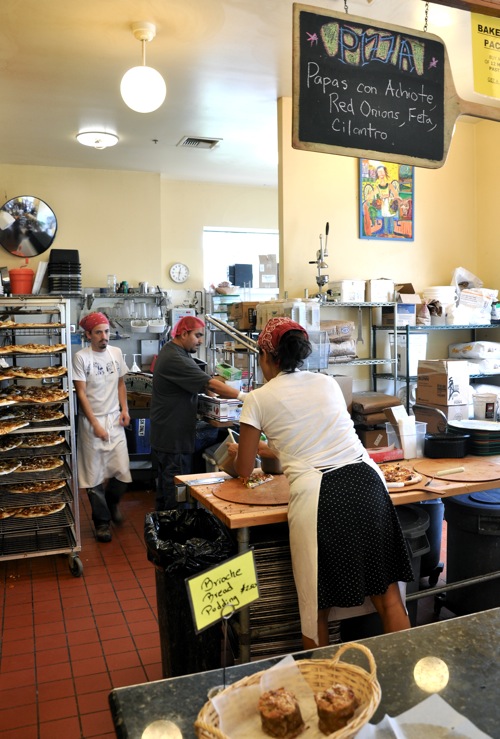
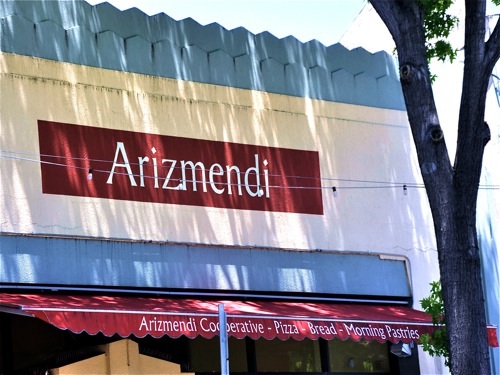
In the Bay Area, one doesn’t have to venture far before coming across a local favorite, the Arizmendi Bakeries. Backed by a development and support cooperative, the Arizmendi Association has 6 cooperative bakeries that specialize in morning pastries, artisan breads and gourmet pizza. Together, these bakeries comprise one of the most successful worker owned associations in the region.

Although cooperatives can take many different shapes, they share a fundamental characteristic: the workers are the ultimate decision-making body. Each worker is a shareholder in the business with one vote in every decision that guides the organization. At Arizmendi, every employee is part owner in the bakery with an equal share in the company.

Tiffany Martinez was a labor rights activist and union organizer before becoming a worker owner of the Emeryville Bakery four years ago.  Despite her years of involvement fighting for worker empowerment, Tiffany was never taught about cooperatives.

“I felt cheated, in the same way that I wished my high school counselors told me about trade school… I didn’t even know about unions until I got to college, which I think is this huge failure in our education system. Young people don’t have exposure to all the different options after high school.”

A co-worker at the union Tiffany worked for told her about Arizmendi. Feeling over worked and underpaid, Tiffany decided to pursue a job opening at the bakery. Following the interview process at Arizmendi – a sit down with the cooperative’s hiring committee and then a tryout in the bakery– she was hired.

“Having dedicated so much of my time as an adult to workers rights I felt really conflicted about having to do anything else or something that contradicted what I had been working for. But the cooperative is about worker’s rights too, so I threw myself into it.”

Arizmendi grew out of a study group in 1995. The group was studying thriving cooperatives in Spain, the Basque region and Italy, to find out why they were not similarly flourishing in the United States.

The study found that cooperatives in other parts of the world used their success to build new cooperatives, while co-ops in the United States were more scattered, without any kind of network to connect them.

“Learning to cooperate among cooperatives has been one of the keys to our success,” explains Tim Huet, a participant in the ’95 study group and member of the Arizmendi Development and Support Cooperative. It is this branch of the Arizmendi Association that coordinates the development of new cooperatives while providing ongoing support to the existing bakeries.
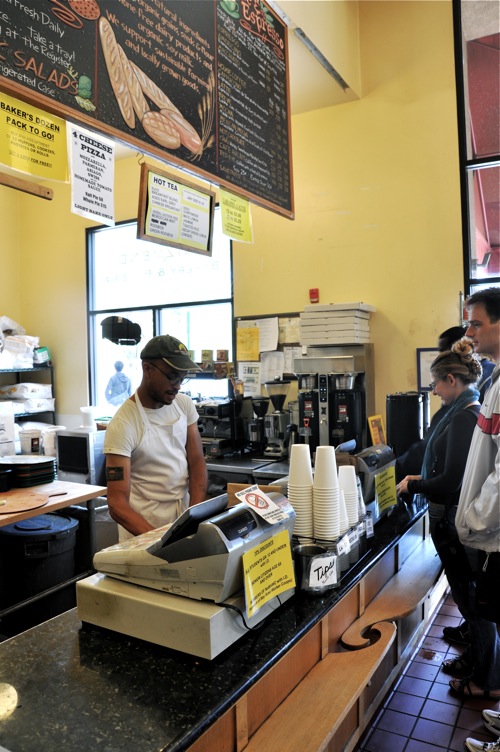
The successful Cheeseboard Collective, which became a cooperative in 1971, presented an excellent, local model from which to build future cooperatives. When approached by the study group, the Cheeseboard Collective agreed to lend its name, recipes and facilities to train people in starting a network of new local bakeries. In this way, Arizmendi was born in 1997, opening its first bakery named after Father Jose María Arizmendiarrieta, the founder of the Mondragón cooperative movement in Basque Country.

The Development and Support Cooperative of the Arizmendi Association is the closest thing in the organization to a manager insofar as it creates the business plan for the cooperatives, finds the funding to start them, recruits and trains the new worker-owners and provides ongoing education and legal support to the bakeries.

Everyone hired at the cooperative goes through an extensive business education program before becoming a worker owner. Tim is a part of this training process.

“We teach them how to read financial sheets and make decisions from that. We teach them conflict resolution because in our co-ops, there are no bosses. There are no managers. There is no one to solve your conflicts so we teach people how to work things out directly.”

The worker-owners are also taught the legal responsibilities of being an owner and director of a cooperative corporation, alongside the history and principles of cooperatives. Learning how to facilitate decision-making rooted in consensus among owners is another important element of running the business.

No one co-op is the same – individual worker-owners decide the shape their cooperative will take, and the differences between the bakeries tend to exist in how much the co-ops delegate decisions and tasks.

“Some cooperatives tend toward making all of their decisions together in one room. Other cooperatives tend to have more work groups that have authority in certain areas as long as they don’t contradict the overall mission,” explains Tim.

The beauty of cooperatives like Arizmendi is the flexibility granted to their workers. As the business changes over time and in size, so can the structures by which the worker owners decide to operate.

However, one consistency across all of the bakeries is the central tenet that every worker has one vote for every decision made. Thumbs up are a go, thumbs to the side are a stand aside vote, and thumbs down are a block. To maintain accountability and clarity in the decision-making process, stand aside and block votes have to explain their positions.

Arizmendi Emeryville delegates decisions among different committees to keep the many tasks at hand from becoming too many or too tedious, and every worker-owner is expected to be involved. Some committee positions are elected like the Policy Council, the Hiring Committee and the Collective Evaluation Committee. Examples of the volunteer committees include those that deal with finance and marketing, the details of production, and the maintenance and repairs of the bakery property.

Currently, one of the most challenging decisions facing the Emeryville cooperative is how to increase their prices in a global climate of rising food costs.  It is a delicate and difficult line to navigate between sustaining the bakery and worker-owners while still keeping the food accessible to the community.
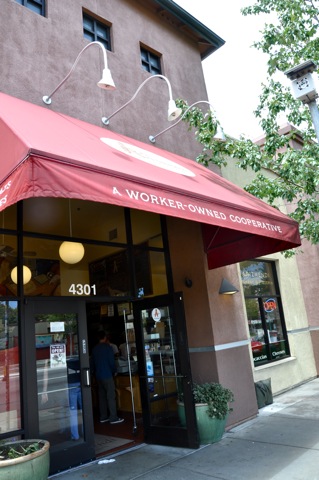
Over the years, Arizmendi has met great success with its business model. In 2010, a year in which jobs loss was high and few new businesses were created, Arizmendi opened two more bakeries employing 30 plus people. Furthermore, Arizmendi has sparked inspiration in other parts of the world and for those who are moved to create cooperatives of their own, Arizmendi has the policy of spending at least an hour with whoever contacts them seeking support and advice.

For both Tim and Tiffany however, the greatest successes of the Arizmendi Cooperative Association are interpersonal.

“A lot of times when we hire people they’ve never been asked how they want their work place to run, they’ve never been asked to make decisions about their pay. So it’s a profoundly altering experience in that case,” explains Tim. “A lot of time people gain skills about conflict resolution with each other and how to run meetings and how to run a business, that then spill over into other aspects of their lives – their family lives, their community lives.”

On a personal level, Tiffany says that the amount of time, energy and personal investment that she has put in the bakery is something she was never compelled to do when she was working for someone else or as a union organizer.

“I’ve never felt taken advantage of or pushed to do something that I couldn’t do – that I didn’t have the training or support to do.”

Tiffany described a lesson she received in humility after years of working the same shift. “I thought I knew everything and there wasn’t anything I could be told that I didn’t know. But that was so arrogant. I realized I have to learn how to listen to people when they have feedback about my stuff. I started practicing taking feedback again and not taking it personally- it’s not about me, it’s about the food that we are putting out together.

We fight like brothers and sisters sometimes. There are a lot of family dynamics there. You know, sometimes we bring our A-game and sometimes we don’t. What I’ve experienced in the last couple years is that we call each other out when we are not doing what we are supposed to be doing and that is really hard because how do you give someone feedback in a way that is going to help them out and not shut them down? That is something that we have all been learning about.”

If she were to leave the bakery, Tiffany said she would go to another worker-owned cooperative because she could no longer imagine working for a boss or a system in which she has no say.

“Look at what is happening in Wisconsin right now. We have to have more structures where people are going to be respected and have a say over what is happening in their workplace. It just seems so logical. Why would you go into a work structure that at its core isn’t committed to making your life better? So that you can have sick time off, so you can be with your kids and have healthcare. So that there aren’t unilateral changes to your shift that affect you and your family.”

The stability of her job at Arizmendi and having coworkers that care enough to shift schedules and work to accommodate the changes in their colleagues lives is simply something Tiffany had never experienced elsewhere. “I may not always agree with my coworkers but I love them and I can’t say that about my previous work experiences.”
The central aim of the Arizmendi Cooperative Association is to create a truly democratic economy – one in which everyone has a say in the decisions that affect them on a day-to-day basis. The biggest challenges to achieving this goal, explains Tim, are raising money (they do not take government or foundation grant money) and more importantly, living in a society that actually teaches people to be powerless.

“I think our political institutions, and most institutions in our society, train us to be undemocratic and they actually want us to accept a role that is not democratic. They have no interest in incorporating new or democratic skills in folks. The idea is that you will follow orders and so they have no interest in having work places where people learn democracy. They actually train people in this kind of deal where you are going to be an employee and take orders and the benefit of that is you don’t have any responsibility. You can complain all you want about the politicians, you get to complain about your bosses all the time and because you have no power, you have no responsibility.

We often encounter people who have been through enculturation into that and part of our job is to teach them that you can’t just be complaining anymore – you are the ones in power, you have to take responsibility to change things.”

Some worker-owners of Arizmendi have not previously had much input in their lives but now have a voice in arguably the most consuming aspect of life – how they earn a living. They come from a diversity of backgrounds, entering into a collective partnership as owners of their own business, feeding the community, and providing inspiration to others.

Arizmendi believes that the solution to the present broken system is to create an every day democracy.

“If people are working in authoritarian work environments, are going to authoritarian schools then they are not going to have the democratic skills they need to run a democratic society on a city, state or national level,” Tim explained. “So, I really think we need to give people that experience in the day to day – how you come together with your coworkers about how you run your business – and that will lead to reform on a national or regional level.”

Written by Alicia Roldan

Photos by Abby Martin

Posted in Uncategorized | 1 Reply

Beyond Boston and Media Reform for 2012

PROJECT CENSORED– As we approach the prophetic and supposed media hyped end-of-times year of 2012, hysterical speculation will abound.  But the ubiquitous corporate media don’t seem to notice that We the People of these United States already stand at our own precipice– the potential end of what has been deemed the Great American Experiment, the institutional embodiment of human freedom protected by government of, by, and for the people.

Of course, for many, the promises of equality and democracy that lie therein may never have existed in the history of the United States.  Certainly, racism, sexism, classism, and imperialism, have all played the role of antagonist to said promises.  However, America’s founding documents were particularly rife with rhetorical flourishes that were supportive of liberty, freedom of expression, the pursuit of happiness– all of which actually sprouted many social and political movements that changed American culture by striving toward those founding principles, achieving them in varying degrees.  In this regard, America has succeeded in realizing the essence of some of its promises.  But in reality, the US, in historical terms, has fallen short in myriad ways across the demographic spectrum and that trend is not abating.  This is in large part due to American’s reliance on reform over revolutionary ideals and action as tools for change.

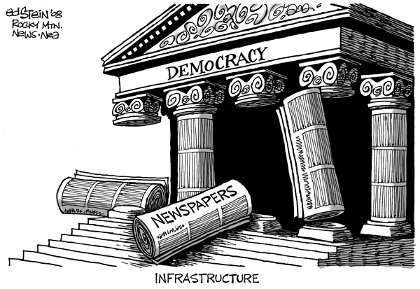
Arguably, the root of these aforementioned problems within democracy, beyond exclusion or manipulation of the franchise, chiefly resides in the controlling of public information and education, and access to it. Thomas Jefferson once offered a possible solution to these issues when he wrote, “The functionaries of every government have propensities to command at will the liberty and property of their constituents. There is no safe deposit for these but with the people themselves, nor can they be safe with them without information. Where the press is free, and every man able to read, all is safe.” 

The focus then is to achieve a truly free press and a literate citizenry in maintenance of democratic government.  More timely, this was purportedly the focus of the organizers and A-list participants of the National Conference on Media Reform this past weekend in the historic (once revolutionary?) city of Boston.  However, these reformers have also fallen short of achieving this goal.

We the people should go straight to the root of our problems with media, which means taking a radical approach in dealing with the current problems of our supposed free press to ensure that all are, as Jefferson put it, safe.  For starters, we should move well beyond reformist calls for attenuating institutional dials, changing a few metaphorical channels, or appointing new FCC commissioners.  This has not worked.  The root of democracy is with the people, in education, in literacy, in media awareness, and the path to change comes from the people, not the president.  That we move beyond a reform ethos concentrated on elite media control must be agreed upon by all those aware of the problem in order for real change to take place.  And while moving beyond reform, we cannot succumb to “hope and change we can believe in,” which was promised, yet never delivered after the 2008 election where many reformers focused great efforts to no avail. These eventual outcomes of reform serve to create a subculture of acceptance in defeat, living to fight again…in another four years.  That is a long game.  And we have played it for a long time. 

It is true that reforms play a role in radical changes, though they are stepladders to paradigmatic changes. The time to unite, face reality, and act to rebuild a new and relevant democracy on the foundation of a truly free press is upon us as we are in dire straights as a country, as a world.

Like falling empires of old, the US today is mired in multi-front, unilateral wars and is engaging in new ones ongoing while living well beyond its means at home; ignoring domestic affairs when not outright waging internal wars against those who actually expect elected and appointed officials to live up to our founding Enlightenment principles.  

These current so-called “wars on terror” have cost over $3 trillion to date and occupy a great deal of time of political leaders.  All the while, the US boasts record declines in middle and working class incomes and opportunities; a jobless “recovery” in the wake of the economic collapse of 2008 (caused in large part by the biggest banks on Wall Street which subsequently were not held accountable and instead bailed out at taxpayer expense); a crumbling infrastructure; failing schools (including public and private charter); abysmal records on access and quality of healthcare given the overall wealth and technological prowess of the country; rising infant mortality rates; increasing homelessness; skyrocketing foreclosures; collapse of community development and non-profit support systems; faulty elections procedures; the use of torture abroad and at home; the list goes on and on.

Last but not least, we suffer a hyperreal condition as a society, spurred on by fearful, factless, and feckless news programming by the nation’s supposed leading journalistic outlets.  This is why most people in America do not seem to notice the inevitable descent.  America is so disconnected that even while individuals may suffer in large numbers they lack a collective adhesive in a modern media landscape.  They erroneously believe they suffer alone, and thanks to corporate media propaganda, are often afraid of the wrong things.  Yet, a truly free press should help build and protect democracy for the people, not destroy it.

All this is taking place in what appears to be absolute decline across the board for most Americans as the upper few percent of the population control most of the nation’s wealth.  A real free press would tell us to forget the GDP and focus on community building and works programs, not abstract market fluctuations.  America is a debtor nation and has not made much outside of weapons and related technologies accompanied by military industrial media complex propaganda/advertising for years– all masquerading as official foreign policy and the “news.”  The US government, along with this massive military industrial complex, has now armed the world to the teeth to justify a permanent warfare state.

America, its government of and by corporations over the people, is now locked in a self-created, last-ditch effort to occupy the nether regions of oil, industrial capitalism’s dwindling lifeblood.  The US forces the rest of the world to trade on the dollar to maintain global hegemony, funding its expansion of over a thousand military bases in over 130 countries.  Meanwhile, China, Russia, and several South American countries, are already operating outside this monetary imposition, which as the late scholar and author of the Blowback trilogy Chalmers Johnson argued, is what would spell the end of American empire– fiscal bankruptcy.  The collapse of the dollar would hasten that.  Indeed, that time draws nigh as the cry for austerity from ostentatious leaders rings hollow across the land.

But again, don’t expect the so-called mainstream media to explain all this to the public.  After all, according to the mainstream media in the US (in actuality, it is the corporate media, but the term “mainstream” is used so often people tend to forget it is not so mainstream) there are teachers to blame and public workers to vilify, and there is an ever ready supply of immigrant populations to enslave or deport as well as exotic lands Americans can’t find on a map to invade in efforts to rout evildoers that supposedly cause our current calamities.  And if that’s too much to handle, big media in the US can intersperse a steady diet of junk food news where Americans can vicariously feast on celebrity gossip and sport spectacles ranging from Charlie Sheen and Dancing With the Stars to the Super Bowl and March Madness in hopes that the problems we all face in the real world will simply just go away.

These are the same issues many in the media reform movement also decry, and rightfully so.  Reform efforts have been laudable.  But the solutions reformers offer mostly seem to involve “fixing the system” by focusing on influence of advertisers or regulating ownership (which to date have not achieved reformer objectives).  Other reformers want the government to step in to “fix the system” by creating a public media, without noting government has played a big role in the current problem and even while public media is under attack by Congress, PBS and NPR have hardly stood out in major ways to challenge the plutocracy in the name of the people.

These reform notions do not go to the root of the problem, they do not map out a radical solution.  And, despite reformers’ benevolent instincts and intentions, don’t always expect reformers that criticize the big media messengers’ behaviors to realize that the system they spend so much time trying to repair is now defunct, if it ever existed in any democratically functional means in the first place.  This is why we, the media literate citizens of this dying republic, must now move beyond reform to create a new way.

We need to be the media in word and deed, not lobby those in power to reform their own current establishment megaphones for their own power elite agendas, as that will not happen, and indeed, it has not in the past.  In order to achieve real change, we need not have elaborate conferences that rely on power elite voices, their foundation monies, and their apologetic reformist rhetoric.  In the words of 19th century American activist Elizabeth Cady Stanton, we need to embody the true change she channeled when she said, “Reformers who are always compromising have not yet grasped the idea that truth is the only safe ground to stand upon.”  Indeed.

The time to speak truth to power, to media power elites and their political allies, is now.  Media reform is an important movement, but it should not be seen as the only path to create a more just and democratic media system.  More radical approaches are needed at this point.  So just say no to reform driven agendas delivered as so much managed news propaganda and embrace the possibilities of a radical media democracy in action, of, by, and for the people.  Show it with actions through citizen journalism and support of local and independent, non-corporate, community media.   Do it after the reform spectacle of vicarious deference to power and celebrity is over in Boston this year, as the real change only begins with true, radical action at home.  That’s the only way a truly free press can be created, preserved, and grown to be a tool of the people and not the reformers with their unrequited overtures to the media power elite.  The time to act is now.  We may not have time enough for the next reform conference to save us.

Mickey Huff is Director of Project Censored, on the board of directors for the Media Freedom Foundation, and Associate Professor of History at Diablo Valley College in the San Francisco Bay Area.  Contact: Mickey [at] projectcensored.org and Peter [at] projectcensored.org

See “Truth Emergency Meets Media Reform” by Peter Phillips, Mickey Huff, et al, in chapter 11 of Peter Phillips and Andrew Roth, eds, Censored 2009, NY, Seven Stories Press, 2008, pp. 281-295.


MR Original – Tale of Two Tyrants

MEDIA ROOTS- If anyone had any doubt that the morals of our governors in Washington are as flexible and flimsy as a half-chewed rubber band, then they need look no further than Obama & Co.’s disparate, polar-opposite approaches to the twin tyrants of Egypt and Libya.

When democracy ‘threatened’ (as Washington political elites saw it) to break out in Egypt recently, President Obama, Secretary of State Clinton, and most Republicans looked on with great consternation and apprehension. One of our closest allies in the Middle East, torturer and tyrant Hosni Mubarak, was in danger of being toppled from his throne by the Egyptian rabble. Our government had no idea whatsoever how to handle this unusual state of affairs.

Mubarak, after all, has been a loyal supporter of US foreign policy in the Middle East, a strong ally in the region for decades, and someone our government felt it could control- unlike the Iranians, for example. Losing Mubarak in Egypt would introduce uncertainty into the region, something American power elites hate and fear much more than any tin-pot dictator; and it would allow the Egyptian people to choose a new leader, perhaps one not as subservient to Washington as our politicians and military would like.

“Shall we give Mubarak more money and bombs to stay in power?” “Shall we publicly claim to support the Egyptian public while maneuvering behind the scenes to prop up our loyal dictator-friend?” “Maybe we quickly replace Mubarak with a new and improved despot, with a bright and shiny smile, to appease these people.” One can imagine that these were the kinds of things going through the minds of our political leaders at the time.

The silence publicly emanating from Washington in the early days of the Egyptian Uprising was deafening. Then, after the insipid silence, came mealy-mouthed and meaningless mumbo jumbo designed to please everyone, while satisfying no one. 

Obama tried to sound diplomatic, telling both sides of the growing conflict in Egypt to do the right thing, to let events play themselves out, and to behave responsibly. This mindless drivel and gutless pontificating angered Egyptian democracy activists, who were expecting the US government to pay more than just lip service to their professed democratic ideals.

Yet, many Americans pretend to support democracy while aggressively undermining it around the world.  In fact, our government has turned such activity into an art form–no one does it better, or with greater style and aplomb.

Dictators, tyrants, despots and wannabe autocrats across the globe stand in awe at our accomplishments in this field of endeavor: we invade country after country, we continually wage multiple wars, we maintain hundreds of military garrisons spread through the vast majority of the world’s countries, we provide munitions and money to countless dictatorships, we steal the oil and natural gas of other countries shamelessly and continuously, and we lie, cheat and steal to our hearts’ content.  

Then, our government proudly proclaims to the world, and to the rubes back in the US, that we worship the word of The People, that we are “The Greatest Democracy In The World,” pillars of the global community, Gods of Liberty and Fountains of Freedom.

We do this effortlessly, convincingly and apparently, sincerely. It is an awe-inspiring act worthy of Shakespeare. The level of hypocrisy, coupled with some self-deception, is truly staggering. Mind boggling. A monument to prevarication that would put the builders of the Great Pyramids to shame for artfulness, audacity and craftsmanship.

Let us now turn to the case of Libya’s Moammar Khadafy, a tyrant we don’t like because we can’t control him. He doesn’t do what we say. He won’t follow our orders. He refuses to give preferential treatment to our corporations. He snubs the CIA. He won’t allow us to pock his land with US military installations. He is simply incorrigible.

What is to be done with such a man?  

Well, Ronald Reagan, who loved a good tyrant (the bloodier the better, of course– take Philippine blood-lover Ferdinand Marcos) knew that Khadafy wouldn’t take marching orders from Washington. So, he did what countless others in the Oval Office, before him did to recalcitrant adversaries– he bombed him.

He missed Khadafy, but killed his infant daughter. Blew her to smithereens. Blatant terrorism. Illegal act of war. Horrible violation of international law. But US presidents routinely commit acts of murder without prejudice, and this case was no different.

Now, Khadafy’s people are rising up against him, and Obama & Co. are licking their lips at their good fortune. The President (shortly after slipping on the angel’s halo which all U.S. presidents have fitted themselves with for a century) declared that he is simply “appalled” at this tin pot dictator’s actions (according to The San Francisco Chronicle and Associated Press); Secretary Clinton roars that this nonsense must stop RIGHT NOW!;  the U.S. Corporate Press thunders their denunciation of this evil demagogue who MUST BE STOPPED from hurting his people and destroying the delicate leaves of a blooming democracy before they can take root.

(Military action, as of this writing, has been launched against Libya, with President Obama set to go before the nation to tell Americans why the United States is now involved in three separate wars across the Middle East. Four wars actually, if you count Pakistan.)

And on and on.

It is a sad state of affairs of course, for the nation that introduced the world to Tom Paine, Thomas Jefferson, George Washington and Benjamin Franklin. And no doubt, these fine gentlemen are looking down from their place in the starry firmament with no small amount of disgust and anger, right now; for betraying one’s own stated principles is the worst kind of fraud imaginable.    

I wish the people of Libya, Egypt and all the other nations of the Middle East much good fortune in their quest for freedom. But my message to those brave souls is this: You may or may not receive help (and could be actively undermined) from the government of the United States in your continued quest for democratic freedoms. Everything that our government does, especially in the Middle East, is strategic and control-based and dependent upon political, economic and social considerations, which can change quickly and without warning.

So be warned: conniving Washington politicians sailing the ship of state have had no problem in the past throwing Lady Democracy overboard to make room for more Middle East oil. They are perfectly capable of supporting another dictator just like the ones you’ve been overthrowing, and will, if it serves the interests of America’s political and economic elite.

Written by Tom J. Wright

Photo by flickr user Muhammad