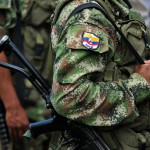
Colombia’s presidential election could determine the fate of the historic peace deal ending their 53-year civil war. While most in the country want to honor the agreement, Colombia’s right wing has been a fervent opponent.
In Bogotá,Abby Martin interviews Congressman Edward Rodriguez, a leading member of the far-right Democratic Center Party founded by former President Uribe. She challenges him on his party’s ties to death squads, drug cartels and potential to reignite the war.
Martin also visits the government office dedicated to compensating the civilian victims and speaks with Director Ana Maria Almario about their monumental task.
Nearing the end of Season II, The Empire Files team expresses our deepest gratitude to so many of you who have followed our reports, written feedback, and shared our work. 2017 was no-doubt a watershed chapter in the advancement of US Empire, and we are honored to have your support telling the stories that were marginalized and distorted by corporate press as weapons of propaganda for US militarism. We’re excited that our reports have been seen on a growing number of countries in Latin America on TeleSUR Spanish as well as across the United States on Free Speech TV. Don’t miss the launch of our new podcast archiving our full episode library.
Below is a summary of our work in 2017––we are looking forward to helping cut through the imperialist propaganda and featuring more untold histories and censored voices in the year to come.
In a year when so much of the corporate media was hyper-focused on President Trump, Abby Martin and the Empire Files crew sought to cover underrepresented domestic and international issues that affects real people.
Inside the Empire, that meantthe ongoing opioid epidemicin a discussion with leadingattorney Mike Papantonio, examining why 91 Americans die each day due to opioids, and how Big Pharma’s desperate pursuit of profit is attempted murder upon all injured Americans.
It meant examining the new Administration’s assault on the freedom of assembly in the form ofcontroversial J20 arrests, where more than 200 demonstrators faced decades in prison for conspiracy and other charges.
And it meant examining overarching issues in America, like racism, inequality, the dysfunction of capitalism and the US Empire’s need to prop up the system.
Always connecting struggles in here to the victims of US Empire, Empire Files revealed the censored history of how the US Empire destroyed and subjugated the Philippines, Colombia, Palestine, Venezuela and more.
While the mass media’s most-reported story in 2017 was fear-mongering and aggression towards Russia, Empire Files sought to explorewhat could happenif this trend continues how the US Empire looted Russia after it led the overthrow of the Soviet Union, and Russia’s own history of defeating the oligarchs a century ago.
The Places
In 2017, Abby Martin and the Empire Files crew traveled both domestically and abroad to cover the year’s most important stories: From Houston, Texas amonth after Hurricane Harveyto cover thegovernment’s inaction in communities that were affected the most, to Washington, D.C. to dive deep into theprotests surrounding the inaugurationof President Trump.
Alongside Trump’s major announcement to declare Jerusalem the official capital of Israel, Abby Martin’s interviews with Israelis in Jerusalem, who wished exile and worseupon Palestinians, gave an eye-opening counter-narrative to the corporate media’s depiction of the situation. Martin’s report was so controversial that shebecame the target of a smear campaignby Israeli organizations.
Amidst a relentless regime-change operation in Venezuela by the Pentagon and Venezuelan oligarchs, Empire Files went into the heat of the battle, producing the only widely-seen coverage countering US propaganda–everything from being tear gassed with opposition protesters, to using hidden cameras to investigate food shortages, to explaining the reality of the country’s economic crisis, to pro-government protests ignored by Western media.
Most recently Empire Files travelled to Colombia, covering the historic peace deal that ended a 53-year civil war–and went deep into the jungles to investigate abreech of trustthat left 8 farmers massacred by police.
In each location, Abby Martin spoke with victims of violence and colonization funded and perpetrated by the US Empire – points of view never found in the mainstream.
The Voices
Those voices, those marginalized individuals deemed too inconvenient to the Empire’s agenda, were amplified through Empire Files in 2017.
Profiling academics rarely seen on television, interviews withDr. Gerald Horne, Rosa ClementeandChris Hedgesgave essential perspective on the resurgence of neo-Nazis and white supremacists under Trump.
Brining grassroots voices to the forefront, Empire Files was especially honored to interview Filipina domestic workers fighting human trafficking, young radical organizers in the People’s Congress of Resistance, Sikh Americans responding to racism and Islamophobia, poor and working-class Venezuelans fighting US regime change, peasant farmers in Colombia in the wake of a state massacre, and unsung heroes who saved lives in the Hurricane Harvey.
Without these voices, these stories simply could not have been told.
You can view the full library of Empire Files episodes here, and be sure to follow us on Twitter and Facebook to see what we have coming in 2018!
To contrast the human rights realities, Abby Martin interviews human rights attorney Dan Kovalik, who has recently returned from both countries.
Kovalik has done extensive work in Latin America and was an observer to the recent Constituent Assembly election in Venezuela. He also serves as the Associate General Counsel of the United Steelworkers union, teaches International Human Rights at the University of Pittsburgh’s School of Law, and is the author of the new book “The Plot to Scapegoat Russia.”
Colombia remains one of the most dangerous countries on earth, where more than220,000have been killed and countless displaced over the last 57 years. The human rights abuses in the country are regularly dismissed by the corporate media, which ignores the heavy hand of US Empire.
The US began heavily pushing military intervention in Colombia under the Kennedy administration, whose National Security Doctrine aimed to wipe out all populist movements in Latin America through the backing of right wing death squads.
FARC (Fuerzas Armadas Revolucionarias de Colombia), the Marxist-Leninist rebel group, is branded a terrorist group by the US, yet is trying to initiate a peace process. The US prevents this from happening, and continues to use the rebel group as an excuse to increase its military involvement. The so-called Drug War is just another arm of the ongoing violence on the ground.
The role of the US military in Colombia is intense. According to the former US Ambassador to Colombia, the US has more involvement in Colombia than anywhere in the world, including Afghanistan. There is also widespread abuse on behalf of the US military throughout the community. Between 2003-2007, US soldiers and contractors sexually abused at least 54 children and could not be tried or extradited due to immunity clauses between the two countries.
All this aside, Colombia remains the invisible country in the invisible war, shunned by the world. Abby and Robbie Martin are joined by Dan Kovalik, human and labor rights lawyer, on Media Roots Radio to discuss Colombia’s current war and the far-reaching effects of US interventionism over the past half century.
If you want to directly download the podcast, click the down arrow icon on the right of the soundcloud display.
This Media Roots podcast is the product of many long hours of hard work and love. If you want to encourage our voice, please consider supporting us as we continue to speak from outside party lines. Even the smallest donations help us with operating costs.
Listen to all previous episodes of Media Roots Radiohere.