
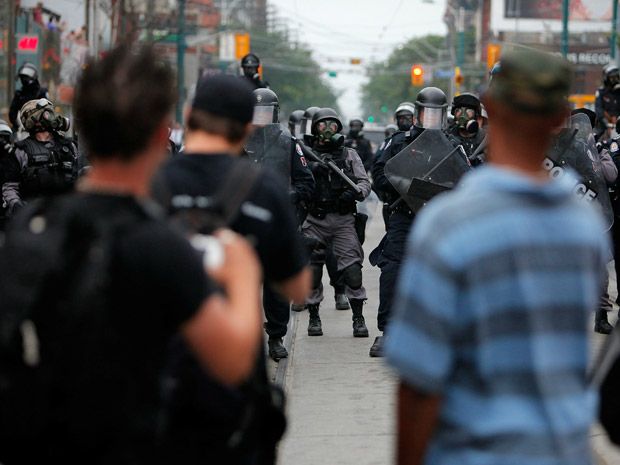
Four Journalists File Police Complaints After G20 Arrests

(Video Below)

NATIONAL POST– A Toronto-based lawyer representing four journalists, who filed complaints with Ontario’s police watchdog and claimed that police physically assaulted and threatened to sexually assault the female reporters during the G20 summit, is calling for a full investigation into the alleged violence.

On Tuesday, Jesse Rosenfeld, Amy Miller, Daniel McIsaac and Lisa Walter each filed complaints about their arrests during the G20 summit with the Office of Independent Police Review Director.

Julian Falconer is representing the “Free Press 4” group.

“From our point of view, if peaceful protesters and journalists engaged in peaceful coverage are treated this way, this is a sad day for democracy. My clients are seeking accountability for what appears to be a serious overreaction by some police officers,” he said in a written statement.

Toronto Police spokesman Mark Pugash said there were more than 100 cameras documenting everything that happened in the prisoner processing centres and on the streets so “it’s not someone’s word against someone else’s.”

“We have video of everything. We’ll make sure that we provide the best possible evidence to determine the truth or otherwise in these allegations,” he said.

Police “anticipated” people would make complaints.

“We have to consider the possibility that complaints are completely unfounded. There are people who have said things so far that are clearly lies,” Pugash said.

Rosenfeld, a 26-year-old freelancer for the Guardian, a U.K.-based newspaper, was arrested when he was covering a group of demonstrators in front of a downtown Toronto hotel on Saturday night.

He said one officer told his colleague, “that’s the loudmouth kid who was mouthing off to me yesterday” and the officials didn’t bother to confirm his credentials. Instead, Rosenfeld said the officers “jumped” him.

“I was grabbed on each side and hit in the stomach and back and pounced on by officers. I kept asking them why they were beating me because I wasn’t resisting arrest. But they lifted my leg and twisted my ankle.”
Rosenfeld alleged he was also kneed in the ribs.

In Amy Miller’s complaint she said officers threatened to sexually assault her.

“You’re going to be raped. We always like the pretty ones. We’re going to wipe the grin off your face when we gang bang you. We know how the Montreal girls roll,” her complaint read.

Miller is a Montreal-based freelance journalist with The Dominion, a monthly paper published by a network of independent journalists.

Miller said the officers called her accreditation “garbage” and told her to get a “real job.”

OIPRD director Gerry McNeilly said all complaints are screened for “validity” and the investigation is then handed to the police division or to McNeilly’s office.

McNeilly must decide to group the “Free Press 4” complaints or look at them individually.

“I have the ability but I haven’t made the decision. If I say a complaint has no validity, that’s final. There’s no appeal, so I have to look at each case very carefully,” McNeilly said.

“I hoped the G20 had proceeded with minimum interruption and disruption but the complaints are coming in and we’re going to deal with them in a way that’s transparent.”

OIPRD spokesperson Allison Hawkins said the office receives, on average, 80 complaints a week. Between June 20 and June 26, 95 complaints were filed.

The civilian-led organization, which formed last October, investigates public complaints against the province’s police associations.

By Carmen Chai

Police brutality against women in Toronto at the G20


© COPYRIGHT NATIONAL POST, 2010

Senators Propose President Emergency Internet Power

CNET– A new U.S. Senate bill would grant the president far-reaching emergency powers to seize control of or even shut down portions of the Internet.

The legislation announced Thursday says that companies such as broadband providers, search engines, or software firms that the government selects “shall immediately comply with any emergency measure or action developed” by the Department of Homeland Security. Anyone failing to comply would be fined.

That emergency authority would allow the federal government to “preserve those networks and assets and our country and protect our people,” Joe Lieberman, the primary sponsor of the measure and the chairman of the Homeland Security committee, told reporters on Thursday. Lieberman is an independent senator from Connecticut who caucuses with the Democrats.

Because there are few limits on the president’s emergency power, which can be renewed indefinitely, the densely worded 197-page bill (PDF) is likely to encounter stiff opposition.

TechAmerica, probably the largest U.S. technology lobby group, said it was concerned about “unintended consequences that would result from the legislation’s regulatory approach” and “the potential for absolute power.” And the Center for Democracy and Technology publicly worried that the Lieberman bill’s emergency powers “include authority to shut down or limit Internet traffic on private systems.”

The idea of an Internet “kill switch” that the president could flip is not new. A draft Senate proposal that CNET obtained in August allowed the White House to “declare a cybersecurity emergency,” and another from Sens. Jay Rockefeller (D-W.V.) and Olympia Snowe (R-Maine) would have explicitly given the government the power to “order the disconnection” of certain networks or Web sites.

Read full article HERE.

© CNET, 2010

Internet Monitoring Needed to Fight Homegrown Terrorism

FOX NEWS– Fighting homegrown terrorism by monitoring Internet communications is a civil liberties trade-off the U.S. government must make to beef up national security, the nation’s homeland security chief said Friday.  

As terrorists increasingly recruit U.S. citizens, the government needs to constantly balance Americans’ civil rights and privacy with the need to keep people safe, said Homeland Security Secretary Janet Napolitano. 

But finding that balance has become more complex as homegrown terrorists have used the Internet to reach out to extremists abroad for inspiration and training. Those contacts have spurred a recent rash of U.S.-based terror plots and incidents. 

“The First Amendment protects radical opinions, but we need the legal tools to do things like monitor the recruitment of terrorists via the Internet,” Napolitano told a gathering of the American Constitution Society for Law and Policy. 

Continue reading about Internet Monitoring Needed to Fight Homegrown Terrorism.

© COPYRIGHT FOX NEWS, 2010

Are Cameras the New Guns?

GIZMODO– In response to a flood of Facebook and YouTube videos that depict police abuse, a new trend in law enforcement is gaining popularity. In at least three states, it is now illegal to record any on-duty police officer.

Even if the encounter involves you and may be necessary to your defense, and even if the recording is on a public street where no expectation of privacy exists.

The legal justification for arresting the “shooter” rests on existing wiretapping or eavesdropping laws, with statutes against obstructing law enforcement sometimes cited. Illinois, Massachusetts, and Maryland are among the 12 states in which all parties must consent for a recording to be legal unless, as with TV news crews, it is obvious to all that recording is underway. Since the police do not consent, the camera-wielder can be arrested. Most all-party-consent states also include an exception for recording in public places where “no expectation of privacy exists” (Illinois does not) but in practice this exception is not being recognized.

Massachusetts attorney June Jensen represented Simon Glik who was arrested for such a recording. She explained, “[T]he statute has been misconstrued by Boston police. You could go to the Boston Common and snap pictures and record if you want.” Legal scholar and professor Jonathan Turley agrees, “The police are basing this claim on a ridiculous reading of the two-party consent surveillance law – requiring all parties to consent to being taped. I have written in the area of surveillance law and can say that this is utter nonsense.”

The courts, however, disagree. A few weeks ago, an Illinois judge rejected a motion to dismiss an eavesdropping charge against Christopher Drew, who recorded his own arrest for selling one-dollar artwork on the streets of Chicago. Although the misdemeanor charges of not having a peddler’s license and peddling in a prohibited area were dropped, Drew is being prosecuted for illegal recording, a Class I felony punishable by 4 to 15 years in prison.

Continue reading at GIZMODO.

Wendy McElroy is the author of several books on anarchism and feminism. She maintains the iconoclastic website ifeminists.net as well as an active blog at wendymcelroy.com.

© COPYRIGHT GIZMODO, 2010

Arizona Bans Ethnic Studies in Public School

ALTERNET– Hispanic students fill nearly half the seats in Arizona’s public school classrooms, but a new law signed by Governor Jan Brewer Tuesday makes it illegal for these students to learn about their heritage in school. HB 2281 prohibits schools from offering courses at any grade level that advocate ethnic solidarity, promote overthrow of the US government, or cater to specific ethnic groups—regulations which will dismantle the state’s popular Mexican-American studies programs.

Much like Arizona’s new immigration law, this ethnic studies ban is political interest dressed up to look like education reform. The bill was passed largely because of State Superintendent of Public Instruction Tom Horne’s personal distaste for the Tuscon Unified School District’s Chicano studies program, in which 3 percent of the district’s 55,000 students participate. He has been hell-bent on squashing the program ever since learning several years ago that Hispanic civil rights activist Dolores Huerta told Tucson High School students that “Republicans hate Latinos,” the Associated Press reports.

“Traditionally, the American public school system has brought together students from different backgrounds and taught them to be Americans and to treat each other as individuals, and not on the basis of their ethnic backgrounds,”…

Continue reading about Arizona Banning Ethnic Studies in School.

© COPYRIGHT ALTERNET, 2010

Photo by Esparta
