MEDIA ROOTS — On
November 14, 2011, Abby Martin of Media Roots interviewed award-winning
journalist and best-selling author Greg Palast after his talk at the First
Congregational Church of Berkeley.
Greg Palast, a freelance journalist for the BBC as well as British newspaper The Observer, discusses his newly published book Vultures’ Picnic, corporate
collusion, the bought-and-paid-for-media establishment, the role of citizen
journalism around the Occupy Wall Street Movement, and the value of organisations
such as Project Censored.
MR
***
Abby Martin of Media Roots Interviews Greg Palast about Vultures’ Picnic
MEDIA ROOTS— As
people in the U.S. and abroad endeavour to exercise their rights and civil
liberties, such as the right to freedom of speech and peaceful assembly, the
state and its police forces continue finding methods to repress such civic activity. An important component of social control and repression of dissent has
been the curtailment of telecommunications.
Earlier this year, when San Francisco Bay Area Rapid
Transit (BART) police killings spurred groups, such as ‘No Justice, No Bart!,’ to call for critical mass demonstrations, BART officials
attempted to thwart communication among activists by cutting mobile phone
service entirely to transit stations targeted by demonstrators.
Not to be outdone in the U.K., the Metropolitan Police Service of Greater London
has been “operating covert surveillance technology that can masquerade as a
mobile phone network, transmitting a signal that allows authorities to shut off
phones remotely, intercept communications and gather data about thousands of
users in a targeted area.”
Messina
***
THE GUARDIAN– The surveillance system has been
procured by the Metropolitan police
from Leeds-based company Datong plc, which counts the US Secret Service, the
Ministry of Defence and regimes in the Middle East among its customers.
Strictly classified under government protocol as “Listed X”, it can
emit a signal over an area of up to an estimated 10 sq km, forcing hundreds of mobile phones per minute
to release their unique IMSI and IMEI identity codes, which can be used to
track a person’s movements in real time.
The disclosure has caused concern
among lawyers and privacy groups that large numbers of innocent people could be
unwittingly implicated in covert intelligence gathering. The Met has refused to
confirm whether the system is used in public order situations, such as during
large protests or demonstrations.
Nick Pickles, director of privacy
and civil liberties campaign group Big Brother Watch, warned the technology
could give police the ability to conduct “blanket and indiscriminate”
monitoring: “It raises a number of serious civil liberties concerns and
clarification is urgently needed on when and where this technology has been
deployed, and what data has been gathered,” he said. “Such invasive
surveillance must be tightly regulated, authorised at the highest level and
only used in the most serious of investigations. It should be absolutely clear
that only data directly relating to targets of investigations is monitored or
stored,” he said.
The company’s systems, showcased
at the DSEi arms fair in east London last month, allow
authorities to intercept SMS messages and phone calls by secretly duping mobile
phones within range into operating on a false network, where they can be
subjected to “intelligent denial of service”. This function is
designed to cut off a phone used as a trigger for an explosive device.
A transceiver around the size of
a suitcase can be placed in a vehicle or at another static location and
operated remotely by officers wirelessly. Datong also offers clandestine
portable transceivers with “covered antennae options available”.
Datong sells its products to nearly 40 countries around the world, including in
Eastern Europe, South America, the Middle East and Asia Pacific. In 2009 it was
refused an export licence to ship technology worth £0.8m to an unnamed Asia
Pacific country, after the Department for Business, Innovation and Skills
judged it could be used to commit human rights abuses.
MEDIA ROOTS – Ralph Nader answers questions from the
audience at Berkeley’s Hillside Club on Saturday, October 1, 2011 at the
First Annual Peter Miguel Camejo Commemorative Lecture. [Transcript Below]
Ralph Nader discusses Occupy Wall Street, Gandhi’s ‘Seven Deadly
Social Sins’, media reform, his presidential candidacy and what people
can do to fight back.
***
Ralph Nader:
“Gandhi’s ‘Seven Deadly Social Sins,’ you’ve probably heard them, that’s
his words, ‘Seven Deadly Social Sins.’
Everyone has three words. Gandhi
was really the sound-bite champion. He’d
have been great on TV.
“‘Politics
Without Principle. Wealth Without Work. Commerce Without Morality. Pleasure Without Conscience. Education Without Character. Science Without Humanity.’
“Science
is building drones. You heard about the
coming drone. You heard about the coming
drone? This is one that’s what’s called
Self-Automated. That is, a software will
select the suspects, locate the suspects, execute them. They don’t even need a button-pusher in
Nevada or Langley. The next drone is
gonna be a size of a hummingbird. With
nanotechnology, they’ll put the drone in your hair for surveillance. You’ll never know it. It’s a, it’s a coming, 1984 is a masterpiece of understatement.
“And
then, ‘Worship Without Sacrifice.’
“You
know, that’s like the so-called organised Christians who organise for war. You know, they organise for destroying the
rights of poor people. I wonder if Jesus
Christ would’ve condemned.
“I added
two more. You gotta bring it up to date.
“Belief
Without Thought.’ This is what Peter
[Camejo] was against. ‘Belief Without
Thought.’ And ‘Respect Without
Self-Respect.’ That’s the most important
one of all ‘cos if you respect yourself you don’t say, ‘I don’t have any
power. Why should I do anything? It doesn’t matter. It won’t change anything. It won’t have any effect ‘cos everyone else
is not gonna do what I’m doing.’
No. You do what you do. And you try to talk to others to convince
them. You never say, you don’t wanna go
out of your way to discomfort yourself because a million other people haven’t told
you, in one way or another, that they’re doing the same thing.
“So, the
key is how to get people who know what the prob-, there are very few people in
this country who are ignorant of the injustices. I mean they get it handed to ‘em every
day. Right? You have to, you have to have people who say
to themselves that if I know something I have a moral obligation to do
something about it, personally. I don’t care if ten million people don’t do
it. I can’t live with myself, unless I
do it. And once that spreads, you’ll get ten million people. So, that’s, that’s what we have to look ahead
for.”
Question: What do
you think about the Occupy Wall Street protests?
Ralph Nader: “Well, you
know, we don’t know what it is, but it’s refreshing whatever it is. It’s the young people, uh, probably without
jobs, a sense of theatre, uh, make sure there’s no leaders, no organisers, so
they’re, become [more] resistant to infiltration. And they’re modestly violating permits. Like, uh, the permit to march in the City of
New York and, therefore, they’re provoking the police to try to channel them
with these orange fences. And they’re
spreading to other areas. And that’s the
kind of spark that gets things underway.
“I wrote
a column years ago, months ago. I said,
‘How do we know when the spark comes? I
mean, the spark doesn’t usually come from [a] predictable source. It doesn’t come from the usual suspects, like
a bunch of oppressed people in some ghetto, in some city. It comes like the Tunisian spark, see? Who would have ever thought a fruit peddler,
slapped by a police woman who is rippin’ off his stall…? And look what happened. So, this may be a spark.
“What usually
launches things are totally unpredictable episodes that suddenly say to a lot
of people, ‘That’s it! We’ve had
enough!’ You know? So, we’ll see how it turns out. They’ve got a big band coming to get a bigger
crowd. I always worry about that, if
people come just for the music. Cornel West, Michael Moore, they’ve spoken to
‘em. Uh, the authorities are very
worried about this ‘cos they saw what happened in London. And they saw what happened in the Middle
East, the Arab Spring, and all. They’re
very worried about that. And so we’ll
see. I think we’re gonna have to wait [many]
days and see what goes on.”
Question: “A number
of people have asked, Mr. Nader, given the present crisis and this Presidential
year, will you make your announcement here for your candidacy for President of
the United States?” [audience chuckles]
Ralph Nader:
“No.
“I, [audience
laughs] I ran unofficially in the Green Party in 1996. I ran a none-of-the-above, really unofficial, Candidacy in New
Hampshire and Massachusetts in 1992, just none-of-the-above. I got almost as many votes as Jerry
Brown. And he was a rival in New Hampshire. Then
I ran officially in 2000 and 2004 and 2008.
[…]
“Four
out five people who declared to the pollsters they were gonna vote for us,
Nader-Camejo, Nader-Gonzalez, didn’t
when they got in the voting booth. They
chickened out and voted for the Democrats or the Republican, whatever. Mo-, people think all our votes would’ve gone
to the Democrats. No. The exit polls in 2000 by a Democratic
pollster have, uh, Nader-LaDuke, said that 25% of our votes would have voted
for Bush, 39% for Gore, and the rest would have stayed home.
“So, to
make a long answer short, it’s time for other people to do it, uh, because, uh,
I’m tired of pushing strings. I’m tired
of having a lot of people agree with our positions and they don’t put their
vote behind our positions. And, uh,
unless, that’s what I mean by ‘Respect Without Self-Respect.’ We are supported on many issues by a majority
of the American people. A majority of the
people wanted us on the Debates. These
are traditional poll, polling companies.
A majority of the people wanted us on the Presidential Debates. We didn’t get on. And a majority of the people, I mean, the
people, you meet all over the country, ‘I voted for you!’ And I look at ‘em and I say, ‘Uh, where did
you vote for me? Where? North Carolina?’ I’ll say, ‘I wasn’t on the ballot in North
Carolina.’ [audience chuckles] You know, I mean, people feel like, you know,
they wanted to, but.”
Question: “I
just, feeling, hearing all this, I’m just feeling so much that, you know, we
get the government we deserve. When
people voted for the lesser-of-two-evils instead of voting for their heart I
felt that we really get the government we deserve. That’s my statement. My question to you is: Is there any way that we can get the, uh, the
telecommunications and the communications and the airwaves and all that back to
the people. That was our public
domain. And I think if we control that
again, we would be able to control the length of the political season that goes
on, which is interminable, because the TV, uh, people wanna make profits and
they love to create fights that, that they’re not even, they don’t even care
who wins. They’re just making
money. And I think we can also get the
money out of, uh, politics. If we the
people own the airwaves, we give the Candidates the right to be on those
airwaves, an equal time kind of situation.
They don’t have to pay the TV, get ‘em, put ‘em on free.”
Ralph Nader:
“Yeah. Well, that was one of the
agendas we ran on. And probably helped
keep us off national TV.
“We own
the public airwaves. We’re the
landlords. The FCC is the real estate
agent. And the radio and TV stations,
the tenants. And they pay us no
rent. They haven’t paid us any rent for
this valuable property since 1934, the Communications Act of 1934. And they decide who says what and who doesn’t
say what on our property, namely the TV and radio, the public airwaves. So, you know?
That’s an easy one, right? I
mean, who’s gonna be against controlling what we own? Having our own audience, network, our own radio
and TV. It’s our property. We can say we want two hours a day,
here. We want three hours a day,
here. And then we’ll rent you the rest
of the time. You’ll have to pay rent. We’re gonna take the rent and put it into
studios and reporters and programmers and producers. And communicate with one another. And mobilise one another on anything we want,
from serious to humour. Boy, I mean, can
you imagine getting on national TV with that?
You see?
“So,
that was a larger part of the Commons.
We had a policy on the Commonwealth where we control what we own. We own a third of the, America, the public
lands and, you know, who controls it the timber, oil, gas, gold, whatever, the
companies. And we own trillions of
dollars of government taxpayer R & D.
Who do you think created the internet?
Who do you think built the biotech industry? Who do you think built the semiconductor
industry? Who do you think built the
aerospace? It was all government R &
D! You wouldn’t recognise it. I mean, it was all government R & D, out
of the Pentagon, NASA, National Institutes of Health. Half, three-quarters of the anti-cancer drugs
came from tax-payer-supported research from the National Cancer Institute with no
controls on the prices that the receiving drug companies could charge us. They were given all this free. So, you gotta dialogue like that. You know, you can’t do it with sound-bite.
“But
we’re shut out of our own property. That
should be the calling card. Let’s start
with our assets! Our assets are the
biggest wealth in America. $5 trillion
dollars of pension funds owned by workers.
That could control the New York Stock Exchange Members. That could control the companies in the New
York Stock Exchange. I mean, about a
third of all stock is held by worker pensions.
But, it’s not controlled by
worker pensions. It’s controlled by the banks and the insurance companies or
the intermediate.
“So, you
see, it’s not that hard once you get people, uh, just thinking a little bit,
getting excited. You gotta ask ‘em the
basic question, ‘Do you want power? Or
do you want to be powerless? You want
multiple choice tests? You want power or
do you want powerlessness? So, you need
thousands of people talking to millions of people. Just like the populist tradition. They call themselves lecturers. I’d have [texted this, no calling]. And they talk to people. So, if you have a thousand people who are
talking to a thousand people a week with these messages. They would talk to a million people face to
face in rooms like this. You have 10,000
people. They talk to a thousand people a
week in different venues. You have ten
million people. That’s the way we gotta
think. The hell with the media for the
meantime. One thing they can’t stop us
from doing is talking to one another.
And there are a lot of empty auditoriums and empty spaces around the
country that we could use to do that.
“That’s
why we need a few very rich people, like George Soros or Ted Turner or
whatever. You know, there’s always a few
tiny ones, a tiny percent. All you need,
a tiny percent to say, ‘Here’s a billion dollars. We want you to hire 20,000 organisers in the
country, all over the country.’ You will
see remarkable dramatic changes. There’s
no social movement in the country that was created without organising. And the lack of organisers delay the
maturation of these movements, women’s suffrage, abolition.
“But
remember, and there’s a fella yesterday, he came out, gawd, these guys are like
so predictable. This guy was real
hardcore, socialist, idealist. He said,
‘How dare you write a book called Only
the Super Rich Can Save Us. I said,
well, remember, it’s in quotes. It’s in fiction. He said, ‘I know! But I saw you on TV! You explained it. And you think that we have to rely on rich
people to mobilise the masses.’ So, I
said, ‘Well, how are you gonna hire the organisers?’ And he wouldn’t listen. So, I said, ‘Well, you ever heard of the Abolition
Movement? Slavery?’ He said, ‘Yeah.’ I said, ‘Don’t you know that a lot of proper
Bostonian rich people funded William Lloyd Garrison, Frederick Douglass, and
others? How about the Women’s Suffrage Movement? Some rich women funded those people. Women who were on the ramparts all over the
country. How about the early Civil Rights
Movement? Did you ever hear?’ He, he went away by then. [audience laughs] ‘How about the Stern Family? How about the Curry Family of the 1950s? Gave a big lot. Who’s gonna pay for those buses? Who’s gonna pay for the expenses, the
organisers? […]
“It’s
ridiculous. But, you know what? After he left, I said, I had the best
response to him. You always think after
it’s over. Here’s what I would’ve said
to him right after that: ‘Hey, you’re a socialist, right?’ He’d
have said, ‘Damn right! I’m proud of it!’ ‘All power to you. You gotta fight those corporate socialists.’ Okay. I’d
say ‘Hey, you ever hear of Karl Marx?’
He’d say, ‘What? Are you bein’
funny?’ I’d say, ‘Well, who do you think
funded year after year after year Karl Marx?
His name was Friedrich Engels.
And he got co-authorship of the Communist Manifesto.’ But he funded the living expenses of Karl
Marx. And a number of children. And he didn’t earn it writing Das Kapital.
“So, we
have to, people feel overwhelmed. They
feel depressed, discouraged. They can’t
do anything. The country’s gettin’
worse. The world’s goin’ to hell. [audience chuckles] Break it down and let’s each do our thing. And then build it. Someone strikes gold with a enlightened
billionaire whose in their 80s or 90s and has a sense of posterity and is quite
enlightened. As far as I’m concerned, if
you had two multi-billionaires givin’ us 15, 20 billion. And mind you, some of these people are worth
30, 40 billion. 15, 20 billion’s
nothing. You can turn the country
around. How do I know? I wrote 700 pages of this book only just to
prove it. Very, very detailed. Once the money, the resources, top-down,
bottom-up, movement.”
MEDIA ROOTS- Abby Martin of Media Roots talks to political activist and former presidential candidate Ralph Nader about Project Censored,
the landscape of media censorship, the establishment co-opting of the
tea party, the two party dictatorship in the US, Obama’s exacerbation of Bush era policies and the recent assassination of Anwar
al-Awlaki. [Transcript Below]
Ralph Nader sits down to speak with Media Roots.
Abby Martin: “Ralph, thanks so much for taking the time.
Ralph Nader: “Great.”
Abby Martin: “Why do you support Project Censored? I know that their, last year’s, book was on your essential reading list. Why?”
Ralph Nader: “Because Project Censored focuses on the courageous media that publishes articles that the mass media doesn’t cover. And it does it in a very clear way. And the selection process, I think, has been pretty effective. They take really important subjects that are censored out by the networks or the major newspapers and they find it being covered, say, in Mother Jones or Multinational Monitor or Nation magazine and they highlight it. So, it’s a memorable way to show how much censorship there is, still, in the media because these topics that they select are extremely important ones. They’re not marginal trivial matters.”
Abby Martin: “Do you think media censorship is more of a problem now than ever before?”
Ralph Nader: “Well, in some ways there’s more disclosure and reporting because of the internet, because of the blogs, and the websites, and the world-wide range, like if you can’t find the story reported in the U.S., you get it from The Guardian or the independent newspapers or, you know, some newspaper abroad. Or you see it on Al Jazeera. So, in that sense it’s better than the past. In the second, though, there’s far more censorship of citizen activity trying to do something about the very revelations that are reported in the newspapers. So, you get great feature stories that are Pulitzer Prize-winning in The New York Times or The Washington Post and The Wall Street Journal; and then when people rally or march or file lawsuits or give testimony about the very abuses that these papers have exposed they don’t cover it, the citizen efforts. That is worse, by far. For example, we used to be able to get on the Phil Donohue Show; there’s no more Phil Donahue Show. He opened the door for the women’s movement, the consumer movement, the environmental movement, the displaced worker movement like no one before with a huge audience of eight million people. And nothing has replaced him since he closed down in 1996. We used to get on Mike Douglas and Merv Griffin Shows. They were largely entertainment shows, but they felt a responsibility to devote maybe ten, fifteen percent of their time to serious activities going on. They, of course, have been replaced by these sadomasochistic shows that are on afternoon daily TV. So, things are really going down. A lot of seasoned reporters have been laid off. Or that their contract has been bought out. And, so, that memory and experience is not doing much. Then you have the embedded journalists. You know? Can you imagine being an embedded journalist in Iraq or Afghanistan? That’s another way of saying, ‘Oh, we’re muzzled journalists.’ So, they’re missing all kinds of major stories and, with the budget cuts for the mass media, there’s less foreign bureaus, less reporters in bureaus in the United States for these big newspapers and television networks. So, that, all those represent a real decay in the mass media.”
Abby Martin: “Absolutely. One of the things Project Censored talks about is ‘framing’ and that’s a really crucial aspect of censorship that people don’t really realise is censorship. And I wanted you to speak, I know that you spoke about this in your talk [here at The Hillside Club in Berkeley], but I wanted you to speak about the framing of how the media portrays elections and that whole false dichotomy of the lesser-of-two-evils, um, basically we’re fear-mongered into voting against our interests. And I just wanted you to speak about that, even though you did already, just, you know, something that you can say just ‘cos it is, it’s infuriating. [Chuckles.] I know that you’re probably…”
Ralph Nader: “Yeah, well, framing is…
Abby Martin: “…used…”
Ralph Nader: “…is a way of excluding. Let’s face it. I mean, if they ‘frame’ the Israeli-Palestinian conflict in terms of pro-Israeli, then they slaughter in Gaza, and its precedence and the fact that it was Israelis that broke the truce, uh, and, and had a continuing embargo, uh, it would’ve been a completely different reporting…”
Abby Martin: “Right.”
Ralph Nader: “…situation. And, and, that’s true in terms of covering the Pentagon, covering the predatory seizure of our natural resources on Federal lands, which belong to us, or a whole host of subjects that simply are not covered. For example, the stealing of, from the health care expenditures, it’s about $250 billion dollars out of a $2.7 trillion dollars. That’s $250 billion, with a ‘b.’ And there’s a professor at Harvard, he’s documented this. His name is Malcolm Sparrow and he’s the world authority on this and he’s been a consultant on this to various states and federal agencies. He’s almost never interviewed by the public, eh, the newspapers or by the TV. And he’s a great source. That amount of money would cover the uninsured. And every year it’s $250 billion dollars. So…”
Abby Martin: “It’s called shared sacrifice. Come on, we all need to cut expenses, except the Defense, of course.”
Ralph Nader: “Yeah. No, this is an oligarchy and a plutocracy, you know? Pick your word. And that infects the media, ‘cos the media, the mass media is a conglomerate of corporations. And six or seven now control the bulk of TV, radio, uh, magazine, newspaper circulation. When Ben Bagdikian did his first study over 25 years ago it was about 50 media corporations that had that ratio of control. It’s down to about six now. So, you see where it’s going. And that’s why Fox News has such a influence. And that’s why the Dow Jones has, because they get a bigger, bigger share by fewer and fewer corporations serving their investments. I mean, they’re out for profits. When the Wall Street Journal does all these editorials, always against consumer protection, against civil justice, tort system, against, uh, fear of taxation. Nobody has, ever says, ‘hey, these Wall Street Journal editorials, they’re not so more than servicing the page after page of corporate advertising in their newspaper!’ Why give them any credibility at all?”
Abby Martin: “Right. Exactly. And one of the stories in this year’s book is about the Tea Party and the ‘astro-turfing’ of what happened in this. And it, kind of, just goes along with the whole thing that you, you know, there was a question in the audience, ‘oh, I just hate these Tea-baggers.’ It’s the fear that, that prevents people from really voting with their heart and from what they really want to make happen. And you see the Tea Party was just totally co-opted and ‘astro-turfed,’ it’s not even really real. There’s no substance there. Um, and, yeah, I really liked what you said about, you know, both parties will get worse if you keep doing that. And I was wondering if you could, maybe, just elaborate on, on why you said that.”
Ralph Nader: “Well, the Tea Party started out as, sort of, spontaneously, and there were a lot of different parts to it. There were Libertarians. There were conservatives. There were the corporatists. There were the militarists. Whatever reason. Then, it was hijacked. And, it’s really interesting how it happened because first it was influenced in numbers, hugely exaggerated. They really couldn’t turn out that many people. Especially, since they had their own television network every day pushing it, the Fox Network. So, the Washington Post wrote an article saying there wasn’t more than three hundred thousand people who had any kind of membership in these Tea Party organisations all over the country. So, it was hijacked because the brand name, corporatist wing of the Republican Party figured, ‘hey,’ you know, ‘this is the trademark, politically, de jour, grab it, it’s valuable!’ And, so, it’s really the wing of the Republican Party that has hijacked the Tea Party brand and appropriated this exaggerated aura, whose balloon has now been punctured by vigorous investigative reporting. And you know, in Washington, as they say, ‘perception is reality,’ even though it doesn’t reflect any force of numbers out there in the country. So, the Tea Party now is the conservative, corporatist wing of the Democratic, excuse me, the Tea Party now is the resurgence of the conservative, largely non-Libertarian, wing of the Republican Party. And it’s ensconced in Congress.”
Abby Martin: “We interviewed Mike Gravel a couple weeks ago and he was just talking about, you know, during the 2008 Election. He felt like the game was rigged. He wasn’t allowed on the MSNBC or NBC debates because of GE. How do you feel about candidates who, you know, you try so hard to get in there and the game’s rigged all along? The establishment won’t let you. They’ll faze you out. And we saw what happened to you in 2000 and 2004 when people, still, to this day, ‘Ralph Nader cost the Election,’ when, really, there was widespread voter fraud that no one really followed up on, even though it was very blatant. And Greg Palast did a great report on it. It’s just, it’s just amazing that those talking points are still perpetuated and, um, that the game is really rigged. I was wondering if you could talk about that.”
Ralph Nader: “Well, Mike Gravel, he got on the debates early on.”
Abby Martin: “Yeah.”
Ralph Nader: “But he tried to wing it too much. If he raised enough money just to have an office in Des Moines or an office in New Hampshire, by the rules of the Democratic Primary, they couldn’t have excluded him. So, he could’ve lasted a little longer and maybe got a foothold, so as to get at least as much attention as Ron Paul did, who spent time trying to raise money. Mike Gravel has a very good proposal, but he thinks, has legs on no money.”
Abby Martin: “Right. Well, do you think the game is rigged?”
Ralph Nader: “Well, of course.”
Abby Martin: (laughs)
Ralph Nader: “Two-party dictatorship, completely rigged, right down to the Presidential Debate Commission, which is a fancy phrase for a private corporation created in 1987 by the Republican and Democratic parties to get rid of the League of Women Voters, which supervised Presidential Debates up to then, and to exclude anyone who they think should not reach tens of millions of Americans.”
Abby Martin: “How do we get people out of this paradigm that they’re living in where they need to do one or the other when both mirror each other?
Ralph Nader: “Well, they have to do what no one can stop them from doing. That is vote their belief and conscience. Don’t go tactical and vote for least worst. And every four years both parties get worse. And get out and march and demonstrate. That’s the first rampart, uh, that get’s attention and gets more and more people on board. And last I learned about our system, they can’t stop you from marching and demonstrating in front of the right buildings and the right places at the right time all over the country in ever greater numbers.”
Abby Martin: “Civil disobedience at the, I love Cornel West, kind of turnaround on that. And I know I said that was my last question, but I wanted you, really quickly, I just remembered, I mean as it’s still relevant that al-Awlaki assassination, you were talking about Obama’s exacerbation of a lot of Bush’s foreign policy. And this is, I mean, is this, you’ve been in politics for a long time, is this open kind of accepted assassination now of American citizens, is this kind of par for the course, is this just playing the game of politics, or is this kind of an unprecedented thing that we should be standing up and saying…”
Ralph Nader: “Well…”
Abby Martin: “…‘what’s going on?’”
Ralph Nader: “…President Obama, who is a Constitutional lecturer, has just torn up another part of the Constitution. He now believes in summary execution of suspects, even American citizens, which violates the due process of law guaranteed by our Constitution. That is an impeachable offence. And that should be a issue in the Campaign. He has made Bush look modest in terms of his aggressiveness abroad. And he’s, Obama is doing exactly what he said he was gonna do. That he thinks he can send the armed forces anywhere in the world irrespective of international law, U.N. Charter, national sovereignties, kill, injure, and crush anything that he, as prosecutor, judge, jury, and executioner, thinks needs to be destroyed. That is about as radical and anti-American [a] position, given the founders of our Constitution and our Constitutional heritage, as can be imagined. It was done by an expert in Constitutional Law, the former President of the Harvard Law Review, and a Black American. We better get worried.”
Abby Martin: “Absolutely. Thank you so much, Ralph.”
***
MR: Ralph, thanks so much for taking the time.
Ralph Nader: Great.
MR: Why do you support Project Censored? I know that their, last year’s, book was on your essential reading list. Why?
Ralph Nader: Because Project Censored focuses on the courageous media that publishes articles that the mass media doesn’t cover. And it does it in a very clear way. And the selection process, I think, has been pretty effective. They take really important subjects that are censored out by the networks or the major newspapers and they find it being covered, say, in Mother Jones or Multinational Monitor or Nation magazine and they highlight it. So, it’s a memorable way to show how much censorship there is, still, in the media because these topics that they select are extremely important ones. They’re not marginal trivial matters.
MR: Do you think media censorship is more of a problem now than ever before?
Ralph Nader: Well, in some ways there’s more disclosure and reporting because of the internet, because of the blogs, and the websites, and the world-wide range, like if you can’t find the story reported in the U.S., you get it from The Guardian or the independent newspapers or, you know, some newspaper abroad. Or you see it on Al Jazeera. So, in that sense it’s better than the past. In the second, though, there’s far more censorship of citizen activity trying to do something about the very revelations that are reported in the newspapers. So, you get great feature stories that are Pulitzer Prize-winning in The New York Times or The Washington Post and The Wall Street Journal; and then when people rally or march or file lawsuits or give testimony about the very abuses that these papers have exposed they don’t cover it, the citizen efforts. That is worse, by far.
For example, we used to be able to get on the Phil Donahue Show; there’s no more Phil Donahue Show. He opened the door for the women’s movement, the consumer movement, the environmental movement, the displaced worker movement like no one before with a huge audience of eight million people. And nothing has replaced him since he closed down in 1996. We used to get on Mike Douglas and Merv Griffin Shows. They were largely entertainment shows, but they felt a responsibility to devote maybe ten, fifteen percent of their time to serious activities going on. They, of course, have been replaced by these sadomasochistic shows that are on afternoon daily TV. So, things are really going down. A lot of seasoned reporters have been laid off. Or that their contract has been bought out. And, so, that memory and experience is not doing much.
Then you have the embedded journalists. You know? Can you imagine being an embedded journalist in Iraq or Afghanistan? That’s another way of saying, ‘Oh, we’re muzzled journalists.’ So, they’re missing all kinds of major stories and, with the budget cuts for the mass media, there’s less foreign bureaus, less reporters in bureaus in the United States for these big newspapers and television networks. So, that, all those represent a real decay in the mass media.
MR: Absolutely. One of the things Project Censored talks about is ‘framing’ and that’s a really crucial aspect of censorship that people don’t really realise is censorship. And I wanted you to speak, I know that you spoke about this in your talk [here at The Hillside Club in Berkeley], but I wanted you to speak about the framing of how the media portrays elections and that whole false dichotomy of the lesser-of-two-evils, um, basically we’re fear-mongered into voting against our interests. And I just wanted you to speak about that, even though you did already, just, you know, something that you can say just ‘cos it is, it’s infuriating.
Ralph Nader: Yeah, well, framing is a way of excluding. Let’s face it. I mean, if they ‘frame’ the Israeli-Palestinian conflict in terms of pro-Israeli, then they slaughter in Gaza, and its precedence and the fact that it was Israelis that broke the truce, uh, and, and had a continuing embargo, uh, it would’ve been a completely different reporting situation.
And, and, that’s true in terms of covering the Pentagon, covering the predatory seizure of our natural resources on Federal lands, which belong to us, or a whole host of subjects that simply are not covered. For example, the stealing of, from the health care expenditures, it’s about $250 billion dollars out of a $2.7 trillion dollars. That’s $250 billion, with a ‘b.’
And there’s a professor at Harvard, he’s documented this. His name is Malcolm Sparrow and he’s the world authority on this and he’s been a consultant on this to various states and federal agencies. He’s almost never interviewed by the public, eh, the newspapers or by the TV. And he’s a great source. That amount of money would cover the uninsured. And every year it’s $250 billion dollars.
MR: It’s called shared sacrifice. Come on Ralph, we all need to cut expenses, except the Defense, of course.
Ralph Nader: Yeah. No, this is an oligarchy and a plutocracy, you know? Pick your word. And that infects the media, ‘cos the media, the mass media is a conglomerate of corporations. And six or seven now control the bulk of TV, radio, uh, magazine, newspaper circulation. When Ben Bagdikian did his first study over 25 years ago it was about 50 media corporations that had that ratio of control. It’s down to about six now. So, you see where it’s going. And that’s why Fox News has such a influence. And that’s why the Dow Jones has, because they get a bigger, bigger share by fewer and fewer corporations serving their investments. I mean, they’re out for profits. When the Wall Street Journal does all these editorials, always against consumer protection, against civil justice, tort system, against, uh, fear of taxation. Nobody has, ever says, ‘hey, these Wall Street Journal editorials, they’re not so more than servicing the page after page of corporate advertising in their newspaper!’ Why give them any credibility at all?
MR: Right. Exactly. And one of the stories in this year’s book is about the Tea Party and the ‘astro-turfing’ of what happened in this. And it, kind of, just goes along with the whole thing that you, you know, there was a question in the audience, ‘oh, I just hate these Tea-baggers.’ It’s the fear that, that prevents people from really voting with their heart and from what they really want to make happen. And you see the Tea Party was just totally co-opted and ‘astro-turfed,’ it’s not even really real. There’s no substance there. I really liked what you said about, you know, both parties will get worse if you keep doing that. And I was wondering if you could, maybe, just elaborate on, on why you said that.
Ralph Nader: Well, the Tea Party started out as, sort of, spontaneously, and there were a lot of different parts to it. There were Libertarians. There were conservatives. There were the corporatists. There were the militarists. Whatever reason. Then, it was hijacked. And, it’s really interesting how it happened because first it was influenced in numbers, hugely exaggerated. They really couldn’t turn out that many people. Especially, since they had their own television network every day pushing it, the Fox Network. So, the Washington Post wrote an article saying there wasn’t more than three hundred thousand people who had any kind of membership in these Tea Party organisations all over the country.
So, it was hijacked because the brand name, corporatist wing of the Republican Party figured, ‘hey,’ you know, ‘this is the trademark, politically, de jour, grab it, it’s valuable!’ And, so, it’s really the wing of the Republican Party that has hijacked the Tea Party brand and appropriated this exaggerated aura, whose balloon has now been punctured by vigorous investigative reporting. And you know, in Washington, as they say, ‘perception is reality,’ even though it doesn’t reflect any force of numbers out there in the country. So, the Tea Party now is the conservative, corporatist wing of the Democratic, excuse me, the Tea Party now is the resurgence of the conservative, largely non-Libertarian, wing of the Republican Party. And it’s ensconced in Congress.
MR: We interviewed Mike Gravel a couple weeks ago and he was just talking about, you know, during the 2008 Election. He felt like the game was rigged. He wasn’t allowed on the MSNBC or NBC debates because of GE. How do you feel about candidates who try so hard to get in there and the game’s rigged all along? The establishment won’t let you. They’ll phase you out. And we saw what happened to you in 2000 and 2004 when people, still, to this day, ‘Ralph Nader cost the Election,’ when, really, there was widespread voter fraud that no one really followed up on, even though it was very blatant. And Greg Palast did a great report on it. It’s just, it’s just amazing that those talking points are still perpetuated and that the game is really rigged. I was wondering if you could talk about that.
Ralph Nader: Well, Mike Gravel, he got on the debates early on. But he tried to wing it too much. If he raised enough money just to have an office in Des Moines or an office in New Hampshire, by the rules of the Democratic Primary, they couldn’t have excluded him. So, he could’ve lasted a little longer and maybe got a foothold, so as to get at least as much attention as Ron Paul did, who spent time trying to raise money. Mike Gravel has a very good proposal, but he thinks, has legs on no money.
MR: Right. Well, do you think the game is rigged?
Ralph Nader: Well, of course. Two-party dictatorship, completely rigged, right down to the Presidential Debate Commission, which is a fancy phrase for a private corporation created in 1987 by the Republican and Democratic parties to get rid of the League of Women Voters, which supervised Presidential Debates up to then, and to exclude anyone who they think should not reach tens of millions of Americans.
MR: How do we get people out of this paradigm that they’re living in where they need to do one or the other when both mirror each other?
Ralph Nader: Well, they have to do what no one can stop them from doing. That is vote their belief and conscience. Don’t go tactical and vote for least worst. And every four years both parties get worse. And get out and march and demonstrate. That’s the first rampart, uh, that get’s attention and gets more and more people on board. And last I learned about our system, they can’t stop you from marching and demonstrating in front of the right buildings and the right places at the right time all over the country in ever greater numbers.
MR: Civil disobedience at the, I love Cornel West, kind of turnaround on that. And I know I said that was my last question, but I wanted you, really quickly, I just remembered, I mean as it’s still relevant that al-Awlaki assassination, you were talking about Obama’s exacerbation of a lot of Bush’s foreign policy. And this is, I mean, is this, you’ve been in politics for a long time, is this open kind of accepted assassination now of American citizens, is this kind of par for the course, is this just playing the game of politics, or is this kind of an unprecedented thing that we should be standing up and saying what’s going on?
Ralph Nader: President Obama, who is a Constitutional lecturer, has just torn up another part of the Constitution. He now believes in summary execution of suspects, even American citizens, which violates the due process of law guaranteed by our Constitution. That is an impeachable offence. And that should be a issue in the Campaign. He has made Bush look modest in terms of his aggressiveness abroad. And he’s, Obama is doing exactly what he said he was gonna do. That he thinks he can send the armed forces anywhere in the world irrespective of international law, U.N. Charter, national sovereignties, kill, injure, and crush anything that he, as prosecutor, judge, jury, and executioner, thinks needs to be destroyed. That is about as radical and anti-American [a] position, given the founders of our Constitution and our Constitutional heritage, as can be imagined. It was done by an expert in Constitutional Law, the former President of the Harvard Law Review, and a Black American. We better get worried.
MEDIA ROOTS- Project Censored spoke about corporate media censorship, managed news and the media blackout surrounding 9/11 at Oakland’s anniversary film festival on September 8, 2011. Watch the powerful talks by Mickey Huff, Director of Project Censored, and Peter Phillips.
Mickey Huff, Director of Project Censored, gives a poignant, powerful talk.
Peter Phillips, former Director of Project Censored, moved the room with this speech.



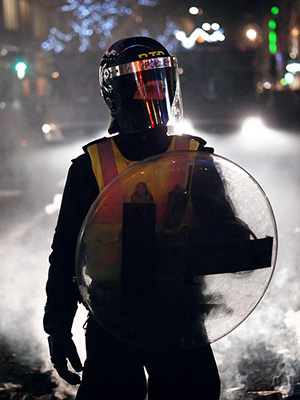 MEDIA ROOTS— As
people in the U.S. and abroad endeavour to exercise their rights and civil
liberties, such as the right to freedom of speech and peaceful assembly, the
state and its police forces continue finding methods to repress such civic activity. An important component of social control and repression of dissent has
been the curtailment of telecommunications.
MEDIA ROOTS— As
people in the U.S. and abroad endeavour to exercise their rights and civil
liberties, such as the right to freedom of speech and peaceful assembly, the
state and its police forces continue finding methods to repress such civic activity. An important component of social control and repression of dissent has
been the curtailment of telecommunications.
