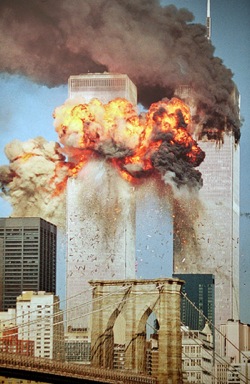
 WASHINGTON POST– Some staff members and commissioners of the Sept. 11 panel concluded that
the Pentagon’s initial story of how it reacted to the 2001 terrorist attacks
may have been part of a deliberate effort to mislead the commission and the
public rather than a reflection of the fog of events on that day, according to
sources involved in the debate.
WASHINGTON POST– Some staff members and commissioners of the Sept. 11 panel concluded that
the Pentagon’s initial story of how it reacted to the 2001 terrorist attacks
may have been part of a deliberate effort to mislead the commission and the
public rather than a reflection of the fog of events on that day, according to
sources involved in the debate.
Suspicion of wrongdoing ran so deep that the 10-member commission, in a
secret meeting at the end of its tenure in summer 2004, debated referring the
matter to the Justice Department for criminal investigation, according to
several commission sources. Staff members and some commissioners thought that
e-mails and other evidence provided enough probable cause to believe that
military and aviation officials violated the law by making false statements to
Congress and to the commission, hoping to hide the bungled response to the
hijackings, these sources said.
In the end, the panel agreed to a compromise, turning over the allegations
to the inspectors general for the Defense and Transportation departments, who
can make criminal referrals if they believe they are warranted, officials said.
“We to this day don’t know why NORAD [the North American Aerospace Command]
told us what they told us,” said Thomas H. Kean, the former New Jersey
Republican governor who led the commission. “It was just so far from the
truth. . . . It’s one of those loose ends that never got tied.”
Although the commission’s landmark report made it clear that the Defense
Department’s early versions of events on the day of the attacks were
inaccurate, the revelation that it considered criminal referrals reveals how
skeptically those reports were viewed by the panel and provides a glimpse of
the tension between it and the Bush administration.
A Pentagon spokesman said yesterday that the inspector general’s office will
soon release a report addressing whether testimony delivered to the commission
was “knowingly false.” A separate report, delivered secretly to
Congress in May 2005, blamed inaccuracies in part on problems with the way the
Defense Department kept its records, according to a summary released yesterday.
A spokesman for the Transportation Department’s inspector general’s office
said its investigation is complete and that a final report is being drafted.
Laura Brown, a spokeswoman for the Federal Aviation Administration, said she
could not comment on the inspector general’s inquiry.
In an article scheduled to be on newsstands today, Vanity Fair magazine
reports aspects of the commission debate — though it does not mention the
possible criminal referrals — and publishes lengthy excerpts from military
audiotapes recorded on Sept. 11. ABC News aired excerpts last night.
For more than two years after the attacks, officials with NORAD and the FAA
provided inaccurate information about the response to the hijackings in
testimony and media appearances. Authorities suggested that U.S.
air defenses had reacted quickly, that jets had been scrambled in response to
the last two hijackings and that fighters were prepared to shoot down United
Airlines Flight 93 if it threatened Washington.
In fact, the commission reported a year later, audiotapes from NORAD’s
Northeast headquarters and other evidence showed clearly that the military
never had any of the hijacked airliners in its sights and at one point chased a
phantom aircraft — American Airlines Flight 11 — long after it had crashed
into the World Trade
Center.
Maj. Gen. Larry Arnold and Col. Alan Scott told the commission that NORAD
had begun tracking United 93 at 9:16 a.m.,
but the commission determined that the airliner was not hijacked until 12
minutes later. The military was not aware of the flight until after it had
crashed in Pennsylvania.
These and other discrepancies did not become clear until the commission,
forced to use subpoenas, obtained audiotapes from the FAA and NORAD, officials
said. The agencies’ reluctance to release the tapes — along with e-mails,
erroneous public statements and other evidence — led some of the panel’s staff
members and commissioners to believe that authorities sought to mislead the
commission and the public about what happened on Sept. 11.
“I was shocked at how different the truth was from the way it was
described,” John Farmer, a former New Jersey
attorney general who led the staff inquiry into events on Sept. 11, said in a
recent interview. “The tapes told a radically different story from what
had been told to us and the public for two years. . . . This is not spin. This
is not true.”
Arnold, who could not be reached for comment yesterday, told the commission
in 2004 that he did not have all the information unearthed by the panel when he
testified earlier. Other military officials also denied any intent to mislead
the panel.
John F. Lehman, a Republican commission member and former Navy secretary,
said in a recent interview that he believed the panel may have been lied to but
that he did not believe the evidence was sufficient to support a criminal
referral.
“My view of that was that whether it was willful or just the fog of
stupid bureaucracy, I don’t know,” Lehman said. “But in the order of
magnitude of things, going after bureaucrats because they misled the commission
didn’t seem to make sense to me.”
By Dan Eggen, Washington Post Staff Writer
© 2006 The Washington Post Company
Photo by flickr user Cliff1066



 FOX NEWS– As it fights two wars, the Pentagon is steadily and dramatically increasing
the money it spends to win what it calls “the human terrain” of world
public opinion. In the process, it is raising concerns of spreading propaganda
at home in violation of federal law.
FOX NEWS– As it fights two wars, the Pentagon is steadily and dramatically increasing
the money it spends to win what it calls “the human terrain” of world
public opinion. In the process, it is raising concerns of spreading propaganda
at home in violation of federal law. WASHINGTON POST