No Ties Between al Qaeda and Iraq, Pentagon Says

CNN– The U.S. military’s first and only study looking into ties between Saddam Hussein’s Iraq and al Qaeda showed no connection between the two, according to a military report released by the Pentagon.

A U.S. soldier in front of a bus hit by a roadside bomb near Nasiriyah, southeast of Baghdad, Iraq, on Tuesday.

The report released by the Joint Forces Command five years after the U.S.-led invasion of Iraq said it found no “smoking gun” after reviewing about 600,000 Iraqi documents captured in the invasion and looking at interviews of key Iraqi leadership held by the United States, Pentagon officials said.

The assessment of the al Qaeda connection and the insistence that Hussein had weapons of mass destruction were two primary elements in the Bush administration’s arguments in favor of going to war with Iraq.

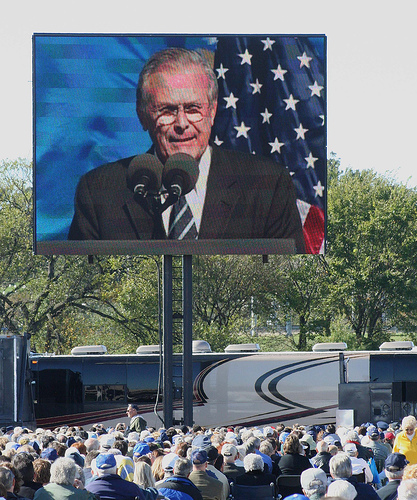
The Pentagon’s report also contradicts then-Secretary of Defense Donald Rumsfeld, who said in September 2002 that the CIA provided “bulletproof” evidence demonstrating “that there are, in fact, al Qaeda in Iraq.”

Although other groups, like the September 11 commission, have concluded that there was no link between Hussein and al Qaeda, the Pentagon was able to analyze much more information.

The documents cited in the report do reveal that Hussein supported a number of terrorists and terrorist activities inside and outside Iraq.

“The Iraqi regime was involved in regional and international terrorist operations prior to Operation Iraqi Freedom. The predominant targets of Iraqi state terror operations were Iraqi citizens, both inside and outside of Iraq,” according to the report. Read excerpts from report (pdf)

Most of the terrorism was aimed at keeping Hussein and his Baath party in power, according to Pentagon officials.

“State sponsorship of terrorism became such a routine tool of state power that Iraq developed elaborate bureaucratic processes to monitor progress and accountability in the recruiting, training and resourcing of terrorists,” according to the report.

The report cited such examples as training for car bombs and suicide bombings in 1999 and 2000, both of which U.S. and Iraqi forces have struggled to contain since the rise of the insurgency in summer 2003.

Photo by flickr user DBKing

© COPYRIGHT CNN, 2008

Khalid Sheikh Mohammed Waterboarded 183 times in One Month

TIMES ONLINE– CIA interrogators used the controverisal waterboarding technique 183 times on Khalid Sheikh Mohammed, the mastermind behind the September 11, 2001, attacks and 83 times on another al-Qaeda suspect, according to The New York Times.

A 2005 Justice Department memorandum revealed that the simulated drowning technique was used on Mohammed 183 times in March 2003.

Abu Zubaydah, the first prisoner questioned in the CIA’s overseas detention programme in August 2002, was waterboarded 83 times, although a former CIA officer had told news organisations that he had been subjected to only 35 seconds under water before agreeing to tell everything he knew.

President Barack Obama has banned the use of waterboarding, overturning a Bush Administration policy that it did not constitute torture.

The memo is one of four authorising “harsh interrogation” that were declassified by the Obama Administration last week. They show that the CIA based more than 3,000 intelligence reports on the questioning of “high-value” terror suspects from September 11, 2001, to April 2003.

Continue reading about Khalid Sheikh Mohammed being Waterboarded 183 Times.

© TIMES ONLINE, 2009

Marjorie Cohn: Prosecute War Criminals and Their Lawyers

TRUTHOUT– Since he took office, President Obama has instituted many changes that break with the policies of the Bush administration. The new president has ordered that no government agency will be allowed to torture, that the U.S. prison at Guantánamo will be shuttered, and that the CIA’s secret black sites will be closed down. But Obama is non-committal when asked whether he will seek investigation and prosecution of Bush officials who broke the law.

“My view is also that nobody’s above the law and, if there are clear instances of wrongdoing, that people should be prosecuted just like any ordinary citizen,” Obama said. “But,” he added, “generally speaking, I’m more interested in looking forward than I am in looking backwards.” Obama fears that holding Team Bush to account will risk alienating Republicans whom he still seeks to win over.

Obama may be off the hook, at least with respect to investigating the lawyers who advised the White House on how to torture and get away with it. The Office of Professional Responsibility (OPR) has written a draft report that apparently excoriates former Justice Department lawyers John Yoo and Jay Bybee, authors of the infamous torture memos, according to Newsweek’s Michael Isikoff.

OPR can report these lawyers to their state bar associations for possible discipline, or even refer them for criminal investigation. Obama doesn’t have to initiate investigations; the OPR has already launched them, on Bush’s watch.

The smoking gun that may incriminate George W. Bush, Dick Cheney, et al., is the email traffic that passed between the lawyers and the White House. Isikoff revealed the existence of these emails on The Rachel Maddow Show. Some maintain that Bush officials are innocent because they relied in good faith on legal advice from their lawyers. But if the president and vice president told the lawyers to manipulate the law to allow them to commit torture, then that defense won’t fly.

A bipartisan report of the Senate Armed Services Committee found that “senior officials in the United States government solicited information on how to use aggressive techniques, redefined the law to create the appearance of their legality, and authorized their use against detainees.”

Cheney recently admitted to authorizing waterboarding, which has long been considered torture under U.S. law. Donald Rumsfeld, Condoleezza Rice, George Tenet, Colin Powell, and John Ashcroft met with Cheney in the White House basement and authorized harsh interrogation techniques, including waterboarding, according to an ABC News report. When asked, Bush said he knew about it and approved.

John Yoo wrote in a Wall Street Journal oped that Bush “could even authorize waterboarding, which he did three times in the years after 9/11.”

A representative of the Justice Department promised that OPR’s report would be released sometime last November. But Bush’s attorney general Michael Mukasey objected to the draft. A final version will be presented to Attorney General Eric Holder. The administration will then have to decide whether to make it, and the emails, public and then how to proceed.

When the United States ratified the Convention Against Torture, we promised to extradite or prosecute those who commit, or are complicit in the commission, of torture. We have two federal criminal statutes for torture prosecutions – the Torture Statute and the War Crimes Act (torture is considered a war crime under U.S. law). The Torture Convention is unequivocal: nothing, including a state of war, can be invoked as a justification for torture.

Yoo redefined torture much more narrowly than U.S. law provides, and counseled the White House that it could evade prosecution under the War Crimes Act by claiming self-defense or necessity. Yoo knew or should have known of the Torture Convention’s absolute prohibition of torture.

There is precedent for holding lawyers criminally liable for giving legally erroneous advice that resulted in great physical or mental harm or death. In U.S. v. Altstoetter, Nazi lawyers were convicted of war crimes and crimes against humanity for advising Hitler on how to “legally” disappear political suspects to special detention camps.

Almost two-thirds of respondents to a USA Today/Gallup Poll favor investigations of the Bush team for torture and warrantless wiretapping. Nearly four in 10 favor criminal investigations. Cong. John Conyers has introduced legislation to establish a National Commission on Presidential War Powers and Civil Liberties. Sen. Patrick Leahy advocates for a Truth and Reconciliation Commission; but this is insufficient. TRC’s are used for nascent democracies in transition. By giving immunity to those who testify before them, it would ensure that those responsible for torture, abuse and illegal spying will never be brought to justice.

Attorney General Eric Holder should appoint a Special Prosecutor to investigate and prosecute high Bush officials including lawyers like John Yoo who gave them “legal” cover. Obama is correct when he said that no one is above the law. Accountability is critical to ensuring that our leaders never again torture and abuse people.

Written by Marjorie Cohn, President of the National Lawyers Guild

© TRUTHOUT 2009

Obama Advisers Say No Charges Against Those Who Authorized Torture

TRUTHOUT– Barack Obama’s incoming administration is unlikely to bring criminal charges against government officials who authorized or engaged in harsh interrogations of suspected terrorists during the George W. Bush presidency. Obama, who has criticized the use of torture, is being urged by some constitutional scholars and human rights groups to investigate possible war crimes by the Bush administration.

Two Obama advisers said there’s little – if any – chance that the incoming president’s Justice Department will go after anyone involved in authorizing or carrying out interrogations that provoked worldwide outrage.

The advisers spoke on condition of anonymity because the plans are still tentative. A spokesman for Obama’s transition team did not respond to requests for comment Monday.

Additionally, the question of whether to prosecute may never become an issue if Bush issues pre-emptive pardons to protect those involved.

Obama has committed to reviewing interrogations on al-Qaida and other terror suspects. After he takes office in January, Obama is expected to create a panel modeled after the 9/11 Commission to study interrogations, including those using waterboarding and other tactics that critics call torture. The panel’s findings would be used to ensure that future interrogations are undisputedly legal.

“I have said repeatedly that America doesn’t torture, and I’m going to make sure that we don’t torture,” Obama said Sunday on CBS’ “60 Minutes.” “Those are part and parcel of an effort to regain America’s moral stature in the world.”

Obama’s most ardent supporters are split on whether he should prosecute Bush officials.

Asked this weekend during a Vermont Public Radio interview if Bush administration officials would face war crimes, Senate Judiciary Chairman Patrick Leahy flatly said, “In the United States, no.”

“These things are not going to happen,” said Leahy, D-Vt.

Robert Litt, a former top Clinton administration Justice Department prosecutor, said Obama should focus on moving forward with anti-torture policy instead of looking back.

“Both for policy and political reasons, it would not be beneficial to spend a lot of time hauling people up before Congress or before grand juries and going over what went on,” Litt said at a Brookings Institution discussion about Obama’s legal policy. “To as great of an extent we can say, the last eight years are over, now we can move forward – that would be beneficial both to the country and the president, politically.”

But Michael Ratner, a professor at Columbia Law School and president of the Center for Constitutional Rights, said prosecuting Bush officials is necessary to set future anti-torture policy.

“The only way to prevent this from happening again is to make sure that those who were responsible for the torture program pay the price for it,” Ratner said. “I don’t see how we regain our moral stature by allowing those who were intimately involved in the torture programs to simply walk off the stage and lead lives where they are not held accountable.”

In the years after the Sept. 11, 2001, terror attacks, the White House authorized U.S. interrogators to use harsh tactics on captured al-Qaida and Taliban suspects. Bush officials relied on a 2002 Justice Department legal memo to assert that its interrogations did not amount to torture – and therefore did not violate U.S. or international laws. That memo has since been rescinded.

At least three top al-Qaida operatives – including 9/11 mastermind Khalid Sheik Mohammed – were waterboarded in 2002 and 2003 because of intelligence officials’ belief that more attacks were imminent. Waterboarding creates the sensation of drowning, and has been traced back hundreds of years and is condemned by nations worldwide.

Bush could take the issue of criminal charges off the table with one stroke of his pardons pen. Whether Bush will protect his top aides and interrogators with a pre-emptive pardon – before they are ever charged – has become a hot topic of discussion in legal and political circles in the administration’s waning days. White House deputy press secretary Tony Fratto declined to comment on the issue.

Under the Constitution, the president’s power to issue pardons is absolute and cannot be overruled.

Pre-emptive pardons would be highly controversial, but former White House counsel Arthur B. Culvahouse Jr. said it would protect those who were following orders or otherwise trying to protect the nation.

“I know of no one who acted in reckless disregard of U.S. law or international law,” said Culvahouse, who served under President Ronald Reagan. “It’s just not good for the intelligence community and the defense community to have people in the field, under exigent circumstances, being told these are the rules, to be exposed months and years after the fact to criminal prosecution.”

The Federalist Papers discourage presidents from pardoning themselves. It took former President Gerald Ford to clear former President Richard Nixon of wrongdoing in the 1972 Watergate break-in.

All republished content that appears on Truthout has been obtained by permission or license.

© TRUTHOUT 2008

Top Bush Advisers Approved Enhanced Interrogation

ABC NEWS– In dozens of top-secret talks and meetings in the White House, the most senior Bush administration officials discussed and approved specific details of how high-value al Qaeda suspects would be interrogated by the Central Intelligence Agency, sources tell ABC News.

The so-called Principals who participated in the meetings also approved the use of “combined” interrogation techniques — using different techniques during interrogations, instead of using one method at a time — on terrorist suspects who proved difficult to break, sources said.

Highly placed sources said a handful of top advisers signed off on how the CIA would interrogate top al Qaeda suspects — whether they would be slapped, pushed, deprived of sleep or subjected to simulated drowning, called waterboarding.

The high-level discussions about these “enhanced interrogation techniques” were so detailed, these sources said, some of the interrogation sessions were almost choreographed — down to the number of times CIA agents could use a specific tactic.

The advisers were members of the National Security Council’s Principals Committee, a select group of senior officials who met frequently to advise President Bush on issues of national security policy.

At the time, the Principals Committee included Vice President Cheney, former National Security Advisor Condoleezza Rice, Defense Secretary Donald Rumsfeld and Secretary of State Colin Powell, as well as CIA Director George Tenet and Attorney General John Ashcroft.

Continue article about the Approval of Enhanced Interrogation.

© ABC NEWS 2008