Bush Received PDB Month Before 9/11: Bin Laden Determined to Strike Within US

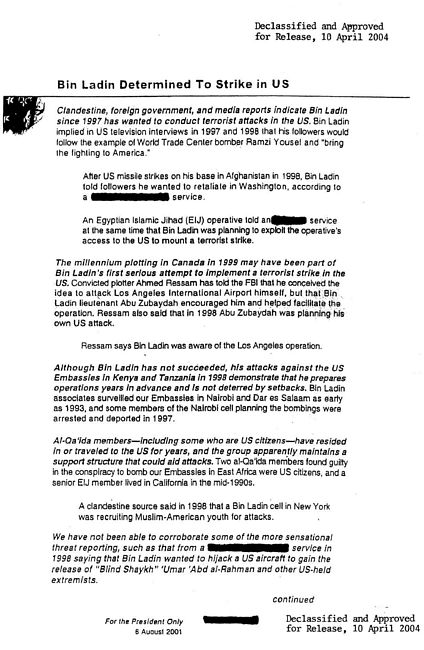
CNN– The White House declassified and released Saturday the daily intelligence briefing delivered to President Bush a month before the terrorist attacks of September 11, 2001.

The declassified intelligence report said the FBI had detected “patterns of suspicious activity in this country consistent with preparations for hijackings.”

The names of countries that supplied the CIA with intelligence have been removed from the memo dealing with Osama bin Laden’s al Qaeda network and dated August 6, 2001.

“We have not been able to corroborate some of the more sensational threat reporting, such as that from a [redacted] service in 1998 saying that bin Laden wanted to hijack a U.S. aircraft to secure the release of ‘Blind Sheikh’ Omar Abdel Rahman and other U.S.-held extremists,” the memo says in part.

Rahman is serving a life sentence for conspiring to assassinate Egyptian President Hosni Mubarak and to blow up New York landmarks.

The White House said the presidential daily briefing, or PDB, was requested by Bush, who sought information about the possibility of an al Qaeda attack in the United States.

“The PDB article did not warn of the 9/11 attacks,” the White House said in a statement released Saturday night. “Although the PDB referred to the possibility of hijackings, it did not discuss the possible use of planes as weapons.”

The memo, titled “Bin Laden determined to attack inside the U.S.,” had been described by the White House as a largely historical document with scant information about domestic al Qaeda threats.

The memo includes intelligence on al Qaeda threats as recent as three months before the attacks.

Continue reading about Bush Received PDB Month Before 9/11: Bin Laden Determined to Strike Within US.

© 2004 CNN

U.S. Uses Terror Law to Pursue Crimes From Drugs to Swindling

NEW YORK TIMES– The Bush administration, which calls the USA Patriot Act perhaps its most essential tool in fighting terrorists, has begun using the law with increasing frequency in many criminal investigations that have little or no connection to terrorism.

The government is using its expanded authority under the far-reaching law to investigate suspected drug traffickers, white-collar criminals, blackmailers, child pornographers, money launderers, spies and even corrupt foreign leaders, federal officials said.

Justice Department officials say they are simply using all the tools now available to them to pursue criminals- terrorists or otherwise.

But critics of the administration’s antiterrorism tactics assert that such use of the law is evidence the administration is using terrorism as a guise to pursue a broader law enforcement agenda. Justice Department officials point out that they have employed their newfound powers in many instances against suspected terrorists.

With the new law breaking down the wall between intelligence and criminal investigations, the Justice Department in February was able to bring terrorism-related charges against a Florida professor, for example, and it has used its expanded surveillance powers to move against several suspected terrorist cells.

But a new Justice Department report, given to members of Congress this month, also cites more than a dozen cases that are not directly related to terrorism in which federal authorities have used their expanded power to investigate individuals, initiate wiretaps and other surveillance, or seize millions in tainted assets.

For instance, the ability to secure nationwide warrants to obtain e-mail and electronic evidence ”has proved invaluable in several sensitive nonterrorism investigations,” including the tracking of an unidentified fugitive and an investigation into a computer hacker who stole a company’s trade secrets, the report said.

Justice Department officials said the cases cited in the report represent only a small sampling of the many hundreds of nonterrorism cases pursued under the law.

The authorities have also used toughened penalties under the law to press charges against a lovesick 20-year-old woman from Orange County, Calif., who planted threatening notes aboard a Hawaii-bound cruise ship she was traveling on with her family in May. The woman, who said she made the threats to try to return home to her boyfriend, was sentenced this week to two years in federal prison because of a provision in the Patriot Act on the threat of terrorism against mass transportation systems.

And officials said they had used their expanded authority to track private Internet communications in order to investigate a major drug distributor, a four-time killer, an identity thief and a fugitive who fled on the eve of trial by using a fake passport.

In one case, an e-mail provider disclosed information that allowed federal authorities to apprehend two suspects who had threatened to kill executives at a foreign corporation unless they were paid a hefty ransom, officials said. Previously, they said, gray areas in the law made it difficult to get such global Internet and computer data.

The law passed by Congress just five weeks after the terror attacks of Sept. 11, 2001, has proved a particularly powerful tool in pursuing financial crimes.

Officials with the Bureau of Immigration and Customs Enforcement have seen a sharp spike in investigations as a result of their expanded powers, officials said in interviews.

A senior official said investigators in the last two years had seized about $35 million at American borders in undeclared cash, checks and currency being smuggled out of the country. That was a significant increase over the past few years, the official said. While the authorities say they suspect that large amounts of the smuggled cash may have been intended to finance Middle Eastern terrorists, much of it involved drug smuggling, corporate fraud and other crimes not directly related to terrorism.

The terrorism law allows the authorities to investigate cash smuggling cases more aggressively and to seek stiffer penalties by elevating them from what had been mere reporting failures.

Obama Channels Cheney in Regards to Presidential Powers

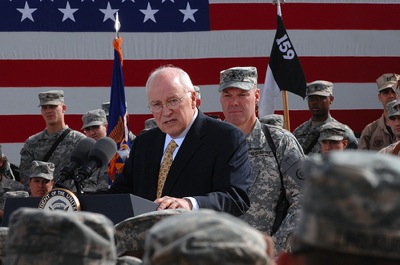
WALL STREET JOURNAL– The Obama Administration this week released its predecessor’s post-9/11 legal memoranda in the name of “transparency,” producing another round of feel-good Bush criticism. Anyone interested in President Obama’s actual executive-power policies, however, should look at his position on warrantless wiretapping. Dick Cheney must be smiling.

In a federal lawsuit, the Obama legal team is arguing that judges lack the authority to enforce their own rulings in classified matters of national security. The standoff concerns the Oregon chapter of the Al-Haramain Islamic Foundation, a Saudi Arabian charity that was shut down in 2004 on evidence that it was financing al Qaeda. Al-Haramain sued the Bush Administration in 2005, claiming it had been illegally wiretapped.

At the heart of Al-Haramain’s case is a classified document that it says proves that the alleged eavesdropping was not authorized under the Foreign Intelligence Surveillance Act, or FISA. That record was inadvertently disclosed after Al-Haramain was designated as a terrorist organization; the Bush Administration declared such documents state secrets after their existence became known.

In July, the Ninth Circuit Court of Appeals upheld the President’s right to do so, which should have ended the matter. But the San Francisco panel also returned the case to the presiding district court judge, Vaughn Walker, ordering him to decide if FISA pre-empts the state secrets privilege. If he does, Al-Haramain would be allowed to use the document to establish the standing to litigate.

The Obama Justice Department has adopted a legal stance identical to, if not more aggressive than, the Bush version. It argues that the court-forced disclosure of the surveillance programs would cause “exceptional harm to national security” by exposing intelligence sources and methods. Last Friday the Ninth Circuit denied the latest emergency motion to dismiss, again kicking matters back to Judge Walker.

Continue reading about Obama Channeling Cheney.

© WALL STREET JOURNAL 2009

Photo by flickr user US Army

Despite Rhetoric, Obama Continues Bush Policy on Detainees

RAW STORY– In a stunning departure from his rhetoric on Guantánamo Bay prison, President Barack Obama signaled Friday he will continue Bush Administration policy with regard to detainees held at a US airbase in Afghanistan, saying they have no right to challenge their detentions in US courts — and denying them legal status altogether.

“This Court’s Order of January 22, 2009 invited the Government to inform the Court by February 20, 2009, whether it intends to refine its position on whether the Court has jurisdiction over habeas petitions filed by detainees held at the United States military base in Bagram, Afghanistan,” Acting Assistant Obama Attorney General Michael Hertz wrote in a brief filed Friday. “Having considered the matter, the Government adheres to its previously articulated position.”

The move seems to be a reversal from Obama’s much-trumpeted announcement to close the US prison at Guantánamo Bay, Cuba in January, in which he promised to return the United States to the “moral high ground” and “restore the standards of due process”

The US Supreme Court previously ruled that it was unconstitutional to hold detainees at Guantánamo Bay without giving them access to US courts. Following that ruling, more than 200 detainees filed suit in the District Court for the District of Columbia.

The Obama Administration announcement would appear to fly in the face of that ruling. The Court, while often supportive of previous Bush Administration terror policies, has strongly resisted efforts to curb its role in the legal aspect of US detention systems.

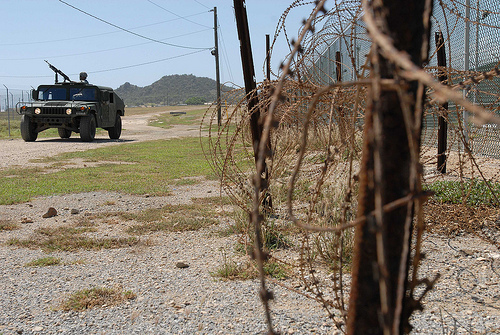
Bagram prison, where approximately 600 detainees are being held without charge or even term limits on their stay, is located about 30 miles north of Kabul in a converted Soviet Union base. The US is mulling a $60 million plan to expand the facility, which would double its current size.

Continue reading about Obama Continuing Bush’s Policy on Detainees.

Photo by US Army Flickr

© RAW STORY, 2009

Obama Justice Department Defends Rumsfeld in Torture Case

RAW STORY– In a brief filed Thursday evening, Obama Justice Department lawyers extended many of the same arguments made by Bush attorneys — that top government officials have qualified immunity from prosecution and that Guantanamo detainees do not have constitutional rights to due process.

The Department of Justice has asserted that a Supreme Court ruling reaffirming the rights of Guantanamo detainees to habeas corpus does not apply to plaintiffs in a case against former Secretary of Defense Donald Rumsfeld because the plaintiffs were released from prison four years prior to the Supreme Court’s decision.

“It is fair to say that the current brief that is filed by the new administration supports a lot of the arguments that were made by the previous administration,” said Kate Toomey, an attorney with Baach Robinson & Lewis who is representing the former detainees in an interview with RAW STORY. “They continue to assert that torture was in the scope of employment and could be reasonably expected. They continue to assert that these [top officials] be entitled to immunity. They also continue to argue that detainees at Guantanamo don’t have constitutional rights.”

The brief was filed as part of the Rasul v. Rumsfeld lawsuit of four former detainees, who include the “Tipton Three,” and are seeking damages for their detention and reported torture at Guantanamo Bay against Rumsfeld, the Chairmen of the Joint Chief of Staffs and other top military officials. The suit charges them with violations of the Fifth and Eighth Amendments, the Alien Tort Statute, the Geneva Conventions and the Religious Freedom Restoration Act. The plaintiffs are individually each seeking $10 million in damages.

The men were held for more than two years at Guantanamo where they were reportedly subjected to regular beatings, death threats, sleep deprivation, extreme temperatures, forced nakedness, interrogations at gun point and religious and racial harassment. They were never charged with any crime. The men were released in March 2004 and returned to their home country of Britain.

The plaintiffs are also being represented by the Center for Constitutional Rights, which has a full background of the case, including all court documents here.

Read full story about Obama Defending Rumsfeld in Torture Case.

© RAW STORY 2009