Will Getting Dumped Affect Your Next Relationship?

MEDIA ROOTS- In an ideal world, your partner would not judge you based on the way your last relationship ended. Unfortunately, as a recent study in the scientific journal Evolutionary Psychology discovered, the real world is a little different.

It is no surprise that neither men nor women find their partners more attractive after discovering that they were on the receiving end of their last break-ups. The flip-side, however, is a different story.

According to the study, titled “Rejection Hurts: The Effect of Being Dumped on Subsequent Mating Efforts,” the average woman actually finds her partner more attractive after discovering that he initiated the split with his last partner.

The subjects of the study rated fictional personal ads for individuals of their genders of choice before and after they learned whether the fictional people had dumped their last partners, had been dumped, or refused to say. According to the results, nobody will like you better if you’ve been dumped, and nobody will like you better if you won’t tell – but women will like you better if you were the one to end your last relationship.

As with any scientific study, this does not apply to everyone; it merely points out a trend. And the trend, in this case, appears to be that you can’t win with men no matter what you do, and you can only win with women by breaking someone’s heart.

Don’t come to any conclusions about what you should do with your current relationship just because of this study; all of the differences in preference were relatively minor. But if you date women, and you expect your current relationship to end soon, you might want to consider doing the dirty work yourself. It may help you in the long run.

Mitchell Singer is an SFSU undergraduate student with a great interest in all types of verbal expression. Aside from newswriting, blogging, and freelance copywriting, he spends his time sampling different media of visual art and reading books on a variety of subjects.

Photo by flickr user oedipusphinx

Jill Bolte Taylor’s Stroke of Insight

TED– One morning, a blood vessel in Jill Bolte Taylor’s brain exploded. As a brain scientist, she realized she had a ringside seat to her own stroke. She watched as her brain functions shut down one by one: motion, speech, memory, self-awareness…

Amazed to find herself alive, Taylor spent eight years recovering her ability to think, walk and talk. She has become a spokesperson for stroke recovery and for the possibility of coming back from brain injury stronger than before. In her case, although the stroke damaged the left side of her brain, her recovery unleashed a torrent of creative energy from her right. From her home base in Indiana, she now travels the country on behalf of the Harvard Brain Bank as the “Singin’ Scientist.”

© TED, 2008

Photo by flickr user brain_blogger

10 Things You Didn’t Know About the Brain

LIVE SCIENCE – Ten things you didn’t know about the brain…

10. Human brains are big…

The average adult brain weighs just under 3 pounds (between 1.3 and 1.4 kilograms). Some neurosurgeons describe the texture of a living brain as that of toothpaste, but according to neurosurgeon Katrina Firlik, a better analogy can be found in the local health-food store.

“[The brain] doesn’t spread like toothpaste. It doesn’t adhere to your fingers the way toothpaste does,” Firlik writes in her memoir, “Another Day in the Frontal Lobe: A Brain Surgeon Exposes Life on the Inside” (Random House, 2006). “Tofu — the soft variety, if you know tofu — may be a more accurate comparison.”

If you aren’t charmed by that description, consider this: About 80 percent of the contents of your cranium is brain, while equal amounts of blood and cerebrospinal fluid, the clear liquid that buffers neural tissue, make up the rest. If you were to blend up all of that brain, blood and fluid, it would come to about 1.7 liters, or not quite enough to fill a 2-liter soda bottle.

9. …But they’re getting smaller

Don’t get too cocky about your soda-bottle-sized brain. Humans 5,000 years ago had brains that were even larger.

Continue reading about 10 Things You Didn’t Know About the Brain.

© Copyright Live Science, 2011

Photograph by moujemouje

Computers that Read Minds are Being Developed by Intel

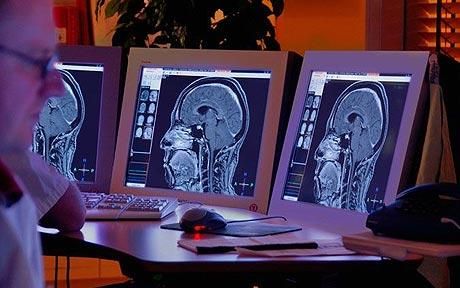
TELEGRAPH– Unlike current brain-controlled computers, which require users to imagine making physical movements to control a cursor on a screen, the new technology will be capable of directly interpreting words as they are thought.

Intel’s scientists are creating detailed maps of the activity in the brain for individual words which can then be matched against the brain activity of someone using the computer, allowing the machine to determine the word they are thinking.

Preliminary tests of the system have shown that the computer can work out words by looking at similar brain patterns and looking for key differences that suggest what the word might be.

Dean Pomerleau, a senior researcher at Intel Laboratories, said that currently, the devices required to get sufficient detail of brain activity were bulky, expensive magnetic resonance scanners, like those used in hospitals.

But he said work was under way to produce smaller pieces of equipment that can be worn as headsets and that can produce the same level of detail.

Continue reading about Computers that Read Minds are Being Developed by Intel.

© Telegraph, 2010

Photo by ALAMY

IBM Researchers Create the Most Detailed Brain Map Yet

brainPOPSCI– Researchers at IBM have created the most complex neurological map ever seen, detailing the comprehensive long-distance network that makes up the macaque monkey brain in unprecedented detail. Such a roadmap through the brain’s complex networking processes could have major implications for attempts at reverse-engineering neural networks and creating cognitive computer chips that “think” as powerfully and efficiently as the biological brain.

Focusing on a long-distance network connecting 383 brain regions and 6,602 long-distance connections that function like highways to connect disparate regions of the brain. Shorter, more localized connections were found to carry signals within regions.

But most importantly, they found what they describe in a paper published in PNAS as a “tightly integrated core” that might be they key to cognition in higher-thinking biological creatures. That core might be what gives us consciousness (we won’t get into the philosophical implications there). Further, the core isn’t located in one, or even two regions. The researchers found it stretches through the premotor cortex, prefrontal cortex, temporal lobe, thalamus, visual cortex and a handful of other regions.

Continue reading about IBM Researchers Create the Most Detailed Brain Map Yet.

© POPSCI, 2010

Photo by flickr user ky_olsen