 MEDIA ROOTS- In 2002, Jeanmarie Simpson co-adapted the
book, Amigas: Letters of Friendship and Exile, a chronicle of
correspondence between two Chilean friends separated during the Pinochet
era. The theatre adaptation, Amigas, won a 2003 grant from the National
Endowment for the Arts.
MEDIA ROOTS- In 2002, Jeanmarie Simpson co-adapted the
book, Amigas: Letters of Friendship and Exile, a chronicle of
correspondence between two Chilean friends separated during the Pinochet
era. The theatre adaptation, Amigas, won a 2003 grant from the National
Endowment for the Arts.
Later that year, Simpson stumbled across a reference to Jeannette Rankin,
lifelong pacifist and the first and only US Congresswoman who voted against US entry
into both world wars. Her discovery of Rankin led to the production of A Single Woman, a play that toured worldwide and was subsequently made into a a film featuring the talents of Martin Sheen, Patricia Arquette, Peter Coyote, Judd Nelson and Joni Mitchell.
In 2008 Simpson co-adapted another
book called Powder: Writing by Women in the Ranks from Vietnam to Iraq into a
solo piece called Coming in Hot. She has performed the show dozens of times
in Arizona, California, Washington and Nevada and has garnered rave reviews on Huffington Post. A documentary film about the play is currently in production.
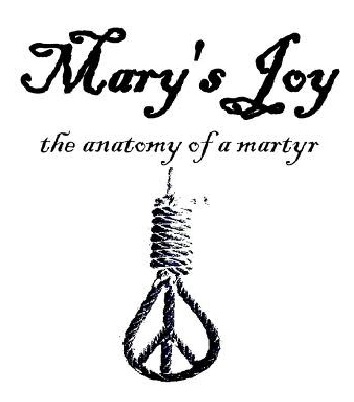
Simpson’s newest solo play, Mary’s Joy: The Anatomy
of a Martyr, is ready to meet the public and has already been performed at a school at CU Boulder. I had the honor of sitting down with Jeanmarie Simpson and getting some insight on her work, art, and what it means to be a self proclaimed “artivist”.
***
Cynthia Schwartz: How do you choose your characters? How do you decide whose
lives are expansive enough, or interesting enough that you could step
inside them and actually become that person on stage?
Jeanmarie Simpson: I guess it’s my enthusiasm for clarity and justice and my
feminist heart that leads me to the characters I want to write about and
play. I love that these women speak for me, they’re a joy to make a
case for, as an artist, because I am so moved by them and their lives.
CS: When you get something back from the audience, does that
feed you not only as an actor, but do the characters respond differently
during different performances?
JS: Absolutely. My work is deeply responsive to the energy in a
room. When the audience is lively and engaged from the get-go, then so
is the character. When an audience is more subdued, the performance will
be sensitive to that and not seek to overwhelm them right off the bat.
That’s the beauty of live performance. It’s an intimate communication. I
feel so honored every time anyone is willing to sit and watch and/or
listen to me for two hours.
CS: Tell us about Mary Dyer. She was hanged for being a Quaker?
JS: Yes. She was hanged on June 1, 1660, for being a Quaker in
Boston, specifically. She had been banished and kept returning.
CS: The play is subtitled “the anatomy of a martyr.” Can you dissect that for us?
JS: Sure. Whenever an event as dramatic as an execution
happens, people become very interested in the “why” of it, and become really
curious about the background of the person. We, as a species, seem to be
fascinated by criminals who are killed by the state – I mean look at
all the documentaries and TV shows that go over every little detail of
their childhoods, etc. In Mary’s case, I was deeply intrigued by
the notion of a colonial woman with six living children, one of them an
infant, getting on a ship alone and going back to England for seven
years. I knew she was one of the first Quakers and that she was hanged
by the Puritans in Boston, but it’s her relationship with her husband
and children that really hooked me- the trajectory of her life led
to such a scary ending. She was incredibly determined to get through to
the authorities, to turn their hearts, and that determination kept her
moving forward. She believed that if she kept advancing in the struggle,
something really beautiful would happen.
CS: Almost sounds like a suicide bomber.
JS: Hmmm. Yes. Maybe so, in terms of dying and believing in
something beyond death, but she didn’t take anyone else with her. She
wasn’t a killer.
CS: Many people view suicide as a selfish act. I can see how
some might say that Mary Dyer is profoundly selfish, leaving a husband
and all of those children behind to miss her and be left with such
horrible images of her death.
JS: True. That’s a theme that is very true, no matter when it
happens, today or 350 years ago. Without giving too much away, I think
when people see the show and hear Mary’s story, they’ll maybe gain some
understanding and a bit more compassion towards people who may be
dealing with depression or suicidal thoughts. To label those people as
selfish is really too easy. There is a community of complex human beings
who suffer from mental diseases and they are really punished for it, by
society in general. The stigma is much more powerful than is the the
movement to make sure there’s plenty of help
for troubled people. So many things can trigger chemical changes in the
brain that can lead to all kinds of disorders. I think anyone who lived
the life Mary Dyer lived would have been hard pressed not to become
disturbed.
CS: Is it also a religious play? Will I walk away wanting to become a Quaker?
JS: (Laughs) I don’t know- I don’t think so. It’s much more
about tolerance than it is any kind of missionary piece. Mary was always
driven by a deep belief that love and grace are more appropriate
expressions by clergy than totalitarianism marked by torture and
execution. She had an intense moral compass and couldn’t accept the
status quo. I hope that you’ll get a chance to see the show and meet her.
She’s really something.
CS: At this point you’re doing a series of dramatic readings rather than a full-blown production, is that correct?
JS: Yes. We’re going to be doing readings, collecting donations
and raising the money to stage the show in a theatre. We’re looking at
several different spaces. Meanwhile, we can raise a bit of awareness
about the Quakers and the Rocky Mountain Peace and Justice Center, here
in Boulder. They have been doing such great work for so long and they’re
always in need of support. Half of the proceeds will go to them, and
the other half will go to Universal Arts Boulder, a new company that a
group of us have started. This is a very exciting time of life for me,
that’s for sure.
***
Written by Cynthia Schwartz
Playwright and actor Jeanmarie Simpson’s one-woman show is called Mary’s Joy: The Anatomy of a Martyr and it’s currently playing in
Boulder, Colorado. For more information please visit universalartsboulder.wordpress.com
or jeanmariesimpson.wordpress.com.



 MEDIA ROOTS- In 2002, Jeanmarie Simpson co-adapted the
book,
MEDIA ROOTS- In 2002, Jeanmarie Simpson co-adapted the
book, 