


 MEDIA ROOTS – In the glory days of Rome, Julius Caesar came to understand that the masses could be pacified so long as they had plenty of food to eat and games to entertain them. It is said that while barbarians crashed at the city gates, Romans sat mesmerized by the displays of gratuitous violence in the Coliseum. Rome, like all empires eventually do, collapsed.
Welcome to the beginning of the end of the American empire. There are more than 44 million citizens on food stamps. Our televisions offer 700 channels to titillate and stimulate at all hours of the day while we flock to the latest Apple products, computers, mobile phones, electronic bells, whistles, and distractions. Meanwhile, Uncle Sam sent troops to more than 150 countries around the world and we are now entangled in military conflicts in Iraq, Afghanistan, Pakistan, and Libya, borrowing billions of dollars from China each day to keep the military machine going.
Stupefying. Where are the riots in the streets? Where are the nationwide protests? Somebody else will step up and fight for us, right?
Maybe we should take a little time to know the people who are fighting in the name of our country. Peter (pseudonym), a former Army Captain, 4th Infantry Division out of Fort Hood, recently contacted Media Roots to express how he had come to be disillusioned by the war on terror and the justifications for a U.S. presence in the Middle East:
“I just started to ask questions like: Why am I here wasting over a year of my early twenties? What is the real purpose behind this war? Why were there no WMDs? Why are soldiers outnumbered by civilian contractors almost 3 to 1?”
He also touched on alarming suicide rates, saying “…the brigade I was in on led the army in suicide rates during 2006 and 2007” and also described Fort Hood as plagued by “high crime, gangs within units, drug dealing in the barracks, bad stuff going on.”
During Peter’s tenure, the divorce rate among married soldiers “topped out at over 80%” and the Army’s maddening stop-loss policy wasn’t helping matters. With stop-loss, soldiers are forced into service past their contractual obligations.
We wanted to get to know Peter, and he was kind enough to talk more in depth in an exclusive Media Roots interview.
***
MR: Why did you join the military?
P: I went on active duty after graduating college when I was 22 to pay back my Army ROTC scholarship commitment. I joined mainly because I wanted to do something exciting and challenging instead of just being a typical college student majoring in business or something boring like that. I also needed a way to pay my tuition. The army agreed to pay all my tuition and fees and in return after graduating I would commission as a 2nd Lieutenant and serve at least 4 years active duty.
MR: What have you done in the service thus far and where has it taken you?
P: I served as a security platoon leader (convoy escort/VIP escort type of thing), company executive officer (2nd in command of over 200 soldiers), and a battalion assistant operations officer (higher level staff mission planning). I served one tour with the 4th Infantry Division for 13 months out of FOB [Forward Operating Base] Falcon in southern Baghdad.
MR: At what point did you start asking the kinds of questions that facilitated your political awakening?
P: When I joined up and for my first year-and-a-half of service I thought Bush and Cheney were doing the right things and keeping us safe. I felt I needed to do my part to fight Islamic extremism. My brigade was one of the last “surge” brigades to go into Baghdad. I first started to ask questions probably my first time outside the wire, maybe my third day on the ground there. The outgoing unit was showing us our OE [Operating Environment] and the main routes they used. I saw how we had basically reduced Baghdad into a cesspool of trash, sewage, rubble, and mud holes as well as displaced thousands of people from their homes. I then noticed around the FOB that civilian contractors from KBR, Raytheon, General Dynamics, etc. outnumbered actual soldiers about 3:1. I thought all this was odd as many of the civilians freely explained how much money they were making by being there, mostly in the six figures + range.
When I was moved to the position of company executive officer, I was in charge of acquiring the new MRAP [Mine Resistant Ambush Protected] vehicles up at Victory Base Complex [VBC, the huge base surrounding Saddam’s palaces and Baghdad airport]. We already had more than enough vehicles and the soldiers in my company said they preferred to use the humvee as opposed to the new MRAP. Nonetheless, we had to follow orders and I ended up leading at least five or six missions to VBC where we would pick up these brand new vehicles for the Battalion to use. While at VBC, I had the pleasure of dealing with attitude-ridden, overpaid civilian contractors who issued us the new vehicles. I also noticed the sheer abundance of the new MRAPs around the complex. I’m talking thousands and thousands of brand new vehicles just sitting in a lot, not being used. I couldn’t help but imagine the cost of making all these huge armored trucks, let alone the cost of shipping all of them thousands of miles overseas to Iraq.
In the end, my company signed for and was responsible for over 35 of these new vehicles and all of their associated equipment. They added to our existing fleet of over 60 vehicles already on the FOB of the older humvees and LMTVs for a grand total of over 95 combat vehicles. So a company-sized element now had a Battalion’s worth of vehicles and equipment. Needless to say we only used about 15% of our vehicles on missions and the rest sat there collecting dust, an absolute waste of resources.
The other thing is that my company commander had to sign for all that sensitive equipment and I was responsible for managing it for him. That means it was his ass and my ass when something went missing. So, if a private leaves a $5,000 handheld radio in a porta-potty on accident and no one can find it then ultimately it is the company commander’s fault. So there would be a big investigation as to why the radio was lost and who was at fault, ending in someone, probably the company commander, having to pay out of his pocket for that missing radio since Uncle Sam always gets his. Meanwhile, Donald Rumsfeld and the Pentagon can have $3 trillion in unaccounted for spending and nothing is done about it. But the junior level army commander has the keep track of all of his property, down to the smallest weapon mount or rifle scope, and will pay for whatever is lost. All of this stuff was the spark that made me start asking questions and looking into things more. Once we got some Internet hooked up in my room on the FOB, I started looking into Ron Paul and Alex Jones type of stuff.
MR: Do you think that the threat of terrorism is exaggerated? Do you feel that the US is engaging in countries abroad to genuinely combat terrorism?
P: I did not want to believe it for the longest time but I am now sure that the terrorism threat is grossly exaggerated and it has all been staged from the beginning, most likely from our own CIA. These wars are not for combating terrorism, but for control of resources and power. It is all used as a tool for profit for international banking interests as well as all the large defense contractors. We were lied to about WMDs to get us into the war in Iraq just as we were lied to about the Gulf of Tonkin incident to get us into Vietnam.
MR: What do you think of the Army as an institution overall?
P: The Army is a good institution overall. It is a great thing for people who are trying to better themselves, get money for college, and challenge themselves. The people I served with, aside from high-level leadership like Gen. Casey and Adm. Mullen, are honorable, caring people who are just trying to do the right thing or are just trying to make a living.
In my experience, most people in the Army aren’t that concerned about the politics behind everything. They are there to do a job, better themselves and make a paycheck or they just like being a soldier and doing cool stuff like shooting machine guns and driving tanks. A lot of soldiers know the wars are a bunch of BS but with the economy so bad they have no choice but to stay in since the pay is so good now.
MR: Is the importance of strict adherence to the Constitution emphasized in the Army?
P: No, it is only mentioned in the oath of enlistment. Most enlisted soldiers have no idea what it truly means.
MR: Do you think a free press and free speech are especially important during times of war?
P: Yes, always.
MR: How would you compare World War 2 and the Vietnam War to the War on Terror?
P: WW2 at least had a known enemy and soldiers knew they were there to liberate Europe, close concentration camps and then go home when the job was done. The whole country was involved as well because of the draft and the women working in the tank and aircraft factories. It was a war with clearer objectives and politics, a good vs. evil. I don’t think it is similar at all to the wars we are in now.
Vietnam is similar in that it began as a result of a false-flag attack (Gulf of Tonkin) and was all a political, elite banker, defense contractor agenda. Kissinger, Lyndon Johnson, CIA, MacNamara—all wanted to go to war and they wanted it to last for a long time so they made the American people fear the spread of communism. That is why there was no clear objective set, strict rules of engagement established, etc. This was a war for international bankers and defense contractors to profit off of while strategically accomplishing nothing and allowing the size of government to expand.
The Wars on Terror were started because of the false flag 9/11 attack and instilled a sense of fear and vengeance among all Americans. I believe these wars had been planned for a long time by globalist neo-cons Rumsfeld, Wolfowitz, Cheney, Bush Jr. and Sr. The other thing about this war is that it is fought by an all-volunteer force of only 0.1% of Americans. The other 99.9% is not directly affected by the war and that is why there is not as much outrage and opposition to it. When I watched TV in our dining facility in Iraq it seemed like America was oblivious to us being over there fighting insurgents. All that was on the news was Anna Nicole Smith, Britney Spears, American Idol, etc. It makes you think, why am I here wasting my time if no one cares?
MR: You said only .1% of Americans serve in the military. Do you think that the stop-loss policy and tour extensions are due to the administration’s attempts at preventing a draft in any way possible, despite the escalation of engagement?
P: Yes, they are a result of not having a draft. I think if there had been a draft a lot more Americans would be affected by the wars and there would be a greater push to end them, as more people would have to sacrifice.
MR: You mentioned that the rate of contractors to soldiers on the ground was 3:1. How are they helping?
P: They don’t do much except take up space. They do jobs that the Army can’t do because we are so strapped for personnel. Normally the Army has its own cooks, laundry people, construction workers, etc. as all enlisted soldiers. Since we are so short on manpower, those support-role soldiers are all used on missions outside the wire and the contractors come in and fill those support jobs and are paid a lot more money to do them. So if you signed up for the Army thinking you were going to be a cook and not see any combat, you better think again because all the cooks in my battalion went on missions outside the wire.
MR: What is a “non-combat” troop? Is the idea that we are scaling down a front?
P: It is just a political term. We don’t have “non-combat” troops. Everyone goes to combat. Everyone carries a weapon. The term is meant to dupe the American people into thinking we are drawing down. I know they have closed the smaller FOBs like Falcon (where I was stationed) but I am sure we will remain at Victory Base Complex for at least fifty years. Iraq will be just like South Korea and Germany. We will be there forever.
***
To touch on a few of Peter’s points, Defense Secretary Gates announced the start of a phased ending of the hugely unpopular stop-loss policy back in March 2009, and the Army’s goal was to completely eliminate the need for stop-loss by March 2011. It is now April 2011, and we are still waiting. Secondly, the Army announced earlier this year that 343 soldiers and personnel took their own lives in 2010. That’s nearly one a day. Thirdly, an FBI report released last year entitled Gang Activity in the U.S. Armed Forces Increasing revealed that members of every major street gang, from Crips to Bloods to Gangster Disciples have members enlisted in the military at installations at home and abroad. Army recruiters have been found to look the other way when it comes to dealing with known gang members in order to meet recruitment quotas.
Bear in mind that Peter does not speak for all men and women in uniform, but he makes no such claim. If nothing else, we can view his testimony as a snapshot in time when a soldier saw the barbarians at the city gates and ran to warn his countrymen.
If you are currently serving in the armed forces or know somebody who is and would like to send us your thoughts, please send a message to [email protected]. We honor all requests for anonymity. Thank you.
Interview conducted by Abby Martin, article written by Jeff Wilson
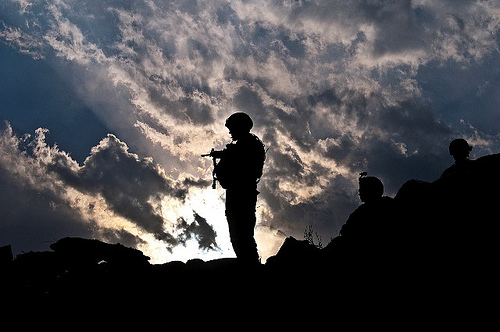
Photo by flickr user US Army Photostream
***
Citizens enroll for military service for a variety of reasons. Some do so for money towards obtaining an online degrees. Others may enroll out of the promise of a early retirement. While some might do so just out of the pride they feel for our country and truly wish to serve and protect all that our nation stands for. Whatever the reasoning might be, one thing is for certain, the path that they travel will rarely be the path that they imagined.
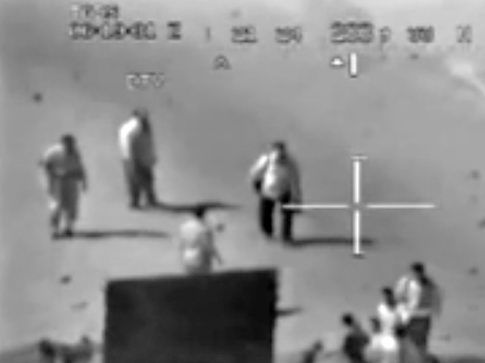 MEDIA ROOTS- What do you get for all the effort and risk involved to
become an Army aviator? In the Apache
video footage of the journalist massacre, US ground forces had already been
engaged sporadically in that area earlier that day.
MEDIA ROOTS- What do you get for all the effort and risk involved to
become an Army aviator? In the Apache
video footage of the journalist massacre, US ground forces had already been
engaged sporadically in that area earlier that day.  This is the first in a series of articles from a soldier’s
perspective that I am writing for Media Roots.
These articles will provide an inside look at the military, war, the
players involved, and my own personal take on it all. While I’ll try not to overly indulge myself
in biographical reverie, I feel it will be important for the reader to know a little about me.
This is the first in a series of articles from a soldier’s
perspective that I am writing for Media Roots.
These articles will provide an inside look at the military, war, the
players involved, and my own personal take on it all. While I’ll try not to overly indulge myself
in biographical reverie, I feel it will be important for the reader to know a little about me. 