


Two months ago, Luke Rudkowski of WeAreChange and I confronted Senator Rand Paul at the Capitol building as he was leaving a public press conference. We asked him why he endorsed war mongerer Mitt Romney for President if he stands for so many things that Rand Paul is against.
A week after the video went viral, my workplace received multiple threatening phone calls from a staffer representing the Media Relations Committee at the Capitol. The representative said I could be arrested and charged with trespassing and harassment for my actions. He also threatened to strip me of my press credentials. It was confirmed to me that Senator Rand Paul had directly filed the complaint.
I proceeded to meet with the Media Committee of Bureau Chief heads of all the major mainstream outlets in the Capitol building to explain my side of the story. They told me that they had worked extremely hard to “get access” to Congress and that they can’t have people like me set it back.
After a month of silence on their end about what the final charges would be against me, I decided to come out with the story for the sake of providing the public the truth.
I was interviewed about the incident via WeAreChange:
I explain the full Rand Paul incident to WeAreChange (transcript below)
**
UPDATE: 10 AUGUST 2012 13:32 PDT
WE ARE CHANGE — “This is Luke Rudkowski here, reporting on another incident of the suppression of the free press. This time it’s of a US Senator trying to get a journalist fired for asking him tough questions. I’m joined by the one and only Abby Martin of MediaRoots.org and RT.
“Now, if you remember, myself and Abby Martin collaborated together on questioning U.S. Senator Rand Paul on his endorsement of Goldman Sachs/Bilderberg puppet Mitt Romney for the 2012 Elections.”
Luke Rudkowski (on the street): “Hey, Senator [Rand] Paul. My name is Luke of We Are Change. We had an interesting conversation before about the Bilderberg group. And, knowing what you know, how can you support Romney when The Guardian reported he was at the Bilderberg meeting?”
Abby Martin (walking into the building): “Hey, Rand. Abby Martin from Media Roots. I just wanted to ask you one quick question. You know, your endorsement for Mitt Romney. People had a lot of questions about it.”
Luke Rudkowski: “Now, the video was a really big hit online. But the most interesting part of the story happened after the video was already up. Abby, can you tell us exactly what happened to you after that video went online?”
Abby Martin: “After that week passed, the next week I went into the studios, I went into RT America. My boss said, ‘Come in to our office. We need to talk to you.’ And they just said, you know, ‘What did you do last week? And why are we getting threatening phone calls from the Capitol police and also the Senate Media Relations Committee at the Capitol Building?’
“And I just told them exactly what happened. I showed them the video. I said that it was totally unaffiliated with RT America. And they said this guy was calling them, threatening them, saying they were gonna send the Capitol police down to arrest me, threatening to strip, not only, me of my press credentials, but everyone at the station of their press credentials.”
Luke Rudkowski: “This is just for asking a question, asking U.S. Senator Rand Paul.
“And can you tell us who these phone calls came from and where they originated?”
Abby Martin: “They were originated from the Senate Media Relations Committee. I’m not gonna say the guy’s name because I don’t, it’s Mike something; I forget his last name. But he oversees that entire committee. And, so, he was calling to threaten me on behalf of him coming from, directly from, the Senator. So, this was confirmed to me later. And I’ll tell you what happened after that.
“I, actually, had to go meet with them in the Capitol Building. And it was really intense and an intimidating experience. But, yeah, they called RT America, were threatening to arrest me, threatening to strip me of my press credentials and of the entire office.
“So, once I explained to my boss and producers what exactly happened, they were just like: It doesn’t sound like you did anything wrong. If I were you I would definitely get a lawyer or just meet with him. Because he kept following up saying that he wanted to meet me, so he can hear my side of the story. And I didn’t know how to respond; like, should I get a lawyer involved?
“And, so, finally I just wrote him back. And I said, ‘Alright. I’ll meet with you. So, I had to go to the Capitol Building and meet with this guy, and in a small room, like an interrogation room. And it wasn’t just him. It was the Bureau Chief of Al Jazeera, the Bureau Chief of CNN, Fox News, MSNBC. All these Bureau Chief heads sat at a table and just, basically, confronted me about what had happened and wanted to get my side of the story. They said, you know, ‘Did you sneak Luke [Rudkowski] in?’ Like, ‘How do you get in there?’ And I was just like, ‘No. We were registered independent press. All we did was just go into the metal detector and go into the Capitol Building. I mean no one even checked our, no one even checked. It was like so lax. I mean you remember what happened. We walked in there. We even told the woman at the front desk, we’re here for this press event down the way. And she was like, ‘Just go ahead.’
Luke Rudkowski: “They weren’t that lax when they found my cookies and water and all the snacks I had in my book bag and made me throw everything out, made me a little bit mad.
“But people also need to know we were registered press inside the Senate Building. We hold different press credentials because, Abby, you have a Senate press pass. I have a different press pass, that I won’t mention or name. But I do have that magic piece of laminated piece of paper, that grants me some access and leeway to get into different places.
“But we were registered for an event inside the Senate Building. Nobody sneaked in. We walked in through security. We were walking towards the event. We saw Rand Paul and we asked him a question. There’s no other way to go around it. We have to ask these guys serious questions. The mainstream media doesn’t do it. And these people came at you with full litigious might, verbal and email jujitsu trying to attack you and scare you and intimidate you for simply asking a question.
“I mean it must’ve been a very scary feeling because I remember you telling me they were very vague in the beginning about what they were gonna do. They threw out all these options, possible jail, possible losing your credentials, possibly hurting the entire RT office. And just because they didn’t pick on me shows you that they were looking for any reason to respond, any reason to try to intimidate and harass and they found a reason. It was because you were working for RT. And that’s the only reason they did this. It wasn’t a threat. It wasn’t nothing. They did it just to intimidate and scare you.”
Abby Martin: “There was a very scary, it was very, very scary. And I was in contact with you the whole time saying, ‘What should I do? Should I come out with this story? This story is huge. I mean Rand Paul is trying to get me stripped of my press credentials for what happened. I mean that is insane.”
Luke Rudkowski: “Or fired, or arrested for simply asking him a question.”
Abby Martin: “Yeah. And I remember telling my boss, ‘Just have them come arrest me. This is outrageous. This is completely unfounded.’ And, as you know, now there was no charge that they could really do. It was totally baseless. It was completely empty threats. It was very underhanded intimidation tactics against journalism. You know, D.C. is just really scary like that.
“I just had no idea that that would happen for what we did. I mean if we went up to Rand Paul and we were just like, ‘Hey, man. We really like you. Thank you for what you do.’ I mean just the fact that we asked him something he didn’t like he ran away like a coward with his head down, didn’t want to answer the questions.
“He was having a public press event in that room and we were there registered. I was there registered. I was registered under Media Roots to ask him questions. I mean that’s why we were there. That’s why he was having a public press event there, which is why they were having a press conference there. And that’s why we went there.
“So, yeah, it was just really intense, really scary, intimidating. And, you know, at this point, I’m just gonna come out with this story ‘cos I think people need to know, who still think that Rand Paul is somehow, you know, has to make deals for him to play the long game, so he can do good things later. No. I mean he’s sold out. Like, he’s a sell-out to the Republican establishment. And he’s underhandedly trying to intimidate journalists who confront him about his selling out.”
Luke Rudkowski: “This is a U.S. Representative of the people trying to arrest and fire a journalist for asking questions. I mean the story is huge. It’s unprecedented. I never; I mean I’ve worked the Senate beat many times. And I go out to the Senate Building. And I ask all these hard questions to all the senators. And I never experienced or I never went through something that you went through. And it’s pretty insane to have Rand Paul, Mr. Libertarian, himself, use the full might of any rules and regulations, that he could throw at you, throw at you to try to intimidate you.
“But, luckily, knowing you for a while now, I definitely know you will not be intimidated. I know this will only embolden you. And I know you also have new plans and you also have a new show, that you’re gonna be working on. Can you update us on what’s next for you?”
Abby Martin: “Yeah. It certainly won’t intimidate me. In fact, I would love to see him again. In D.C., there’s politicians running around. It’s absurd.
“I won’t be going into the Capitol Building anymore to do it. But I think they’re everywhere. So, you can find out where these people are and talk to them. But, yeah, I mean I want to also clarify one point. He also, the guy who called RT, said that I can be charged with harassment as well. That was another charge that they were throwing out there, kind of blanketly, without any foundation whatsoever.
“But coming up on RT, actually, I haven’t been anchoring for the last two weeks and I won’t be all of August because I’m preparing to take over the Alyona Show. But I’m not gonna take over her show. I’m gonna make a whole new show undercutting the left/right paradigm, corporate/top-down media establishment where I’m talking about Big Brother Watch, surveillance issues, government expansion. I’m talking about things, that are censored in the mainstream media, that get a back-page story. And also talking about heroes in journalism, like Luke, highlighting grassroots activists, people who are out there doing awesome things, that need to be highlighted and are not given enough exposure, and also highlighting the villains, the corporate CEOs and the politicians, that are doing really messed up stuff, so, kind of putting them on the spotlight. And that’s the idea, for the show right now. So, stay tuned for that.”
Luke Rudkowski: “Well, if you need me to question Rand Paul, I can definitely do it. As a matter of fact, I will do it. But I wanna congratulate you on your new show. I hope people tune in. Check out Abby on Twitter @AbbyMartin.
“You’re an amazing human being. Keep up the great work. And I’m very happy to see you not afraid, not intimidated, emboldened and only strengthened by this attack. It will not stop us. The more you try to stop us, the more we grow, the more unstoppable we become.”
Luke Rudkowski: “Anything else we didn’t get into that you wanted to get into, Abby?”
Abby Martin: “Yeah. I mean when the corporate media doesn’t ask these questions, then who else can? And when people say this is ambush journalism, that’s unfounded as well because—people who are like, ‘Oh, how come you couldn’t get in a meeting with him? He said he had a meeting with you.’—they don’t have meetings with people who are not already totally funded by the top-down establishment. I mean that just doesn’t happen. So, sometimes they need to be confronted and about legitimate things. I mean that’s just the way it has to happen.
“And, yeah, just once again, you know, the people who say, ‘Get an appointment! This is ridiculous! Why would he answer you?’ Well, he was happy to talk to Luke before about Bilderberg before he was in the establishment.”
Luke Rudkowski (street footage with Rand Paul): “For people who don’t know what’s going on, can you tell people who are the Bilderberg group? If you feel comfortable doing so.”
Luke Rudkowski: “Yeah. He talked about how bad the Bilderberg group is, how they want a world government, how we need an audit of Goldman Sachs. But then when I was talking to him it was just complete silence, which made the video very awkward.”
Luke Rudkowski (street footage with Rand Paul): “I’m just trying to get answers. And that’s why I’m here talking with you. And that’s why I’m persistent the way I am. I know you can hear me.”
Abby Martin: [Laughs]
Luke Rudkowski: “He didn’t say a single word at all.”
Luke Rudkowski (street footage with Rand Paul): “I know you’re trying to ignore me. But the video will play for itself. It will be on YouTube.”
Luke Rudkowski: “Nothing.”
Luke Rudkowski (street footage with Rand Paul): “We could have explained everything to our audience. They are only gonna have more questions about you, Mr. Rand. And you’re only hurting yourself by not answering the question.”
Luke Rudkowski: “At all.”
Luke Rudkowski (street footage with Rand Paul): “Before you became Senator, you talked about the Bilderberg group and auditing Goldman Sachs. But right now you’re supporting Romney. A lot of your supporters are let down. And I’m let down by your reaction, which I think pretty much made the video as popular as it is because of that, because of that awkward kind of silence, that we went through there.
“And I did try many times when I first started covering the Senate and Congress, I’ve tried to get little sit-down interviews and I call them ahead of time. And after 30 failed attempts and 30 failed responses, this is the only way to really get answers. And we’re also gonna be releasing another video this week showing me being very polite to a politician, asking him for an interview, and him just walking away and going in his car and not talking to anyone. So, the only way to really get answers is not from the corporate mainstream media. It’s to go out there and to ask the damn questions. That’s the only way. Don’t ask for permission. Ask for the truth and ask for accountability. That’s the only way you could really do it. And that’s the only way to be independent fully.”
Abby Martin (c. 12:17): “And these people work for us. These people, we pay their salary. I mean they are public servants to the people. So, if we want answers on why they do shady stuff and are endorsing warmongerers who want to invade Iran and start World War III, I mean, we have the right to do that.”
Luke Rudkowski: “Yeah. We have at least the right to question them on their abuse of authority and their horrible actions. And the free press, pretty much, is the most important thing in this country. And we don’t have one. And that’s why we’re living in the world we’re living in now.
“And I applaud people like yourself, Abby. And other brave, independent journalists out there who were willing to take the risk, who were willing to face arrest, persecution for just asking the right questions. And I appreciate your guts. And I know you’re gonna continue on an amazing journey. You’ve got a great career ahead of you. And full-speed ahead. Thank you for everything you do.”
Transcript by Felipe Messina for Media Roots and We Are Change
***
 MEDIA ROOTS — If you’re like me, you don’t always have the cash or time to catch a flick the first time round. “
 MEDIA ROOTS – Greenpeace specializes in environmental advocacy, striving daily to convince humanity to care for its planet. Recognizing Earth’s fragile state, the organization provides tangible solutions and affects positive change. Their tactics
  MEDIA ROOTS – Since we U.S. citizens all live under a government, which has chosen to engage in
 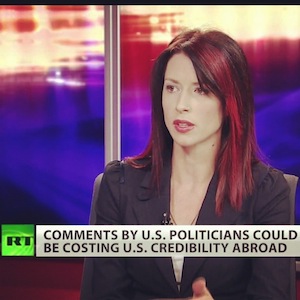 MEDIA ROOTS – Abby Martin initially had little political awareness growing up in Pleasanton, California. When she attended college at San Diego State University, she was introduced to U.S. foreign policy priorities through her studies in Spanish, Sociology and Political Science. Since then – and especially after 9/11 – she began to realize something was terribly wrong in the world. As she began researching more about the underlying motivations of the corporate-controlled federal government, she became a prominent anti-war activist against the invasions of Afghanistan and Iraq.