BLOOMBERG– President Barack Obama probably would veto legislation
authorizing the next budget for U.S.
intelligence agencies if it calls for a new investigation into the 2001 anthrax
attacks, an administration official said.
A proposed probe by the intelligence agencies’ inspector
general “would undermine public confidence” in an FBI probe of the attacks “and
unfairly cast doubt on its conclusions,” Peter Orszag, director of the Office
of Management and Budget, wrote in a letter to leaders of the House and Senate
Intelligence committees.
On Feb. 19, the Obama administration released a 92-page summary
of a Federal Bureau of Investigation probe that said the late Bruce Ivins, a
government scientist, was behind the attacks. Lawmakers including Representative
Rush Holt, a New Jersey Democrat, have questioned the thoroughness of the
investigation.
Anthrax-laced letters sent to lawmakers and news outlets nine
years ago infected 22 people, killing five.
Orszag said the administration also opposes other provisions in
the intelligence budget that allow more scrutiny of spy operations. “The
president’s senior advisers would recommend that he veto the bill” unless those
restrictions are removed, he said.
The White House objects to provisions that would require all
members of the intelligence committees to receive briefings on matters that now
are disclosed only to senior congressional leaders known as the “gang of
eight,” Orszag said.
The administration also opposes letting the General
Accountability Office, Congress’s auditing arm, conduct investigations of spy
activities, he said.
The House and Senate are preparing to meet to resolve
differences between their versions of the legislation.
Editors: Jim Rubin, Don Frederick
To contact the reporter on this story: Jeff Bliss in Washington
[email protected], To contact the editor responsible for this story: Jim Kirk at
[email protected]
WINNIPEG FREE PRESS– A man who tried to break through a barricade of Calgary police officers to get inside a building where a speech was being given by former U.S. president George W. Bush was found guilty Monday of obstructing a peace officer.
But following sentencing arguments that included remarks of support from former U.S. attorney general Ramsey Clark, John Boncore was released with a conditional discharge that would spare him a criminal record.
Boncore, an actor and carpenter who often uses his aboriginal name Splitting the Sky, was taken into custody when he tried push past a line of police officers outside the downtown building where Bush was speaking in March 2009.
Boncore was with a cluster of activists who were protesting the paid appearance by the former president, who they accuse of war crimes in Afghanistan and Iraq. It was Bush’s first public speech since leaving office.
Clark, who held office in the 1960s under President Lyndon Johnson, has since given legal advice to a number of controversial figures at odds with the U.S. government, including Saddam Hussein and Slobodan Milosevic.
He told court that he has known Boncore, 58, since he was a teenager growing up in the U.S. and that the anti-war activist has thousands of supporters in the country.
“There’s not much I wouldn’t do for John,” said Clark. “He is a passionate and committed man.”
However, Judge Manfred Delong said that Boncore’s testimony was inconsistent. The activist began by testifying that he was trying to put Bush under citizen’s arrest but later admitted that was unlikely and said that he was trying to serve him with papers.
Boncore also admitted that he wanted his actions filmed and that he didn’t truly expect to make it past security.
Boncore testified he only tried to break through the line once and was otherwise simply trying to urge RCMP officers to arrest Bush themselves. However, Delong said he found more credible the police testimony suggesting Boncore tried to force his way past the line multiple times.
Delong said that Boncore passionately believed in his case against Bush, but that doesn’t change his actions.
“His sincerity in holding these views is not at issue in this case,” he said.
Crown prosecutor Tracy Davis argued that Boncore should be fined $1,000. She said his actions were planned and deliberate, and that he should have a criminal record so that police know to watch out for him at future protests.
Defence lawyer Charles Davison said that an absolute discharge would be best, pointing out that Boncore has no criminal record and that even without a criminal record police will have his name and image on file.
Before being sentenced, Boncore said he was willing to accept the consequences of his actions and he still believed he was right about Bush’s need to take responsibility for his administration’s actions.
“If it’s only going to cost me $1,000 to make that point, bring it on,” he told the judge.
Delong gave Boncore a conditional discharge and ordered him to pay $1,000 to a charity of his choice. He will also be on probation for a year and must notify his parole officer if he changes his name, address or job. Once he’s served that time he will not have a criminal record.
Outside court, Boncore said that he plans to pick as his charity a group of architects and engineers who claim that residue from the twin towers following 9-11 proves that they were deliberately blown up. His choice of charity must be approved by his parole officer.
Boncore said he still stands by his actions and he can’t say what he’ll do in the future to protest the former and current U.S. administrations.
“I’m not so sure if I’ll make a citizen’s arrest, but you can believe wherever George Bush (and his former cabinet colleagues) … wherever they come I will be there to voice my opposition.”
NY TIMES– More than five years ago, Congress and President Bush created the 9/11 commission. The goal was to provide the American people with the fullest possible account of the “facts and circumstances relating to the terrorist attacks of Sept. 11, 2001” — and to offer recommendations to prevent future attacks. Soon after its creation, the president’s chief of staff directed all executive branch agencies to cooperate with the commission.
The commission’s mandate was sweeping and it explicitly included the intelligence agencies. But the recent revelations that the C.I.A. destroyed videotaped interrogations of Qaeda operatives leads us to conclude that the agency failed to respond to our lawful requests for information about the 9/11 plot. Those who knew about those videotapes — and did not tell us about them — obstructed our investigation.
There could have been absolutely no doubt in the mind of anyone at the C.I.A. — or the White House — of the commission’s interest in any and all information related to Qaeda detainees involved in the 9/11 plot. Yet no one in the administration ever told the commission of the existence of videotapes of detainee interrogations.
When the press reported that, in 2002 and maybe at other times, the C.I.A. had recorded hundreds of hours of interrogations of at least two Qaeda detainees, we went back to check our records. We found that we did ask, repeatedly, for the kind of information that would have been contained in such videotapes.
The commission did not have a mandate to investigate how detainees were treated; our role was to investigate the history and evolution of Al Qaeda and the 9/11 plot. Beginning in June 2003, we requested all reports of intelligence information on these broad topics that had been gleaned from the interrogations of 118 named individuals, including both Abu Zubaydah and Abd al Rahim al-Nashiri, two senior Qaeda operatives, portions of whose interrogations were apparently recorded and then destroyed.
The C.I.A. gave us many reports summarizing information gained in the interrogations. But the reports raised almost as many questions as they answered. Agency officials assured us that, if we posed specific questions, they would do all they could to answer them.
So, in October 2003, we sent another wave of questions to the C.I.A.’s general counsel. One set posed dozens of specific questions about the reports, including those about Abu Zubaydah. A second set, even more important in our view, asked for details about the translation process in the interrogations; the background of the interrogators; the way the interrogators handled inconsistencies in the detainees’ stories; the particular questions that had been asked to elicit reported information; the way interrogators had followed up on certain lines of questioning; the context of the interrogations so we could assess the credibility and demeanor of the detainees when they made the reported statements; and the views or assessments of the interrogators themselves.
The general counsel responded in writing with non-specific replies. The agency did not disclose that any interrogations had ever been recorded or that it had held any further relevant information, in any form. Not satisfied with this response, we decided that we needed to question the detainees directly, including Abu Zubaydah and a few other key captives.
In a lunch meeting on Dec. 23, 2003, George Tenet, the C.I.A. director, told us point blank that we would have no such access. During the meeting, we emphasized to him that the C.I.A. should provide any documents responsive to our requests, even if the commission had not specifically asked for them. Mr. Tenet replied by alluding to several documents he thought would be helpful to us, but neither he, nor anyone else in the meeting, mentioned videotapes.
A meeting on Jan. 21, 2004, with Mr. Tenet, the White House counsel, the secretary of defense and a representative from the Justice Department also resulted in the denial of commission access to the detainees. Once again, videotapes were not mentioned.
As a result of this January meeting, the C.I.A. agreed to pose some of our questions to detainees and report back to us. The commission concluded this was all the administration could give us. But the commission never felt that its earlier questions had been satisfactorily answered. So the public would be aware of our concerns, we highlighted our caveats on page 146 in the commission report.
As a legal matter, it is not up to us to examine the C.I.A.’s failure to disclose the existence of these tapes. That is for others. What we do know is that government officials decided not to inform a lawfully constituted body, created by Congress and the president, to investigate one the greatest tragedies to confront this country. We call that obstruction. Thomas H. Kean and Lee H. Hamilton served as chairman and vice chairman, respectively, of the 9/11 commission.
SALON– Andrew Sullivan rightly
recommends this new
Atlantic article by David Freed, which details how the FBI
and a mindless, stenographic American media combined to destroy the
life of Steven Hatfill. Hatfill is the former U.S. Government scientist
who for years was publicly depicted as the anthrax attacker and
subjected to Government investigations so invasive and relentless that
they forced him into almost total seclusion, paralysis and mental
instability, only to have the Government years later (in
2008) acknowledge that he had nothing to do with those attacks and to pay
him $5.8 million to settle the lawsuit he brought. There are two
crucial lessons that ought to be learned from this horrible — though
far-from-rare — travesty:
(1) It requires an extreme level of irrationality
to read what happened to Hatfill and simultaneously to have faith that
the “real anthrax attacker” has now been identified as a result of the
FBI’s wholly untested
and uninvestigated case against Bruce Ivins. The
parallels are so overwhelming as to be self-evident.
Yet just as was true for years with the Hatfill accusations, no
independent investigations are taking place. That’s true for three
reasons. First, the FBI drove Ivins to suicide, thus creating an
unwarranted public assumption of guilt and ensuring the FBI’s case
would never be subjected to the critical scrutiny of a trial — exactly
what would have happened with Hatfill had he, like Ivins, succumbed to
that temptation, as
Freed describes:
The next morning, driving through Georgetown on the way to visit
one of his friends in suburban Maryland, I ask Hatfill how close he came
to suicide. The muscles in his jaw tighten.
“That was never an option,” Hatfill says, staring straight ahead.
“If I would’ve killed myself, I would’ve been automatically
judged by the press and the FBI to be guilty.”
Second, the American media — with some notableexceptions
— continued to do to Ivins what it did to Hatfill and what it does in
general: uncritically disseminate government claims rather than
questioning or investigating them for accuracy. As a result, many
Americans continue to blindly assume any accusations that come from the
Government must be true. As Freed writes, in a passage with
significance far beyond the Hatfill case:
The same, Hatfill believes, cannot be said about American civil
liberties. “I was a guy who trusted the government,” he says. “Now, I
don’t trust a damn thing they do.” He trusts reporters even
less, dismissing them as little more than lapdogs for law enforcement.
The media’s general willingness to report what was
spoon-fed to them, in an effort to reassure a frightened public
that an arrest was not far off, is somewhat understandable considering
the level of fear that gripped the nation following 9/11. But that
doesn’t “justify the sliming of Steven Hatfill,” says Edward Wasserman,
who is the Knight Professor of Journalism Ethics at Washington and Lee
University, in Virginia. “If anything, it’s a reminder that an
unquestioning media serves as a potential lever of power to be activated
by the government, almost at will.“
No matter how many times the Government and media jointly
disseminate outright lies to the American citizenry — remember Iraq, or
Jessica Lynch’s heroic Rambo-like firefight with Evil Iraqi Villains,
or Pat Tillman’s death at the hands of Al Qaeda Monsters, or all
the gloriously successful air strikes and raids
on Terrorists that never happened? — that propagandistic process
never weakens. As a result, many Americans (especially when their party
is in power) simply place blind faith in whatever the Government
claims (even when the claims are issued anonymously and accompanied by
no tested evidence). Hence, the Government claims it knows that Ivins
is the anthrax killer; the American media largely affirms that claim;
and, for so many people, that’s the end of the story, no matter how many
times that exact process has so woefully misled them and no matter how
many credible and even mainstream sources question it.
Third, the Obama administration is actively and aggressively
blocking any efforts to investigate the FBI’s case against Ivins
through an
Obama veto threat, based
on the Orwellian, backward claim that such an investigation “would
undermine public confidence” in the FBI’s case “and unfairly cast doubt
on its conclusions.” As explained in a letter
to the Obama administration by Rep. Rush Holt, the former physicist
who represents the New Jersey district from which the anthrax letters
were sent:
The Bureau has asserted repeatedly and with confidence that the
“Amerithrax” investigation is the most thorough they have ever conducted
— claims they made even as they were erroneously pursuing Dr. Steven
Hatfill. . . . Many critical questions in this case remain
unanswered, and there are many reasons why there is not, nor
ever has been, public confidence in the investigation or the FBI’s
conclusions, precisely because it was botched at multiple points over
more than eight years. Indeed, opposing an independent
examination of any aspect of the investigation will only fuel the
public’s belief that the FBI’s case could not hold up in court, and that
in fact the real killer may still be at large.
The anthrax attacks were one of the most significant political
events of this generation — as
significant as the 9/11 attack, if
not more so, in creating the climate of fear that prevailed (and
still prevails) in the U.S., which, in turn, spawned so much expansion
of government power. It is worth remembering what happened in the
Hatfill case in order to be reminded of just how inexcusable it is that
there has been no independent investigation of the case against Ivins
and that the current administration is now aggressively and quite
strangely blocking any efforts to do so.
(2) More generally, it is hard to overstate the
authoritarian impulses necessary for someone — even in the wake of
numerous cases like Steven Hatfill’s — to place blind faith in
government accusations without needing to see any evidence or have that
evidence subjected to adversarial scrutiny. Yet that is exactly the
blind faith that dominates so many of our political debates.
Throughout the Bush years, anyone who argued against warrantless
surveillance, or torture, or lawless detention and rendition, was met
with this response: but this is all being done to Terrorists.
What they actually meant was: these are people accused by the
Government, with no evidence or trials, of being Terrorists. But
the authoritarian mind, by definition, recognizes no distinction between
“Our leaders claim X” and “X is true.”
For them, the former is proof of the latter. Identically, those who
now argue against due-process-free presidential assassinations of
American citizens and charge-less indefinite detentions are met with a
similar response: but these are dangerous people who are trying to
kill Americans, when what they actually mean is: Obama
officials claim, with no evidence shown and no process given, that
these are dangerous people trying to kill Americans. The
authoritarian mind refuses to recognize any distinction between those
two very different propositions.
No matter how many Steven Hatfills there are — indeed, no matter
how undeniable
is the evidence that the Government repeatedlyaccused
people of being Terrorists who were no such thing, even while knowing
the accusations were false — the authoritarians among us continue
to blindly recite unproven Government accusations (but he’s a
Terrorist!) to justify the most extreme detention, surveillance and
even assassination
policies, all without needing or wanting any due process or
evidence. No matter how many times it is shown how unreliable those
kinds of untested government accusations are (either due to abuse or
error), there is no shortage of people willing to place blind faith in
such pronouncements and to vest political leaders with all sorts of
unchecked powers to act on them.
History Channel documentary about the Athrax attacks in which they disclose that the Anthrax didn’t originate from Iraq like the Bush administration said- instead it originated in a highly secure US government laboratory.
Keith Olbermann gives a special comment about Bruce Ivins, the man who was aggressively persecuted by the government and media, allegedly forcing him to take his own life because of the allegations. Now evidence is being uncovered that suggests he wasn’t the perpetrator of the attacks after all. David Williams of the LA Times tells Olbermann that he would be “shocked” if the Justice Department didn’t provide the totality of the evidence against Bruce Ivins in the public sphere, but to this day there hasn’t been any solid evidence provided.
WASHINGTON POST– Some staff members and commissioners of the Sept. 11 panel concluded that
the Pentagon’s initial story of how it reacted to the 2001 terrorist attacks
may have been part of a deliberate effort to mislead the commission and the
public rather than a reflection of the fog of events on that day, according to
sources involved in the debate.
Suspicion of wrongdoing ran so deep that the 10-member commission, in a
secret meeting at the end of its tenure in summer 2004, debated referring the
matter to the Justice Department for criminal investigation, according to
several commission sources. Staff members and some commissioners thought that
e-mails and other evidence provided enough probable cause to believe that
military and aviation officials violated the law by making false statements to
Congress and to the commission, hoping to hide the bungled response to the
hijackings, these sources said.
In the end, the panel agreed to a compromise, turning over the allegations
to the inspectors general for the Defense and Transportation departments, who
can make criminal referrals if they believe they are warranted, officials said.
“We to this day don’t know why NORAD [the North American Aerospace Command]
told us what they told us,” said Thomas H. Kean, the former New Jersey
Republican governor who led the commission. “It was just so far from the
truth. . . . It’s one of those loose ends that never got tied.”
Although the commission’s landmark report made it clear that the Defense
Department’s early versions of events on the day of the attacks were
inaccurate, the revelation that it considered criminal referrals reveals how
skeptically those reports were viewed by the panel and provides a glimpse of
the tension between it and the Bush administration.
A Pentagon spokesman said yesterday that the inspector general’s office will
soon release a report addressing whether testimony delivered to the commission
was “knowingly false.” A separate report, delivered secretly to
Congress in May 2005, blamed inaccuracies in part on problems with the way the
Defense Department kept its records, according to a summary released yesterday.
A spokesman for the Transportation Department’s inspector general’s office
said its investigation is complete and that a final report is being drafted.
Laura Brown, a spokeswoman for the Federal Aviation Administration, said she
could not comment on the inspector general’s inquiry.
In an article scheduled to be on newsstands today, Vanity Fair magazine
reports aspects of the commission debate — though it does not mention the
possible criminal referrals — and publishes lengthy excerpts from military
audiotapes recorded on Sept. 11. ABC News aired excerpts last night.
For more than two years after the attacks, officials with NORAD and the FAA
provided inaccurate information about the response to the hijackings in
testimony and media appearances. Authorities suggested that U.S.
air defenses had reacted quickly, that jets had been scrambled in response to
the last two hijackings and that fighters were prepared to shoot down United
Airlines Flight 93 if it threatened Washington.
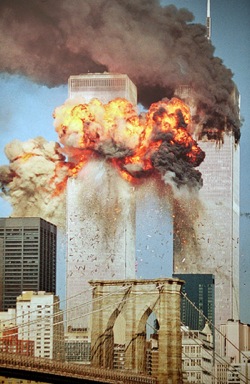
In fact, the commission reported a year later, audiotapes from NORAD’s
Northeast headquarters and other evidence showed clearly that the military
never had any of the hijacked airliners in its sights and at one point chased a
phantom aircraft — American Airlines Flight 11 — long after it had crashed
into the World Trade
Center.
Maj. Gen. Larry Arnold and Col. Alan Scott told the commission that NORAD
had begun tracking United 93 at 9:16 a.m.,
but the commission determined that the airliner was not hijacked until 12
minutes later. The military was not aware of the flight until after it had
crashed in Pennsylvania.
These and other discrepancies did not become clear until the commission,
forced to use subpoenas, obtained audiotapes from the FAA and NORAD, officials
said. The agencies’ reluctance to release the tapes — along with e-mails,
erroneous public statements and other evidence — led some of the panel’s staff
members and commissioners to believe that authorities sought to mislead the
commission and the public about what happened on Sept. 11.
“I was shocked at how different the truth was from the way it was
described,” John Farmer, a former New Jersey
attorney general who led the staff inquiry into events on Sept. 11, said in a
recent interview. “The tapes told a radically different story from what
had been told to us and the public for two years. . . . This is not spin. This
is not true.”
Arnold, who could not be reached for comment yesterday, told the commission
in 2004 that he did not have all the information unearthed by the panel when he
testified earlier. Other military officials also denied any intent to mislead
the panel.
John F. Lehman, a Republican commission member and former Navy secretary,
said in a recent interview that he believed the panel may have been lied to but
that he did not believe the evidence was sufficient to support a criminal
referral.
“My view of that was that whether it was willful or just the fog of
stupid bureaucracy, I don’t know,” Lehman said. “But in the order of
magnitude of things, going after bureaucrats because they misled the commission
didn’t seem to make sense to me.”



 NY TIMES
 WASHINGTON POST