MEDIA ROOTS– What is is that enhances and what is it that inhibits our empathic capacity? Matthew Taylor explores the concept of 21st century enlightment in this RSA animate video, suggesting that the new enlightenment should champion a more self-aware, socially embedded model of autonomy that recognizes the frailties and limitations of the human race and the planet in which we live. Matthew discusses how the idea might help us meet the challenges we face today, and the role
that can be played by certain organizations to help in the evolution of our global consciousness.
GUARDIAN– The desert plants used to distil tequila could cut emissions
from transport by providing an important new biofuel crop, according to
new research.
“Agave has a huge advantage, as it can grow in
marginal or desert land, not on arable land,” and therefore would not
displace food crops, said Oliver Inderwildi, at the University of Oxford.
Much
of the ethanol used as a substitute for petrol is currently produced
from corn, especially in the US, and has been criticised for driving up grain prices to record levels. A
recent inquiry found that laws mandating the addition of biofuels to petrol and diesel had backfired badly and were
unethical because biofuel production often violated human rights and
damaged the environment.
But the new study found that
agave-derived ethanol could produce good yields on hot, dry land and
with relatively little environmental impact. The agave plant,
large rosettes of fleshy leaves, produces high levels of sugar and the
scientists modeled a hypothetical facility in the tequila state of
Jalisco in Mexico which converts the sugars to alcohol for use as a
fuel.
Inderwildi said the research, published in the journal Energy
and Environmental Science, is the first comprehensive life-cycle
analysis of the energy and greenhouse gas
balance for agave-derived ethanol. The team found the production of
agave-ethanol led to the net emission of 35g of carbon dioxide for each
megajoule of energy, far lower than the 85g/MJ estimated for corn
ethanol. In comparison, burning petrol emits about 100g/MJ and some
estimates of corn ethanol suggest it is worse than petrol.
NPR– The letters O-C-D have become a
punch line to describe people who make lists or wash their hands a lot. But for
some people with obsessive-compulsive disorder, the intrusive thoughts and
rituals are severely disabling and don’t respond to drugs or behavioral
therapies.
So doctors have been trying a new
treatment for OCD: deep brain stimulation.
Deep brain stimulation is best known
as a way to reduce the tremors of Parkinson’s disease. A surgeon places wires
deep in the brain that carry electrical impulses from an implanted device a bit
like a pacemaker.
In 2009, the FDA approved the
treatment for some adults with really bad OCD. Since then, about 50 OCD
patients have been treated. One of them is “Mike,” a man in his late
40s who agreed to talk if his real name wasn’t used.
A lot of Mike’s compulsions involve
cars. Before he gets in one, he says, he feels compelled to check the doors,
the brakes, the tires — sometimes more than once. And once he’s on the road,
Mike says every bump can make him wonder if he’s just hit something.
One night, Mike’s OCD actually made
it impossible for him to drive through a quiet neighborhood.
For nearly three decades, Mike tried
the usual treatments: prescription drugs for depression and anxiety, and a type
of behavioral therapy called exposure response prevention. But he was still
constantly checking faucets so the house wouldn’t flood, and light switches so
there wouldn’t be a fire. He couldn’t hold a job. He was living with his
parents.
‘My Mind Was Free’
Greenberg offered Mike a chance to
take part in a study of deep brain stimulation — something that’s been tried on
only about 50 OCD patients in the U.S.
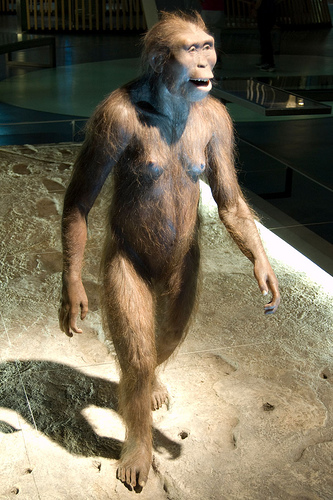
POPULAR SCIENCE– A lot of the debate about when modern humans became modern humans has to do with the head–when our brains evolved into the functional equivalent of that of modern mankind. But while that particular argument continues, a team of UK researchers using a new kind of statistical technique have analyzed ancient footprints at a site in Tanzania and found that if our feet are allowed to tell the tale, our early ancestors were becoming human-like as much as two million years earlier than we previously thought.
The study relies on eleven well-preserved footprints at the Laetoli site in Tanaznia that the researchers subjected to a new statistical technique derived from methods used in functional brain imaging. Using this technique, they created 3-D average of the 11 prints there, comparing them with data obtained from the study of modern humans and living great apes.
The researchers also used computer simulations to model a variety of gaits–and the footprints they would have produced–for the likely maker of the Laetoli prints, a species known as Australopithecus afarensis. It was previously thought that this ancestor walked crouched over, putting pressure on the side of the foot and pushing off from the middle, like a modern ape.
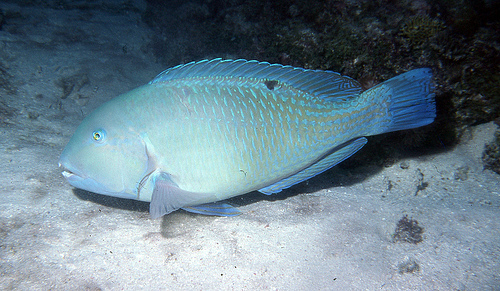
NATIONAL GEOGRAPHIC– A blackspot tuskfish off Australia has its mouth full as it
carries a cockle to a nearby rock, against which the fish was seen repeatedly bashing the
shellfish to get at the fleshy bits inside.
A recent study in the journal Coral Reefs says the picture—snapped at a depth of
nearly 60 feet (18 meters) in Australia’s Great Barrier Reef in
2006—is the first ever taken of a tool-using fish in the wild.
Professional diver Scott Gardner
was just about out of air and swimming back to the surface when he heard an odd
cracking sound nearby. Swimming over to investigate, he spotted the foot-long
(30-centimeter-long) fish at work.
“When Scott showed me his photos,
I said ‘Wow, this is quite amazing,'” said study co-author Alison Jones, a coral ecologist at Central
Queensland University in Rockhampton, Australia.



 GUARDIAN
 POPULAR SCIENCE
 NATIONAL GEOGRAPHIC