Bush Began Invasion Before Authorized by Congress

DEMOCRACY NOW– Writing in The Nation magazine, Democracy Now! correspondent Jeremy Scahill reports on Washington’s undeclared air war against Iraq in 2002:

“It was a huge air assault: Approximately 100 US and British planes flew from Kuwait into Iraqi airspace. At least seven types of aircraft were part of this massive operation, including US F-15 Strike Eagles and Royal Air Force Tornado ground-attack planes. They dropped precision-guided munitions on Saddam Hussein’s major western air-defense facility, clearing the path for Special Forces helicopters that lay in wait in Jordan. Earlier attacks had been carried out against Iraqi command and control centers, radar detection systems, Revolutionary Guard units, communication centers and mobile air-defense systems. The Pentagon’s goal was clear: Destroy Iraq’s ability to resist. This was war.

“But there was a catch: The war hadn’t started yet, at least not officially. This was September 2002–a month before Congress had voted to give President Bush the authority he used to invade Iraq, two months before the United Nations brought the matter to a vote and more than six months before “shock and awe” officially began.”

AMY GOODMAN: Here to talk about this all with us is Jeremy Scahill, producer and correspondent for Democracy Now!, has an article at The Nation magazine’s website, called “The Other Bomb Drops: How Bush Began the Iraq Invasion Before He Went to Congress or the U.N.” We are also joined on the telephone by Hans Von Sponeck, former Assistant Secretary General of the United Nations. And we are joined by John Bonifaz, who has just begun a website that deals with this issue. He is author of Warrior King: The Case for Impeaching George W. Bush. The website is called, AfterDowningStreet.org, a coalition of various groups urging Congress to begin a formal investigation to whether Bush has committed impeachable offenses in connection with the invasion of Iraq. Let’s begin, Jeremy, with you. Welcome to Democracy Now!, on this side of the mic.

JEREMY SCAHILL: Thank you, Amy. It’s good to be here.

AMY GOODMAN: Talk about what you found.

JEREMY SCAHILL: I think for many people who have been following the politics of the invasion and occupation of Iraq, it comes as no surprise to learn that the Bush administration intentionally misled the U.S. public and the world and operated with tremendous bad faith when it said it was trying to do everything it could to avoid war. And what we have here is really solid documentation that backs that up. What the British Times of London published last weekend was statistics from the British defense ministry that showed that in the second half of 2002—let’s remember that the invasion of Iraq officially began in March of 2003—that from May 2002 until the end of 2002, that the United States and Britain doubled the amount of attacks that—the number of attacks that they were carrying out against Iraq, from the whole of 2001. So, what you saw was the Bush administration ordering attacks, offensive attacks on Iraq, that were intended to take out communications infrastructure in the country, the ability of commanders in the Iraqi military to communicate with one another, pretty much defensive mechanics for the country, and these attacks were happening with the justification that they were protecting the so-called no-fly zones in Iraq.

The real scandal here is that the Bush administration, like the Clinton administration before it, oversaw the longest sustained bombing campaign since Vietnam. We reported on this show for years consistently that the United States was bombing Iraq once every three days. This bombing began—you could say that the preparations for this invasion began the moment that the so-called Gulf War ended and that Clinton laid the groundwork for this in his regular bombings of Iraq. We saw a spike in activity in these so-called no-fly zone attacks which had no U.N. mandate whatsoever, which were not approved by the international community.

AMY GOODMAN: Which are often mistakenly called the U.N. no-fly zones.

JEREMY SCAHILL: Right. And it was only the United States and Britain. France pulled out almost immediately after the United States began this program. So you had the United States and Britain, and then with the approval and support of some of the puppet regimes in the region that were for whatever reason in bed with the United States. After the passage of the Iraq Liberation Act in 1998, you saw an escalation in the so-called no-fly zones. The Clinton administration was using them to try to provoke Saddam Hussein’s regime into attacking the United States to justify further attacks. And you remember there was the heavy bombing known as “Operation Desert Fox” in December of 1998. So the Clinton administration is not innocent here. It carried out illegal bombings against Iraq consistently throughout the presidency of Clinton.

What we saw that sort of changed here under Bush is that the Bush administration dropped all of the rhetoric about the no-fly zones having something to do with defending Shiites or Kurds and actually were quite public about what they were using these no-fly zones for. They were using them to systematically and preemptively degrade Iraq’s ability to defend itself, not from an uprising of Shiites or Kurds, but from the invasion of a foreign army.

AMY GOODMAN: And then, can you locate the Downing Street memo, talk about its significance, and what happened with the bombing then? This Downing Street memo, what, July 23rd, 2002.

JEREMY SCAHILL: Yes. It reports on a meeting that senior British officials had had with members of the Bush administration, and what it is is a reflection of what the British understood to be the United States’ policy at the moment. And what’s clear from reading this—it’s actually not a memo, it’s minutes, but it’s called the Downing Street memo. It’s minutes of this meeting with Tony Blair and some of his most senior defense advisers. And the picture that is painted from this memo is that the United States already was not just planning and preparing for war, but was actively carrying out air strikes in support of this war. The invasion had begun already when the British had this meeting. And we find that in the form of remarks attributed to Geoff Hoon within these minutes, where he is talking about the Americans already spiking up activity against Saddam Hussein, and what he’s referring to is the increasing use of these so-called no-fly zones to degrade Iraq’s ability to defend against a U.S. invasion and to prepare the route for U.S. Special Forces to enter into the country. In September of 2002—now this is months before the actual invasion officially began, and a few months before Bush went to the Congress or the United Nations—100 aircraft violate Iraqi airspace, British and American aircraft. They go in and they carry out a systematic campaign of air strikes in the west of Iraq and basically destroy the west of Iraq’s ability to defend against an invasion. And that was one of the main places where U.S. Special Forces troops came in from Jordan into the west of Iraq. That happened in September of 2002. We’re talking about months before the actual invasion began.

AMY GOODMAN: We are talking to Democracy Now! correspondent, Jeremy Scahill, has a piece in The Nation online called “The Other Bomb Drops.” When we come back, we’ll also be joined by attorney John Bonifaz and the former U.N. Assistant Secretary General, Hans Von Sponeck..

Photo by Flickr user US Army
Propaganda Effort in Iraq a Mistake, Rumsfeld Says

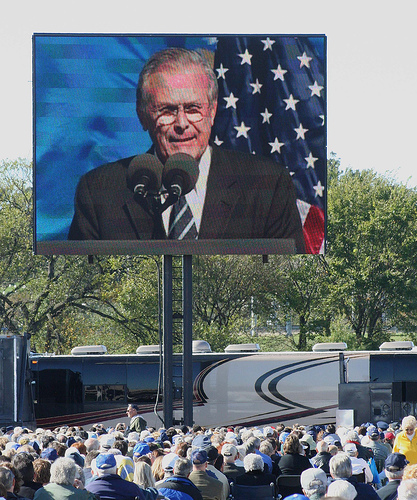
LA TIMES– Defense Secretary Donald H. Rumsfeld on Friday criticized a U.S. military program that pays Iraqi newspapers to plant stories favorable to the American mission, and mistakenly said the Pentagon had shut down the program shortly after its existence was revealed.

In his most specific comments thus far about the information operations program, — carried out by U.S. troops and a private contractor — Rumsfeld said the U.S. military should not be paying Iraqi media to publish articles, whose origin was concealed even from the news outlets.

He said he had not been initially aware of the clandestine program, and ordered it shut down after news outlets published details of it.

“When we heard about it, we said, ‘Gee, that’s not what we ought to be doing,’ ” Rumsfeld said Friday during a taped interview on PBS’ “The Charlie Rose Show.”

Rumsfeld said the contractor, Lincoln Group, and commanders in Iraq were notified of the Pentagon’s concerns and ended the propaganda effort. “They stopped doing that,” he said.

Rumsfeld’s remarks were made available by PBS producers before the show aired late Friday night. One person familiar with Lincoln Group’s operations, who spoke on condition of anonymity because of an ongoing investigation, said the program in Iraq was still active as of a week ago.

Read more at LA TIMES.

© LA TIMES 2006

Photo by flickr user DBKing

Bush Planted Fake News Stories on American TV

INDEPENDENT– Federal authorities are actively investigating dozens of American television stations for broadcasting items produced by the Bush administration and major corporations, and passing them off as normal news. Some of the fake news segments talked up success in the war in Iraq, or promoted the companies’ products.

Investigators from the Federal Communications Commission (FCC) are seeking information about stations across the country after a report produced by a campaign group detailed the extraordinary extent of the use of such items.

The report, by the non-profit group Centre for Media and Democracy, found that over a 10-month period at least 77 television stations were making use of the faux news broadcasts, known as Video News Releases (VNRs). Not one told viewers who had produced the items.

“We know we only had partial access to these VNRs and yet we found 77 stations using them,” said Diana Farsetta, one of the group’s researchers. “I would say it’s pretty extraordinary. The picture we found was much worse than we expected going into the investigation in terms of just how widely these get played and how frequently these pre-packaged segments are put on the air.”

Ms Farsetta said the public relations companies commissioned to produce these segments by corporations had become increasingly sophisticated in their techniques in order to get the VNRs broadcast. “They have got very good at mimicking what a real, independently produced television report would look like,” she said.

The FCC has declined to comment on the investigation but investigators from the commission’s enforcement unit recently approached Ms Farsetta for a copy of her group’s report.

The range of VNR is wide. Among items provided by the Bush administration to news stations was one in which an Iraqi-American in Kansas City was seen saying “Thank you Bush. Thank you USA” in response to the 2003 fall of Baghdad. The footage was actually produced by the State Department, one of 20 federal agencies that have produced and distributed such items.

Many of the corporate reports, produced by drugs manufacturers such as Pfizer, focus on health issues and promote the manufacturer’s product. One example cited by the report was a Hallowe’en segment produced by the confectionery giant Mars, which featured Snickers, M&Ms and other company brands. While the original VNR disclosed that it was produced by Mars, such information was removed when it was broadcast by the television channel – in this case a Fox-owned station in St Louis, Missouri.

Bloomberg news service said that other companies that sponsored the promotions included General Motors, the world’s largest car maker, and Intel, the biggest maker of semi-conductors. All of the companies said they included full disclosure of their involvement in the VNRs. “We in no way attempt to hide that we are providing the video,” said Chuck Mulloy, a spokesman for Intel. “In fact, we bend over backward to make this disclosure.”

The FCC was urged to act by a lobbying campaign organised by Free Press, another non-profit group that focuses on media policy. Spokesman Craig Aaron said more than 25,000 people had written to the FCC about the VNRs. “Essentially it’s corporate advertising or propaganda masquerading as news,” he said. “The public obviously expects their news reports are going to be based on real reporting and real information. If they are watching an advertisement for a company or a government policy, they need to be told.”

The controversy over the use of VNRs by television stations first erupted last spring. At the time the FCC issued a public notice warning broadcasters that they were obliged to inform viewers if items were sponsored. The maximum fine for each violation is $32,500 (£17,500).

Editor’s note: To check out 36 examples of VNRs, including the client(s) that funded it, the TV stations that aired it, and the deceptive techniques that newsrooms used to disguise it as genuine journalism go HERE. You can also compare Quicktime videos of the original VNRs with selected newscasts that incorporated them.

© INDEPENDENT 2006

The FCC on its Knees

ALTERNET– “It’s time to move away from thinking of broadcasters as trustees and time to treat them the way that everyone else in this society does, that is, as a business. Television is just another appliance. It’s a toaster with pictures.”

Those were the memorable droppings of a man named Mark Fowler. Ronald Reagan picked him to run the Federal Communications Commission (FCC) the U.S.’s poor excuse for a media regulatory body. Echoing a historic Republican theme that “the business of America is business,” he summed up how corporate think had insinuated itself into the work of an agency set up to protect the public interest from corporate self-interest.

Fowler’s candor was expressed back in that watershed year of 1984, an irony that George Orwell, the author of the book that made that year infamous, would have found delicious. Perhaps it is fitting that in a sizzling summer in which folks in our nation’s capital say they feel like they live in a toaster, Mark Fowler has reemerged.

Only this time his name is Michael Powell. And its toaster time again.

Michael is an “SOG,” a 38-year-old Son of a General — Gulf War leader and current Secretary of State Colin Powell. Powell the Younger is the current chair of the FCC; according to Brendan Kerner’s informative story in New York’s venerable Village Voice, “If he plays his cards right, he could well become the first African-American president.” Among Powell Jr.’s claims to fame, Kerner writes, is that he is a “younger and brighter version of George W. Bush,” as if that is saying much.

A typical Powellism does to logic what Bush does to language. When asked about the Digital Divide, he quipped: “I think there’s a Mercedes divide. I’d like to have one; I can’t afford one.” His salary is $133,700 a year.

Brace yourself, America. You have been warned.

A Nation Asleep

Most of America is sleeping when it comes to understanding how what we see and hear on TV and radio every day is affected by what a bunch of lawyers decide in a boardroom in Washington. And it is certainly true that arcane talk of the “deployment of the infrastructure” and complicated, Byzantine standards are hard to fathom, much less keep you from dozing.

The media industries understand just how essential control over regulatory bodies is in their bid to aggregate more power. That’s why they spend so much money on political contributions to congressional representatives and senators who sit on regulatory committees, and why, while media jobs are disappearing in outlets worldwide, media lobbyists are building extensions on their patios because of all the work that’s being tossed their way.

These lobbyists are like bagmen spreading manna from media heaven. Media companies gave the Bush campaign over a million dollars, but there is more to it than campaign contributions. They regularly dispense favors, such as a fully paid Paris junket costing $18,910 that recently went to Powell’s patron, Republican Representative Billy Tauzin, a good old boy from Louisiana and chair of the House Energy and Commerce Committee.

But this is chump change compared to how media companies benefit when FCC decisions go their way. A recent example was the gift bestowed by the FCC on Republican Rupert Murdoch, whose Fox News practically got Dubya elected (while G.W.B.’s first cousin John Ellis ran some of the right-wing network’s campaign coverage). Murdoch was just given a waiver of cross-ownership rules permitting him to buy two local TV stations in New York, el numero uno media market. This despite his already owning The New York Post, a political pulpit posing as a newspaper. (Rupert’s son Lachlan recently engineered the firing of that paper’s best-known — well, only — liberal columnist, Jack Newfield, replacing him with Victoria Gotti, daughter of jailed Mafia don John Gotti. Is it possible that children, in this case Michael and Lachlan, are even more rabid than their fathers?)

Media-policy monitor Jeff Chester of the Center for Media Education was apoplectic about the FCC’s latest groveling to Murdoch, noting: “What was not said by Chairman Powell in approving this media merger decision was more important than what he said. Powell ignored the merger’s narrowing impact on local voices, the threats to local TV journalism, the giveaway of additional digital beachfront spectrum, and Murdoch’s vital hold in Gemstar and its electronic program guide. Nor was Murdoch’s attempt to further expand his media empire through the acquisition of Direct-TV included in Powell’s analysis.”

In an editorial on the subject, The New York Times (which does not disclose its own ownership of TV stations) deferentially calls for a Congressional “airing” of the issues. It opines gently: “Congress may now wish to explore new ways of ensuring diversity and competition in an industry of fundamental importance to free expression.” Guess they consider it too radical to call for an investigation, which is what is needed, not a mere “airing.” And phrases like “Congress may now wish” and “explore” brings mealy-mouthed liberalism to a new level. Don’t we have enough hot air already?

Today Murdoch, Tomorrow …?

Today, Murdoch is the beneficiary of the FCC’s largesse. According to Chester, in the near future other public interest safeguards may be on the chopping block: “Likely to be either eliminated or fundamentally weakened are the national ownership cap, the local television multiple ownership rule, and the television/newspaper cross-ownership rule. These and other critical public interest rules have come under fierce legal and regulatory attack by such media giants as Viacom, News Corp., Disney, GE/NBC, and AOL-Time Warner.”

Meanwhile, where are the forces with the political will to challenge these giveaways? On Capitol Hill, we have Senator Joe Lieberman, a vice presidential candidate now back to wagging his finger about vice, taking the industry to task for salacious content but avoiding key institutional issues. When so chastised, media moguls typically nod their heads with contrition and “concern,” promise to tighten voluntary standards (the only kind they favor), and then continue to do whatever they want. It’s been like that for years.

This is very tricky ground because it can easily slide into censorship and worse, as hip hop guru Russell Simmons told Lieberman and co. at a Senate hearing dealing with a system for rating entertainment for sex, violence and foul language. (Even though he wasn’t invited to testify, he showed up anyway and was given a hearing.) “I want to make it clear: Most of the people you’re indicting here today are black and are hip hop,” Simmons said. “Some of the songs you may find offensive — protest songs and other songs — are actually a reflection of the reality that needs to be expressed.”

Conservative groups like Brent Bozell’s Parents Television Council rave about the sex and violence polluting our children, but they want the industry to fix it, not the government, calling for more voluntary standards. In testimony to Congress, Bozell said: “No one likes government interference. Parents are outraged over the marketing and availability to children of violent, sexually graphic and vulgar entertainment. Hollywood wants parents to be the gatekeepers of what children watch and listen to. Calls for individual and corporate responsibility continue to increase as our nation looks for reasonable solutions to the cultural crisis at hand.” His solution: more voluntarism.

The industry and its boosters have another mantra: “If you don’t like it, don’t watch it.” Some years back, as part of the disastrous telecommunications “reform” bill of 1996, they went along with a techno-fix, a congressionally mandated “V-chip” added to new TV sets that would allow parents to block objectionable content. What’s happened? According to a new study from the Kaiser Family Foundation, though 40 percent of American parents now own a TV equipped with a V-chip, only 17 percent of them — or seven percent of all parents — use it. That’s a joke, not a reform. The study adds that more than half of all parents have consulted TV ratings to decide which shows their kids can watch.

I wonder if they would like traffic lights to be voluntary. Sure, the government shouldn’t regulate lyrics, but faith in so-called free markets has ushered in a free market in filth, too. Could music companies and TV networks produce programming that promoted social values like encouraging customers to be citizens as well as consumers and get more involved in trying to improve society and better the world? Of course, they could. Are they? No way. Why? Because they believe that the cruder the content, the higher the return. It’s not true, but why let facts get in the way of their single-minded obsession with profit-making.

So where does this leave us? We can either keep clucking away at how awful it all is or get engaged in bringing other voices to the table and building a constituency for media reform. There are still three years to go before they may be playing “Hail to the Chief” to FCC wunderkind Michael Powell. That’s not a lot of time.

Danny Schechter is the executive editor of MediaChannel.org. His latest book is “News Dissector: Passions, Pieces and Polemics, 1960-2000,” from Akashic Books.

© ALTERNET 2001

Bill Clinton and Media Policy

MEDIA MOUSE– With greater awareness about the role that corporate media plays in the public’s understanding of issues like war, the economy and other public policy matters, it is important to investigate the role that former President Bill Clinton played in shaping the media landscape. Clinton, who will be speaking in West Michigan at the Economics Club of Grand Rapids annual dinner on June 18, signed the Telecommunications Act of 1996, a major change in media regulations.

According to Jeff Chester in his book Digital Destiny deregulation of the media was part of the plan early on with Clinton, who stated “we will support removal of judicial and legislative restrictions on all types of telecommunications companies: cable, telephone, utilities, television and satellite. Market forces replace regulations and judicial models that are no longer appropriate.” This was not just rhetoric for Clinton, but a mandate that was embodied with the passing of the 1996 Tele-Communications Act. Media Scholar Bob McChesney calls the 1996 Tele-Com Act one of the most anti-democratic pieces of legislation passed in the 20th century. Here is a summary of what the 1996 Tele-Com Act changed:

  • Lifted the limit on how many radio stations one company could own. The cap had been set at 40 stations. It made possible the creation of radio giants like Clear Channel, with more than 1,200 stations, and led to a substantial drop in the number of minority station owners, homogenization of play lists, and less local news.

  • Lifted from 12 the number of local TV stations any one corporation could own, and expanded the limit on audience reach. One company had been allowed to own stations that reached up to a quarter of U.S. TV households. The Act raised that national cap to 35 percent. These changes spurred huge media mergers and greatly increased media concentration. Together, just five companies – Viacom, the parent of CBS, Disney, owner of ABC, News Corp, NBC and AOL, owner of Time Warner, now control 75 percent of all prime-time viewing.

  • The Act deregulated cable rates. Between 1996 and 2003, those rates have skyrocketed, increasing by nearly 50 percent.

  • The Act permitted the FCC to ease cable-broadcast cross-ownership rules. As cable systems increased the number of channels, the broadcast networks aggressively expanded their ownership of cable networks with the largest audiences. Ninety percent of the top 50 cable stations are owned by the same parent companies that own the broadcast networks, challenging the notion that cable is any real source of competition.

  • The Act gave broadcasters, for free, valuable digital TV licenses that could have brought in up to $70 billion to the federal treasury if they had been auctioned off. Broadcasters, who claimed they deserved these free licenses because they serve the public, have largely ignored their public interest obligations, failing to provide substantive local news and public affairs reporting and coverage of congressional, local and state elections.

  • The Act reduced broadcasters’ accountability to the public by extending the term of a broadcast license from five to eight years, and made it more difficult for citizens to challenge those license renewals.

The consequences from the 1996 Tele-Com Act have been far reaching and continue to impact the American public, as is documented well in a Common Cause report entitled “The Fallout from the 1996 Telecommunication Act.” One of the consequences of the 1996 Tele-Com Act has been the reduction in female and minority ownership of media, which has also resulted in a decrease in women’s and minority voices in news coverage.

One more important outcome of the Clinton administration’s passage of the 1996 Tele-Com Act has been the ongoing relationship between the telecom industry and the Democrats. According to the Center for Public Integrity, from 1998-2004 the Democrats received over $82 million from the telecom industry and the Republicans just over $63 million. In the same way that Clinton’s support of NAFTA, the war in Iraq, and welfare reform have been a detriment to working people, media deregulation under Clinton has only benefited big business.

© MEDIA MOUSE 2007

Page 79 of 82<<...7778798081...>>