SALON– Halfway through Sunday’s “Meet the Press,” host Tim Russert, interviewing
Republican National Committee chairman Ken Mehlman, asked about a secret,
top-level British government memorandum. Consisting of minutes from a July 23,
2002, meeting attended by Prime Minister Tony Blair and his closest advisors,
the memo revealed their impression that the Bush administration, eight months
before the start of the Iraq war in 2003, had already decided to invade and
that Washington seemed more concerned with justifying a war than preventing
one.
The memo
was leaked this year to the Times of London, which printed it on May 1. The
story, coming on the eve of Blair’s reelection, generated extensive press
coverage in Britain.
In setting up his question to Mehlman on Sunday, Russert said, “Let me
turn to the now famous Downing Street memo”
(emphasis added).
Famous? It would be famous in America
if the D.C. press corps functioned the way it’s supposed to. Russert’s June 5
reference, five weeks after the story broke, represented the first time NBC
News had even mentioned the document or the controversy surrounding it. In
fact, Russert’s query was the first time any of the network news divisions
addressed the issue seriously. In an age of instant communications, the
American mainstream media has taken an exceedingly long time — as if news of
the memo had traveled by vessel across the Atlantic Ocean
— to report on the leaked document. Nor has it considered its grave
implications — namely, that President Bush lied to the American people and
Congress during the run-up to the war with Iraq
when he insisted over and over again that war was his administration’s last
option.
And yet, as Russert’s weeks-late inquiry illustrates, the Downing
Street memo story has also refused to simply fade away. Championed
by progressive activists, media advocates, nearly 100 Democratic members of
Congress, liberal radio hosts and bloggers, ombudsmen, a handful of columnists
and an army of newspaper readers — who have flooded editors with letters
demanding that the story be reported — the British memo continues to enjoy a
peculiar afterlife. A small band of protesters, led by a retired Air Force
lieutenant colonel, even held a sidewalk vigil outside a Tampa, Fla.,
television station over the weekend, demanding that it “Air the truth!”
about the memo.
At Tuesday’s joint White House press briefing, Bush and Blair were finally
asked about the memo in public, an event that the press dutifully chronicled.
But the two leaders, not accepting follow-up questions, simply denied the
accuracy of the memo’s contents, while circumventing the central question of
why Blair’s most senior intelligence officer believed the White House had
already decided on war in the summer of 2002. (Bush finished his response to
the memo question with his well-worn catchphrase, “The world is better off
without Saddam Hussein in power.”)
The fact that it took five weeks for more than a handful of Washington
reporters to focus on the memo highlights a striking disconnect between some
news consumers and mainstream news producers. The memo story epitomizes a
mainstream press corps that is genuinely afraid to ask tough questions and
write tough stories about the Bush administration. Worse, in the case of the Downing
Street memo, it simply refuses to report on the existence of a
plainly newsworthy document.
JUAN GONZALEZ: The House Democratic leadership is getting
close to having enough votes to pass its massive healthcare reform
legislation that aims to extend coverage to more than 30 million people
while forcing millions of Americans to buy private health insurance.
Wednesday saw three key developments for the Democrats.
Congressman Dennis Kucinich of Ohio announced he would switch his vote
and support the legislation, even though the bill does not create a
public option. Kucinich’s decision came two days after he spoke with
President Obama aboard Air Force One on their way to a rally in his
district. Congressman Dale Kildee of Michigan, an anti-abortion
Democrat, also said he would back the bill. And a group representing
59,000 Catholic nuns endorsed the legislation. The Democratic leadership
is hoping the nuns’ support will give political cover for anti-abortion
Democrats still on the fence.
Meanwhile, intense pressure is being made on Democrats who
originally voted against the bill. In recent days, President Obama has
met privately with at least half-a-dozen dissenting Democrats at the
White House. He has lobbied other lawmakers by phone.
House Majority Leader Steny Hoyer said the House could take a
final vote on the Senate healthcare bill by Sunday. House Speaker Nancy
Pelosi also is considering passing the bill using a procedural tactic
known as “deem and pass” that would avoid a direct House vote on the
full Senate bill.
AMY GOODMAN: In a moment we’ll be joined by Congress
member Dennis Kucinich in Washington, but first we turn to his news
conference yesterday.
REP. DENNIS KUCINICH: I know I have to make a
decision, not on the bill as I would like to see it, but as it is. My
criticism of the legislation has been well reported. I do not retract
those criticisms. I incorporate them into this statement. They stand as
legitimate and cautionary. I have doubts about the bill. I do not think
it is a step toward anything I’ve supported in the past. This is not the
bill I wanted to support, even as I continue efforts until the last
minute to try to modify the bill.
However, after careful discussions with President Obama, Speaker
Pelosi, my wife Elizabeth and close friends, I’ve decided to cast a vote
in favor of the legislation. If my vote is to be counted, let it count
now for passage of the bill, hopefully in the direction of comprehensive
healthcare reform.
AMY GOODMAN: Congressman Kucinich, speaking on Wednesday.
Well, last week, the Ohio Democrat appeared on Democracy Now!
voicing his opposition to the bill.
REP. DENNIS KUCINICH: I’m ready to listen to the White
House, if the White House is ready to listen to the concerns about
putting a public option in this bill. I mean, they can do that. You
know, they’re still cutting last-minute deals. Put the public option
back in. Make it a robust public option. Give the people a chance to
really negotiate rates with the insurance companies, where—from the
standpoint of having a public option. But don’t just tell the people
that you’re going to call this healthcare reform, when you’re giving
insurance companies an even more powerful monopoly status in our
economy.
AMY GOODMAN: Congress member Dennis Kucinich joins us now in
Washington, DC.
Well, Congress member Kucinich, you did not get what you were
asking for, yet you are now supporting this bill. Explain what happened
and why you think this bill merits your support.
REP. DENNIS KUCINICH: Well, first of all, I appreciate
that you covered that part where I said that I don’t retract anything
that I said before. I had taken the effort to put a public option into
the bill and also to create an opportunity for states to have their
right protected to pursue single payer. I took it all the way down to
the line with the President, the Speaker of the House, Democratic
leaders. And it became clear to me that, despite my best efforts, I
wasn’t going to be able to get it in the bill and that I was going to
inevitably be looking at a bill that—where I was a decisive vote and
that I was basically, by virtue of circumstances, being put in a
position where I could either kill the bill or let it go forward and—in
the hopes that we could build something from the ruins of this bill.
I think that—you know, I mean, I can just tell you, it was a very
tough decision. But I believe that now we need to look to support the
efforts at the state level for single payer, to really jump over this
debate and not have all those who want to see transformative change in
healthcare be blamed for this bill going down. I think that really it’s a
dangerous moment. You know, the Clinton healthcare reforms, which I
thought were very weak, it’s been sixteen years since we’ve had a
discussion about healthcare reform because of the experience of the
political maelstrom that hit Washington. And I saw—I came to the
conclusion, Amy, that it was going to—it would be impossible to start a
serious healthcare discussion in Washington if this bill goes down,
despite the fact that I don’t like it at all. And every criticism I made
still stands.
I want to see this as a step. It’s not the step that I wanted to
take, but a step so that after it passes, we can continue the discussion
about comprehensive healthcare reform, about what needs to be done at
the state level, because that’s really where we’re going to have to, I
think, have a breakthrough in single payer, about diet, nutrition,
comprehensive alternative medicine. There’s many things that we can do.
But if the bill goes down and we get blamed for it, I think there’ll be
hell to pay, and in the end, it’ll just be used as an excuse as to why
Washington couldn’t get to anything in healthcare in the near future.
JUAN GONZALEZ: Congressman, I’d like to ask you, several
other members of Congress who have had discussions with President Obama
in recent days, as he sought their support, have said that he has
essentially told them that this is—his presidency is riding on this,
that to defeat the bill would severely hamper the remaining time in his
presidency and also the election in November. Did he make that argument
to you, as well? And did that have any impact on your decision?
REP. DENNIS KUCINICH: We talked about that. I mean, I have
been thinking for quite awhile about, you know, what this means in
terms of the Obama presidency. And frankly, you know, I’ve had
differences with this president, on the economy, on environment, on war.
And so, you know, I really hadn’t given them many votes at all. But he
made—he did make the argument that there was a lot on the line. And
frankly, there’s been such an effort to delegitimatize his presidency,
right from the beginning, that, you know, in looking at the big picture
here, we have to see if there’s a way to get into this administration
with an argument that could possibly influence the President to take
some new directions. Standing at the sidelines, I think, is not an
option right now, because, you know, we have to try to reshape the Obama
presidency. And I hope that, in some small way, through my
participation in trying to take healthcare in a new direction, that I
can help do that.
JUAN GONZALEZ: I’d also like to ask you about this whole
issue of the procedure, this “deem and pass” procedure. There have been
several folks in recent days who have questioned whether this is even
constitutional. It was a former—a former federal appeals judge Mike
McConnell, in the Wall Street Journal, questioned it, as have
some lawyers from Public Citizen, whether it is constitutional for the
House, in effect, not to really vote on the Senate—on the version that
was passed in the Senate.
REP. DENNIS KUCINICH: Well, you know, I can tell you, as
far as myself, I’m ready to vote on anything they send down. What the
process is, I’m not sure how that’s going to work out. I think it may
depend on how many votes that the leaders in both the Senate and the
House believe they have. I really haven’t been involved in that
discussion.
And, you know, I—look, I can’t give any kind of process a
blessing. I don’t like much of anything of what’s happening here, except
to say that I think that down the road we need to jump over this debate
and go right to a bigger debate about how do we get healthcare that’s
significant, how do we supplant the role of private insurers. We’re not
going to be able to do it on this pass. I have done everything that I
possibly can to try to take a position and stake out ground to say I’m
not going to change, but there’s a point at which you say, you know,
it’s my way or the highway. And if the highway shows a roadblock and you
go over a cliff, I don’t know what good that does, when you take a
detour and maybe we can still get to the destination, which, for me,
remains single payer. Start at the state level, and do the work there.
And if there’s ERISA implications and lawsuits, we’ll have to deal with
that, and maybe that can force Congress to finally act on some of those
issues.
AMY GOODMAN: Congress member Kucinich, have you ever—
REP. DENNIS KUCINICH: Deem and pass, whatever they do, I
don’t know.
AMY GOODMAN: Have you ever received as much pressure as
you’re getting right now, as you have gotten right now, right down to
your flight on Air Force One with President Obama?
REP. DENNIS KUCINICH: The pressure doesn’t really come so
much from the outside. I mean, I had people who are for this and against
it with equal intensity. What the pressure comes from, being told that
you might be singularly responsible for the passage or failure of an
initiative and having to live with the implications of that.
Amy, I did not want to be in the House on Sunday night with my
voting card, you know, and a finger in the wind about what to do. And
looking at the bigger picture here, I’m hopeful that in making this
decision to switch in favor of voting for the bill, that we can use this
opportunity to, down the road, push for the kind of health reform that I
am for, that I stand for, that I’ve worked my life for. But it’s not
going to happen in this bill. And there’s a point at which you just have
to maturely look at the situation as it is and say, no matter what I
do, it’s not going to change this bill. And I’ve tried harder than
anyone, but, you know, it’s just not going to happen. So—
AMY GOODMAN: Congress member Kucinich, we’re going to
break and then come back to this discussion. We just have to break for a
minute. Congress member Kucinich, speaking to us from Washington after
he has decided to support the healthcare reform bill. We’ll also be
joined by longtime consumer advocate Ralph Nader. Stay with us.
[break]
AMY GOODMAN: We’re joined now by Congress member Dennis
Kucinich of Ohio, who will be voting for the healthcare reform bill, and
longtime consumer advocate Ralph Nader. Both of them, Ralph Nader and
Dennis Kucinich, have run for president of the United States several
times.
Ralph Nader, your response to the healthcare reform bill and
Congress member Kucinich’s position?
RALPH NADER: Well, this is the latest chapter of corporate
Democrats crushing progressive forces both inside their party and
against third parties. There’s nothing new here. It’s being pointed out
in my former running mate’s autobiography, the late Peter Camejo, which
is coming out in a couple weeks from Chicago.
What we’re seeing here is a legislation that doesn’t even kick in
until 2014, except for one or two items on staying with your parents’
insurance policy until you’re twenty-six. That means that there will be
180,000 Americans who will die between now and 2014 before any coverage
expands, and hundreds of thousands of injuries and illnesses untreated.
This bill does not provide universal, comprehensive or affordable care
to the American people. It shovels hundreds and billions of dollars of
taxpayer money into the worst corporations who’ve created this problem:
the Aetnas, the CIGNAs, the health insurance companies. And it doesn’t
require many contractual accountabilities and other accountabilities for
people who are denied healthcare in this continuing pay-or-die system
that is the disgrace of the Western world.
For the drug companies, it’s a bonanza. It doesn’t require Uncle
Sam to negotiate volume discounts. It allows these new biologic drugs,
under patent, to fight off generic competition—that’s a terrible
provision. And it doesn’t allow reimportation from countries like Canada
to keep prices down.
Congressman Kucinich’s points are not respected, either. There is
no public choice or public option in order to keep prices down, so it’s
an open sesame for these giant insurance companies that are
concentrating more and more power, in violation of the antitrust laws,
over the millions of American patients. And it doesn’t safeguard the
states from the kind of litigation that’s heading toward Pennsylvania
and California, that are now trying single payer.
So what we should recognize is nothing is really going to happen
in this bill, if it’s passed, until 2014, because there’s a gap here,
including a presidential campaign and the contest in 2012 and a
congressional elections in 2010, for the single-payer supporters in this
country. Majority of the American people, majority doctors and nurses,
support single payer. They’ve supported Dennis Kucinich all over the
country on this. They have supported singlepayeraction.org,
which I hope a million people will visit in the next few days in their
outrage over what’s happening here.
So I think what we have to do, Amy, is see this as a four-year
gap before this bill kicks in and try to get the single payer as a major
issue in the 2010 campaign and as a major issue in the 2012 campaign
and try to save some of those 180,000 Americans that will die because
they cannot afford health insurance to get diagnosed or treated. And
that figure comes from Harvard Medical School researchers.
JUAN GONZALEZ: Ralph, I would like to ask you, though,
what about the issue that Representative Kucinich raises, that at least
if this bill is passed, there will continue to be debates and battles in
Congress over reform of it, whereas if it was to be defeated, then the
likelihood is that for years down the road there would not be another
effort at healthcare reform?
RALPH NADER: I think both—you know, the Democrats are
basically saying, if you don’t pass this bill, we won’t have a chance
for another ten and fifteen years. And if the bill is passed, they’re
going to say, “OK, that’s behind us. We now have to pay attention to all
the other issues on our plate.” So the mindset of the Pelosis and the
Hoyers, the people who run the House of Representatives, is that this is
it for ten or fifteen years.
And the American people have got to say, no, this isn’t it. Now,
Dennis is—you know, Dennis is subject to retaliation if he didn’t
support this bill in the House of Representatives. And, you know, you
have to have empathy with him on that. He’s got a subcommittee. He’s got
to live with these corporate Democrats. But the American people are not
subject to that kind of retaliation, and they really have to mobilize
now, at the state level, try to get some of the state bills through and
demonstrate the effectiveness of full Medicare for all with free choice
of doctor and hospital. There’s no free choice of doctor and hospital
under this. There’s all kinds of exploitations that the health insurance
companies and drug companies are going to be free to continue their
ravenous ways over people who are at their most vulnerable situation,
when they’re sick and injured. So, you know, we really have to look at
this—
AMY GOODMAN: Congress member Kucinich, your response to
what Ralph Nader is saying, that this is a boondoggle for the health
insurance companies, that that’s what this is all about, and that you
did this because you’re subject to serious retaliation in the House?
REP. DENNIS KUCINICH: Well, you know, I wasn’t thinking
about anyone retaliating, because, as I said, I’m looking at a picture
of, does this enable us to keep the healthcare discussion going?
Now, Ralph Nader, who is someone who I respect greatly, is right
when he says that we need to continue to move forward with a
single-payer movement. That’s what I want. That’s been what I’ve worked
my politic—almost my entire political life towards. And so, I support
what he said in that regard and look forward to working with him. We
need to—well, while it’s said there’s, you know, an ongoing discussion
about healthcare if this passes, we need to make sure that happens,
particularly at a state level. And, you know, that’s why I’ve also
fought so hard to try to keep the ERISA pre-emption waiver alive as an
issue, but it’s not happening in this bill.
And I realize, as does Ralph Nader, not just the limitations of
this bill, but why the whole system is wrong. But, you know, there’s a
point at which you are in the system and you have to figure out, is
there a way to try to use the moment to move in a direction that gives
you a chance to keep pushing the point and not lose total legitimacy by
taking everything over a cliff, at least working inside the system. And
so, that’s kind of what I’ve been faced with here. But it’s beyond me.
This isn’t about me. When you have to make a vote that’s decisive, then
it is about what you think. But I just tell Ralph Nader that I
appreciate his continued integrity and willingness to keep pushing
single payer even at this dark moment. And I agree that’s what we need
to do.
AMY GOODMAN: Congress member Kucinich, if your vote was
that important—I think many progressives feel that the White House
responds to conservatives who withhold their vote and changes, like on
issues of choice, if that’s what it’s going to take to get the bill
passed. What about having held out to the end and demanded—you know, put
your demand on the table, since this is so critical to the White House?
REP. DENNIS KUCINICH: Yeah, you know, I—I mean, I,
frankly, was quite surprised that as we were approaching a moment of
decision, people wouldn’t budge on the question of the public option and
wouldn’t budge on the question of a ERISA waiver. Remember, I was one
of seventy-seven Democrats who said—progressives who said, look, if the
public option isn’t in the final bill—this was the bill that we passed
last year—you know, I’m not going to vote for it. Well, there are only
two members of Congress who actually kept that pledge. I was one of
those two. So now—and, you know, the other one was Mr. Massa, who’s no
longer in the Congress. So now I’m basically left standing alone with a
position that I’ve held consistently.
And, Amy, I’ll tell you that one of the things that surprised me
the most is that even though they said everything’s on the line and even
though they said it could come down to one vote and pointed at me and
said, “That could be your vote,” they still wouldn’t budge on it. So
then, I’m—and I mean, I tested and probed and talked to everybody, all
the way down the chain of leadership, to see if there’s any way, and
frankly, it’s mystifying, except to say that they’re keeping a
for-profit system intact. There’s no air in here to try to find a way to
get to a not-for-profit system. So I have to make the decision within
the context of where we are and to see if, you know, by making that
decision, down the road that we can keep the healthcare debate going.
But this is about a for-profit system, something I don’t endorse. But
the opportunity to stay in the debate about single payer is still there,
without anybody using it as an excuse to say, “Well, you took the whole
thing over the cliff, and who wants to talk to you about anything
anymore?”
JUAN GONZALEZ: Ralph Nader, what about this issue of the—
RALPH NADER: Well, let me just say, you know, Dennis—
JUAN GONZALEZ: Ralph Nader, what about this issue of the
seventy-seven other members of Congress who pledged not to support this
bill? We’ve had quite a few of them on this show—Raul Grijalva, Anthony
Weiner. What about the others who also have gradually agreed to support
this bill?
RALPH NADER: They’ve all caved. They’ve all been put into
line by the majority rulers in the House. So that’s not going to change,
Juan.
What—I think Dennis Kucinich has been known as the great
dissenter in the Democratic Party—against the criminal wars of
aggression in Iraq and Afghanistan, for impeaching Bush and Cheney, for
single payer, on and on. His subcommittee hearings, which are almost
never covered by the press, provide a standard for what House
subcommittees should be investigating all over the country. But I think
he owes an explanation to hundreds of thousands, if not millions, of
progressive Americans, many of whom who watch this show, who have
clinged to Dennis Kucinich as the great dissenter, as the principled
person, as the person who will hold the banner high. “The Star-Spangled
Banner” has this phrase, “And the flag was still there.” But for the
progressives in this country, they want to keep saying, “And Dennis
Kucinich was still there.” So I would like him to go all over the
country, after this malicious vote by the Democrats in the House, and
address audiences all over, starting a complete new wave for full
Medicare for all before this bill kicks in in 2014, so all the members
running for reelection in 2010 are going to have to face it.
And I hope people will visit the videos that are on singlepayeraciton.org to
show how many of his colleagues react when they’re confronted with a
reporter asking the question, “The majority of the American people,
doctors and nurses want this system. They want free choice of doctor and
hospital. They want the insurance companies displaced with full single
payer. Why aren’t you for it?” You look at their faces as they try to
squirm out of that. That’s the moral position. They know it. But they’re
caving into the enormous lobbying power of the drug and insurance
companies, which are deploying over 2,000 full-time lobbyists on Capitol
Hill as we speak.
AMY GOODMAN: Dennis Kucinich, your response? And also to
Jane Hamsher, founder of Firedoglake, who asked if you were going to be
giving back the money to people who gave to you all over the country
because you said you would not support healthcare reform without a
public option?
REP. DENNIS KUCINICH: First of all, with respect to Jane
Hamsher, I talked to her yesterday, and I also indicated through my
campaign early yesterday that anybody who contributed, you know, with
the hopes that I was going to vote against the legislation unless it had
a public option, that of course they’re going to get their money back,
because I changed my position.
Now, with respect to what Ralph Nader just said about the need to
keep a strong public—a strong single-payer campaign going, absolutely. I
mean, you know, I haven’t changed my position one bit on single payer.
I’m not suddenly saying, “Oh, gee, this for-profit model is something we
ought to consider.” I don’t like it. I just want to make sure that
everyone understands that the minute this bill is done, reforms within
the context of a for-profit system, we have to accelerate that, and at
the same time, a parallel track of continuing to pursue single payer. I
agree with Ralph Nader on that.
RALPH NADER: Imagine, the system costs twice as much per
capita, about $7,600 per capita, than similar—than single-payer systems
in Canada and Germany and France. They cover everybody for half the
price per capita that we’re paying here, when 50 million people aren’t
covered and thousands die every year. Eight hundred die every week,
because they can’t afford health insurance to get treatment and
diagnosis. And we’ve got—
AMY GOODMAN: Ralph Nader, what about the fact that—
RALPH NADER: —hundreds of billions of dollars in
Afghanistan and Iraq.
AMY GOODMAN: What about the—
RALPH NADER: Really, it’s time for the American people to
get upset.
AMY GOODMAN: Ralph Nader, what about the fact that thirty
more million people will be covered under this, no matter how much you
feel it is lacking, under this healthcare reform bill?
RALPH NADER: First of all, that won’t even begin until
2014, 180,000 dead Americans later. Second, there’s no guarantee of
that. The insurance companies can game this system. The 2,500 pages is
full of opportunities and ambiguities for the insurance companies to
game the system and to make it even worse.
And let’s say there are more people covered, right? Well, they’re
being forced to buy junk insurance policies. There’s no regulation of
insurance prices. There’s no regulation of the antitrust laws on this.
Everything went down that Dennis was fighting for. There’s no regulation
that prevents the insurance companies from taking this papier-mâché
bill and lighting a fire to it and making a mockery of it. There’s no
shift of power. There’s no facility to create a national consumer health
organization, which we proposed and the Democrats ignored years ago, in
order to give people a voice so they can have their own non-profit
consumer lobby on Washington.
AMY GOODMAN: Dennis Kucinich, let me ask you something.
RALPH NADER: This is really a disaster.
AMY GOODMAN: Let me ask Congress member Kucinich, do you
think if President Obama had done the same arm twisting and enormous
pressure and paying attention and speaking to legislator after
legislator on this, if he had done this at the point where single—where
public option was on the table, it would have made a difference, if he
had weighed in like this before?
REP. DENNIS KUCINICH: I think that right after the
swearing in of President Obama, there was a climate for transformational
change. I think it’s still there. And I think the President could
really be instrumental in bringing about just about any kind of change
that he wants. For whatever reason, he decided to carefully construct a
plan that would admit no chance for any real challenge to the market
structure of private, for-profit insurance companies. And, you know, and
he’s worked very tightly within that system. That’s a choice that he
made. And during the campaign, you know, he made it very clear that he
wasn’t for single payer. He made it very clear that he was looking at
reforms within the context of the for-profit system. I mean, that’s a
choice that he made. And, you know, it’s not the choice that I would
have made, but he’s the president. And if his presidency is on the line,
he made the choice for that. But at the same time, we have to look at
the consequences of what happens if it fails.
And, you know, one of the things that Ralph Nader said—you know,
you have to keep in mind, Ralph, that the House did pass, three weeks
ago, a bill that for the first time took away the antitrust exemptions
that insurance companies had. You know, we’ll have to see what happens
with it in the Senate. It’s interesting that it passed without virtually
any recognition in the larger media. It’s as though that was chopped
liver. That was a big deal.
The insurance companies—you know, as someone who is going to vote
for this bill, I’ve taken on additional responsibility to monitor an
industry that’s proven itself to be predatory, but at the same time I
just want to go back to what Ralph Nader said about the need to keep and
hold fast to a single-payer movement, that that has to happen. You
know, I am not about to abandon that. I made that clear yesterday; I’ll
make it clear again now. Single payer is the only real solution. This is
really a debate within the context of a for-profit system, something
that I did not relish and something that I’m looking forward to
continuing to try to change. I’ve worked on this my whole life. I’m not
about to stop now. But I looked at the moment and thought that it would
be a mistake to be the one who sends this thing down to defeat and hope
that then I can play a role to try to build some fragments from the
ruins to try to create some kind of healthcare system and have
credibility to do it.
JUAN GONZALEZ: Congressman—Congressman Kucinich—
RALPH NADER: You know, one thing President Obama said—
JUAN GONZALEZ: Ralph, one second, I’d like to ask
Congressman Kucinich one other question, in terms of the role of the
labor unions in all of this effort. Obviously the Obama administration
has gotten quite a bit of cover in its efforts to reform health
insurance from organizations like SEIU that basically agreed early on to
try to cut a deal with the insurance industry on what kind of health
reform would occur and then recently threatened to seek to unseat those
who wouldn’t vote for this plan. Your sense of how the role of the labor
unions, especially SEIU, in the bill that is now before the House?
REP. DENNIS KUCINICH: Well, labor is not a monolith. The
SEIU has been strongly supportive of this, but there are also trade
unions that have been leery of the ERISA pre-emption waiver, and because
they have their own plans. I think that you have to keep in mind that
labor’s larger perspective here is they don’t want the Obama presidency
to go down, because they’re concerned if that happens, forces of
reaction would set in that would make it impossible to pass employee
free choice and some other things that labor really wants. So I think
that, you know, you have to keep in mind, number one, labor is not a
monolith; number two, there were some divisions in labor on this bill
that were—that have been kind of muted.
But for myself, I’m in Congress to represent the interests of
working people, and I have felt, from the beginning, that single payer
is the only real solution. This bill, as Amy mentioned, does, you know,
have—you know, does cover 30 million. As Ralph said, it’s not going to
kick in for four years. Look, I am not going to be here to argue the
merits of this bill, but to say that there is a chance now to leap over
this process and go for more comprehensive reform, without carrying the
burden on our backs of saying that we’ve wrecked any chance for reform
within the context of the present system. We have to change the system.
AMY GOODMAN: We’re going to ask you both to stay with us.
We’re going to go to a break. We’re going to come back, because we’re
talking about healthcare, but we’re also talking about this anniversary
of the war. And they are related, when it comes to what is paid for and
what isn’t. Congress member Dennis Kucinich of Ohio, Ralph Nader,
longtime consumer advocate, both have run for president of the United
States.
This is Democracy Now! We’ll be back in a minute.
[break]
AMY GOODMAN: Our guests in Washington are Congress member
Dennis Kucinich, who has switched his vote to supporting the healthcare
reform bill, Ralph Nader, longtime consumer advocate, a fierce critic of
that bill.
The war—Ralph Nader, you mentioned before Afghanistan and Iraq.
We are coming up on the seventh anniversary of the invasion of Iraq. Can
you relate the costs that go into healthcare in this country, or don’t
going into healthcare, with the costs of war?
RALPH NADER: Well, just the cost of the war in
Afghanistan, which is expanding rapidly, is more cost to the taxpayer
than the supposed yearly cost of this health insurance bill that’s about
to pass. So that’s just one country. That doesn’t even count Iraq. Joe
Stiglitz, Nobel Prize-winning economist, whom you’ve had on the show,
estimates the Iraq war to cost $3 trillion.
But how about the human costs? Two countries blown apart,
millions of people dying, many millions refugees from their own
country—such as Iraq, four million refugees out of 25 million
people—more people displaced, more people sick, injured, our soldiers
dying, coming back traumatized with illnesses, family split apart. This
is madness! And the American people have got to really come together
here. Nobody is going to do it for them. Dennis Kucinich is not going to
do it for them. Nobody’s going to do it for them. They have got to
start marching. And there’s going to be a big rally on Saturday—I hope
Dennis will be there—in Washington, DC, in opposition, among other
things, to Obama’s war in Afghanistan.
You know, Eisenhower was so prescient when he warned the American
people in 1960 about the military-industrial complex. It’s devouring
over half of our operating federal budget. The Pentagon budget, which is
over half of the federal operating budget in Washington, isn’t even
auditable. The General Accounting Office of the Congress every year
declares it’s not auditable. You know what that means. That means
there’s no control on how the money is spent, and so they’re hiring
private contractors, as the New York Times reported, to engage in
homicidal activities and military activities, totally unaccountable, in
the dark shadows of the war in Afghanistan.
So the key question, Amy, is, how do we motivate the American
people to start acting on what they already believe, that these are wars
that are eating at the heart of America and damaging its status all
over the world, and that we’ve got to bring those soldiers back home,
and we’ve got to shut down these wars, because all they do is fuel the
insurgencies, as General Casey and many others have said over the years?
Our military occupation in Afghanistan is fuelling the insurgency. It’s
producing huge sectarian revenge animosities and killings, and it’s
propping up a very corrupt government that is loathed by most of the
people in Afghanistan. And all this on the back of the taxpayer, while
we don’t have any money to fix the Americans’ public works and all the
things that Dennis has talked about. How do you get the American people
angry? That’s what your show should try to—to try to inquire in.
JUAN GONZALEZ: Congressman—let me ask Congressman
Kucinich, Ralph—
RALPH NADER: How do you get them to move on what they
already perceive to be the case?
JUAN GONZALEZ: Let me ask Congressman Kucinich on the
issue of the war—again, you’ve talked about the necessity to preserve
the Obama presidency, but yet so many antiwar Americans are furious at
the continued expansion of the Afghanistan war, the fraudulent
elections, the continued corruption in Afghanistan. Your sense of the
administration’s track record on this and the ability of Congress to
rein in these wars?
REP. DENNIS KUCINICH: As you know, we had a vote last
week. Sixty-five members of Congress came forward and said it’s time to
get out now, that, you know, it’s a benchmark in terms of the war in
Afghanistan. This administration made a choice to accelerate the war. I
think it was the wrong choice. And as someone who’s consistently
challenged the foreign policy of this country, I can say that we have to
let the people know that the cost of this war is being borne not only
now, but in future generations. The cost of this war is being borne in
terms of the integrity of our position in the world. The cost of this
war is the deaths of so many—of countless innocent people and of the
inability of our country to play any kind of a role in creating peace.
The problem with war is it has a headlong momentum and that once
it gets started, it’s very hard to stop, which is why those of us, from
the beginning, who said, “Look, don’t go into Iraq. There’s no basis for
it. There’s no weapons of mass destruction,” we were just swept aside
at the time. Now it’s very clear that the war was a pretext, that we
were lied to. More and more people know that.
But what’s also interesting is that there’s a lull that settled
over this country. War has become ordinary. War has become like part of
our daily lives. That’s a serious problem, because it means that we’ve
accepted war. And we have to reject it. We have to reject it in all of
its manifestations, which includes, you know, the spending to keep the
war going, the support for the military contractors, the assassination
policies that are involved, the unmanned aerial vehicles that are used
to strike at people without anyone taking any real responsibility for
the results of dead civilians.
We have reshaped our country in a post-9/11 America, which is so
saturated with fear that we’ve lost the confidence of our nation to be
able to create new possibilities, like peace with other countries, like
being able to get out of Afghanistan after we cut a deal with the
Taliban that says, “Look, we’re not going to keep aggressing. We’re
going to take a new direction. We’re not—we recognize that we can’t run
this country. We have enough problems with things here at home.” War has
depleted our ability to be able to meet the needs of the people, not
only with respect to healthcare, but with respect to job creation,
education and retirement security. All these things are at risk.
AMY GOODMAN: Congress member Kucinich, did you raise this
issue—
REP. DENNIS KUCINICH: There’s a point at which we have to
realize war is a disaster.
AMY GOODMAN: Did you raise this issue with President Obama
on the flight to Cleveland back to your district? And can you recount
what your conversation with President Obama was on that flight?
REP. DENNIS KUCINICH: The conversation I had with
President Obama was about healthcare and healthcare only. I made the
points that I’ve made many times about the importance of having a public
option, the importance of protecting the rights of states to pursue
single payer. I didn’t get any reception on that. I mean, yes, I made
those points. I did not talk to him about Afghanistan.
But also on the flight was General Jones. And I did make—I did
have a half-hour to talk to him about the war and about my concerns. And
I continue to express those on a daily basis to people in the White
House. They’re committed to this surge. I think that they’re going to
look again at the results in October and make a decision as to whether
or not they move forward into the breach.
AMY GOODMAN: Why was General Jones on the flight?
REP. DENNIS KUCINICH: He’s the National Security Adviser.
He was on the flight. You know, it’s not unusual to have members of the
President’s staff and cabinet on these flights on Air Force One. And
that he was on there, I just took the opportunity to talk to him about a
range of concerns that I have. He was receptive to listening. I don’t
know that it will change his mind about anything. But I think that—you
know, he and I have had an ongoing discussion about my concerns about
our policies in Afghanistan, about the surge, about the assassination
policies, about what’s happening in Pakistan, and that’s what we talked
about.
RALPH NADER: You know, President Obama is like President
Bush in this regard: he doesn’t receive dissenting groups in the White
House. He froze out the single-payer advocates, including his longtime
friend, Dr. Quentin Young, in Chicago, Illinois. And he’s freezing out
dissenters, dissenting groups from meeting with him in the White House.
They can’t get a meeting with him. He’s surrounded by warmongers. He’s
surrounded by the military-industrial complex. But he won’t meet, for
example, Veterans for Peace. He won’t meet Iraq Veterans Against the
War. He won’t meet the student groups and the religious groups and the
business groups and others who opposed the Iraq war back in 2003. What
is he afraid of here?
You know, we’re supposed to have a new wave with the Obama
administration. Instead, we have the same old—the same old same old. And
I think the whole idea—just let me make this—the whole idea that Obama
is for things, but they’re not practical—he’s for single payer, he
really doesn’t like war, but, but, but. But he goes along, and he goes
along. We have to have the American people give the White House a
measure of political courage here, because it’s not going to come from
inside the White House. And he ought to open the way to meet with
Veterans for Peace—
JUAN GONZALEZ: Ralph—
REP. DENNIS KUCINICH: If I can respond, what I’d like to
say is this—if I may respond, you know, I think that with three years
left in the Obama presidency, we have to continue to encourage him, but
we’ve got to be careful that we don’t play into those who want to
destroy his presidency and say—you know, the birthers and others who say
that, you know, he should have never been president to begin with. This
is—you know, there is a tension that exists, and I’ve—you know, I’ve
been very critical of the administration on the war, on the so-called
cap and trade, and on a whole range of other issues. But at the same
time, we have to be just very careful about how much we attack this
president, even as we disagree with him. We have to be careful about
that, because we may play into those who just want to destroy his
presidency.
And he’s—you know, like it or not, he’s the president, he’s what
we have, and I’m going to continue whatever I can do, just as one
person, to try to keep trying to influence a different direction. But,
you know, it’s not easy. He’s made his position different than, you
know, what many of us would go along with.
JUAN GONZALEZ: Well, I’d like to ask Ralph Nader—
REP. DENNIS KUCINICH: At the same time, we have to see if
is there a way to work with him.
JUAN GONZALEZ: I’d like to ask Ralph Nader about the issue
of the wars in Iraq and Afghanistan, why you think the antiwar movement
has not gone into the streets or taken the kind of—had the kind of
upsurge against the expansion of the war in Afghanistan, for instance,
that it did during the high times of the war in Iraq?
RALPH NADER: First of all, the 2004 election with Kerry
and Bush, the antiwar movement, most of the groups, gave Kerry a pass
and broke off their mass demonstrations. It broke the momentum. Momentum
is very important in mass demonstrations. Second, there are fewer
people in Congress that these—the antiwar people can cling to. That’s a
demoralization effect on people. And third, it costs a lot of money to
put these demonstrations on, and there aren’t many super-rich antiwar
Americans, like George Soros and others, who are putting some money to
get the buses and get the demonstrations all over the country. And
finally, the Washington Post, New York Times, they do not
give adequate coverage to antiwar demonstrations, compared to the
coverage they’ve been giving to the tea parties. Just check the column
inches in the Washington Post covering the tea parties, compared
to blocking out pro-Gaza, pro-Palestinian demonstrations, for example,
when the Israelis invaded Gaza, or the upcoming demonstrations against
the war. All of this demoralizes people. And they say, “What are we
doing this for?” So, unfortunately, the political leaders—
AMY GOODMAN: Five seconds.
RALPH NADER: —are not leading, and the President is not
leading. We cannot give this president courtesy of words, of course, but
we cannot give this president a pass. He can control the Congress-
AMY GOODMAN: We have to leave it there. Ralph Nader and
Congress member Kucinich, I want to thank you very much for being with
us. Allan Nairn will be on with us to talk about Indonesia tomorrow.
NATION– We should remember what it felt like one year ago, as the ability to
recall it emotionally will pass and it is an emotional memory as much as
anything else. It was a moment rare in a democracy’s history. The
feeling was palpable–to supporters and opponents alike–that something
important had happened. America had elected, the young candidate
promised, a transformational president. And wrapped in a campaign that
had produced the biggest influx of new voters and small-dollar
contributions in a generation, the claim seemed credible, almost
intoxicating, and just in time.
Yet a year into the presidency of Barack Obama, it is already clear that
this administration is an opportunity missed. Not because it is too
conservative. Not because it is too liberal. But because it is too
conventional. Obama has given up the rhetoric of his early campaign–a
campaign that promised to “challenge the broken system in Washington”
and to “fundamentally change the way Washington works.” Indeed,
“fundamental change” is no longer even a hint.
Instead, we are now seeing the consequences of a decision made at the
most vulnerable point of Obama’s campaign–just when it seemed that he
might really have beaten the party’s presumed nominee. For at that
moment, Obama handed the architecture of his new administration over to
a team that thought what America needed most was another Bill Clinton. A
team chosen by the brother of one of DC’s most powerful lobbyists, and a
White House headed by the quintessential DC politician. A team that
could envision nothing more than the ordinary politics of
Washington–the kind of politics Obama had called “small.” A team whose
imagination–politically–is tiny.
These tiny minds–brilliant though they may be in the conventional game
of DC–have given up what distinguished Obama’s extraordinary campaign.
Not the promise of healthcare reform or global warming
legislation–Hillary Clinton had embraced both of those ideas, and every
other substantive proposal that Obama advanced. Instead, the passion
that Obama inspired grew from the recognition that something fundamental
had gone wrong in the way our government functions, and his commitment
to reform it.
For Obama once spoke for the anger that has now boiled over in even the
blue state Massachusetts–that our government is corrupt; that
fundamental change is needed. As he told us, both parties had allowed
“lobbyists and campaign contributions to rig the system.” And “unless
we’re willing to challenge [that] broken system…nothing else is going
to change.” “The reason” Obama said he was “running for president [was]
to challenge that system.” For “if we’re not willing to take up that
fight, then real change–change that will make a lasting difference in
the lives of ordinary Americans–will keep getting blocked by the
defenders of the status quo.”
This administration has not “taken up that fight.” Instead, it has
stepped down from the high ground the president occupied on January 20,
2009, and played a political game no different from the one George W.
Bush played, or Bill Clinton before him. Obama has accepted the power of
the “defenders of the status quo” and simply negotiated with them.
“Audacity” fits nothing on the list of last year’s activity, save the
suggestion that this is the administration the candidate had promised.
Editors’ Note: We encourage readers moved by this essay to sign
the Change Congress petition, a drive to enact solutions proposed
in this article. Click
here to sign. A video commentary by Professor Lessig can be viewed here.
TRUTHDIG– Corporate forces, long before the Supreme Court’s decision in Citizens
United v. Federal Election Commission,
carried out a coup d’état in slow motion. The coup is over. We lost.
The ruling is one more judicial effort to streamline mechanisms for
corporate control. It exposes the myth of a functioning democracy and
the triumph of corporate power. But it does not significantly alter the
political landscape. The corporate state is firmly cemented in place.
The fiction of democracy remains useful,
not only for corporations, but for our bankrupt liberal class. If the
fiction is seriously challenged, liberals will be forced to consider
actual resistance, which will be neither pleasant nor easy. As long as
a democratic facade exists, liberals can engage in an empty moral
posturing that requires little sacrifice or commitment. They can be the
self-appointed scolds of the Democratic Party, acting as if they are
part of the debate and feel vindicated by their cries of protest.
Much of the outrage expressed about the
court’s ruling is the outrage of those who prefer this choreographed
charade. As long as the charade is played, they do not have to consider
how to combat what the political philosopher Sheldon
Wolin calls our system of “inverted totalitarianism.”
Inverted totalitarianism represents “the
political coming of age of corporate power and the political
demobilization of the citizenry,” Wolin writes in “Democracy
Incorporated.” Inverted totalitarianism differs from classical forms of
totalitarianism, which revolve around a demagogue or charismatic
leader, and finds its expression in the anonymity of the corporate
state. The corporate forces behind inverted totalitarianism do not, as
classical totalitarian movements do, boast of replacing decaying
structures with a new, revolutionary structure. They purport to honor
electoral politics, freedom and the Constitution. But they so corrupt
and manipulate the levers of power as to make democracy impossible.
Inverted totalitarianism is not
conceptualized as an ideology or objectified in public policy. It is
furthered by “power-holders and citizens who often seem unaware of the
deeper consequences of their actions or inactions,” Wolin writes. But
it is as dangerous as classical forms of totalitarianism. In a system
of inverted totalitarianism, as this court ruling illustrates, it is
not necessary to rewrite the Constitution, as fascist and communist
regimes do. It is enough to exploit legitimate power by means of
judicial and legislative interpretation.
This exploitation ensures that
huge corporate campaign contributions are protected speech under the
First Amendment. It ensures that heavily financed and organized
lobbying by large corporations is interpreted as an application of the
people’s right to petition the government. The court again ratified the
concept that corporations are persons, except in those cases where the
“persons” agree to a “settlement.” Those within corporations who commit
crimes can avoid going to prison by paying large sums of money to the
government while, according to this twisted judicial reasoning, not
“admitting any wrongdoing.” There is a word for this. It is called
corruption.
Corporations have 35,000 lobbyists
in Washington and thousands more in state capitals that dole out
corporate money to shape and write legislation. They use their
political action committees to solicit employees and shareholders for
donations to fund pliable candidates. The financial sector, for
example, spent more than $5 billion on political campaigns, influence
peddling and lobbying during the past decade, which resulted in
sweeping deregulation, the gouging of consumers, our global financial
meltdown and the subsequent looting of the U.S. Treasury.
The
Pharmaceutical Research and Manufacturers of America spent $26 million
last year and drug companies such as Pfizer, Amgen and Eli Lilly kicked
in tens of millions more to buy off the two parties. These corporations
have made sure our so-called health reform bill will force us to buy
their predatory and defective products. The oil and gas industry, the
coal industry, defense contractors and telecommunications companies
have thwarted the drive for sustainable energy and orchestrated the
steady erosion of civil liberties. Politicians do corporate bidding and
stage hollow acts of political theater to keep the fiction of the
democratic state alive.
There is no national institution left that
can accurately be described as democratic. Citizens, rather than
participate in power, are allowed to have virtual opinions to
preordained questions, a kind of participatory fascism as meaningless
as voting on “American Idol.” Mass emotions are directed toward the raging
culture wars. This allows us to take emotional stands on issues
that are inconsequential to the power elite.
Our transformation into an empire, as
happened in ancient Athens and Rome, has seen the tyranny we practice
abroad become the tyranny we practice at home. We, like all empires,
have been eviscerated by our own expansionism. We utilize weapons of
horrific destructive power, subsidize their development with billions
in taxpayer dollars, and are the world’s largest arms dealer. And the
Constitution, as Wolin notes, is “conscripted to serve as power’s
apprentice rather than its conscience.”
“Inverted totalitarianism
reverses
things,” Wolin writes. “It is politics all of the time but a politics
largely untempered by the political. Party squabbles are occasionally
on public display, and there is a frantic and continuous politics among
factions of the party, interest groups, competing corporate powers, and
rival media concerns. And there is, of course, the culminating moment
of national elections when the attention of the nation is required to
make a choice of personalities rather than a choice between
alternatives. What is absent is the political, the commitment to
finding where the common good lies amidst the welter of well-financed,
highly organized, single-minded interests rabidly seeking governmental
favors and overwhelming the practices of representative government and
public administration by a sea of cash.”
Hollywood, the news industry and
television, all corporate controlled, have become instruments of
inverted totalitarianism. They censor or ridicule those who critique or
challenge corporate structures and assumptions. They saturate the
airwaves with manufactured controversy, whether it is Tiger Woods or
the dispute between Jay Leno and Conan O’Brien. They manipulate images
to make us confuse how we are made to feel with knowledge, which is how
Barack Obama became president. And the draconian internal control
employed by the Department of Homeland Security, the military and the
police over any form of popular dissent,
coupled with the corporate media’s censorship, does for inverted
totalitarianism what thugs and bonfires of books do in classical
totalitarian regimes.
“It seems a replay of historical
experience that the bias displayed by today’s media should be aimed
consistently at the shredded remains of liberalism,” Wolin writes.
“Recall that an element common to most 20th century totalitarianism,
whether Fascist or Stalinist, was hostility towards the left. In the
United States, the left is assumed to consist solely of liberals,
occasionally of ‘the left wing of the Democratic Party,’ never of
democrats.”
Liberals, socialists, trade unionists,
independent journalists and intellectuals, many of whom were once
important voices in our society, have been silenced or targeted for
elimination within corporate-controlled academia, the media and
government. Wolin, who taught at Berkeley and later at Princeton, is
arguably the country’s foremost political philosopher. And yet his book
was virtually ignored. This is also why Ralph Nader, Dennis Kucinich
and Cynthia McKinney, along with intellectuals like Noam Chomsky, are
not given a part in our national discourse.
The uniformity of
opinion is reinforced by the skillfully orchestrated
mass emotions of nationalism and patriotism, which paints all
dissidents as “soft” or “unpatriotic.” The “patriotic” citizen, plagued
by fear of job losses and possible terrorist attacks, unfailingly
supports widespread surveillance and the militarized state. This means
no questioning of the $1 trillion in defense-related spending. It means
that the military and intelligence agencies are held above government,
as if somehow they are not part of government. The most powerful
instruments of state power and control are effectively removed from
public discussion. We, as imperial citizens, are taught to be
contemptuous of government bureaucracy, yet we stand like sheep before
Homeland Security agents in airports and are mute when Congress permits
our private correspondence and conversations to be monitored
and archived. We endure more state control than at any time in
American history.
The civic, patriotic and political
language we use to describe ourselves remains unchanged. We pay fealty
to the same national symbols and iconography. We find our collective
identity in the same national myths. We continue to deify the Founding
Fathers. But the America we celebrate is an illusion. It does not
exist. Our government and judiciary have no real sovereignty. Our press
provides diversion, not information. Our organs of security and power
keep us as domesticated and as fearful as most Iraqis. Capitalism, as
Karl Marx understood, when it emasculates government, becomes a
revolutionary force. And this revolutionary force, best described as
inverted totalitarianism, is plunging us into a state of neo-feudalism,
perpetual war and severe repression. The Supreme Court decision is part
of our transformation by the corporate state from citizens to prisoners.
TIMES ONLINE– SECRET AND STRICTLY PERSONAL – UK EYES ONLY
DAVID MANNING From: Matthew Rycroft
Date: 23 July 2002
S 195 02
cc: Defence Secretary, Foreign Secretary, Attorney-General, Sir Richard Wilson,
John Scarlett, Francis Richards, CDS, C, Jonathan Powell, Sally Morgan,
Alastair Campbell
IRAQ: PRIME MINISTER’S MEETING, 23 JULY
Copy addressees and you met the Prime Minister on 23 July to discuss Iraq.
This record is extremely sensitive. No further copies should be made.
It should be shown only to those with a genuine need to know its contents.
John Scarlett summarised the intelligence and latest JIC assessment. Saddam’s
regime was tough and based on extreme fear. The only way to overthrow it was
likely to be by massive military action. Saddam was worried and expected an
attack, probably by air and land, but he was not convinced that it would be
immediate or overwhelming. His regime expected their neighbours to line up with
the US. Saddam
knew that regular army morale was poor. Real support for Saddam among the
public was probably narrowly based.
C reported on his recent talks in Washington.
There was a perceptible shift in attitude. Military action was now seen as
inevitable. Bush wanted to remove Saddam, through military action, justified by
the conjunction of terrorism and WMD. But the intelligence and facts were being
fixed around the policy. The NSC had no patience with the UN route, and no
enthusiasm for publishing material on the Iraqi regime’s record. There was
little discussion in Washington
of the aftermath after military action.
CDS said that military planners would brief CENTCOM on 1-2 August, Rumsfeld on
3 August and Bush on 4 August.
The two broad US options were:
(a) Generated Start. A slow build-up of 250,000 US
troops, a short (72 hour) air campaign, then a move up to Baghdad
from the south. Lead time of 90 days (30 days preparation plus 60 days
deployment to Kuwait).
(b) Running Start. Use forces already in theatre (3 x 6,000), continuous air
campaign, initiated by an Iraqi casus belli. Total lead time of 60 days with
the air campaign beginning even earlier. A hazardous option.
The US saw the UK
(and Kuwait) as
essential, with basing in Diego Garcia and Cyprus
critical for either option. Turkey
and other Gulf states were also
important, but less vital. The three main options for UK
involvement were:
(i) Basing in Diego Garcia and Cyprus,
plus three SF squadrons.
(ii) As above, with maritime and air assets in addition.
(iii) As above, plus a land contribution of up to 40,000, perhaps with a
discrete role in Northern Iraq entering from Turkey,
tying down two Iraqi divisions.
The Defence Secretary said that the US
had already begun “spikes of activity” to put pressure on the regime.
No decisions had been taken, but he thought the most likely timing in US minds
for military action to begin was January, with the timeline beginning 30 days
before the US
Congressional elections.
The Foreign Secretary said he would discuss this with Colin Powell this week.
It seemed clear that Bush had made up his mind to take military action, even if
the timing was not yet decided. But the case was thin. Saddam was not
threatening his neighbours, and his WMD capability was less than that of Libya,
North Korea or Iran.
We should work up a plan for an ultimatum to Saddam to allow back in the UN
weapons inspectors. This would also help with the legal justification for the
use of force.
The Attorney-General said that the desire for regime change was not a legal
base for military action. There were three possible legal bases: self-defence,
humanitarian intervention, or UNSC authorisation. The first and second could
not be the base in this case. Relying on UNSCR 1205 of three years ago would be
difficult. The situation might of course change.
The Prime Minister said that it would make a big difference politically and
legally if Saddam refused to allow in the UN inspectors. Regime change and WMD
were linked in the sense that it was the regime that was producing the WMD.
There were different strategies for dealing with Libya
and Iran. If
the political context were right, people would support regime change. The two
key issues were whether the military plan worked and whether we had the
political strategy to give the military plan the space to work.
On the first, CDS said that we did not know yet if the US
battleplan was workable. The military were continuing to ask lots of questions.
For instance, what were the consequences, if Saddam used WMD on day one, or if Baghdad
did not collapse and urban warfighting began? You said that Saddam could also
use his WMD on Kuwait.
Or on Israel,
added the Defence Secretary.
The Foreign Secretary thought the US
would not go ahead with a military plan unless convinced that it was a winning
strategy. On this, US and UK
interests converged. But on the political strategy, there could be US/UK
differences. Despite US
resistance, we should explore discreetly the ultimatum. Saddam would continue
to play hard-ball with the UN.
John Scarlett assessed that Saddam would allow the inspectors back in only when
he thought the threat of military action was real.
The Defence Secretary said that if the Prime Minister wanted UK
military involvement, he would need to decide this early. He cautioned that
many in the US
did not think it worth going down the ultimatum route. It would be important
for the Prime Minister to set out the political context to Bush.
Conclusions:
(a) We should work on the assumption that the UK
would take part in any military action. But we needed a fuller picture of US
planning before we could take any firm decisions. CDS should tell the US
military that we were considering a range of options.
(b) The Prime Minister would revert on the question of whether funds could be
spent in preparation for this operation.
(c) CDS would send the Prime Minister full details of the proposed military
campaign and possible UK
contributions by the end of the week.
(d) The Foreign Secretary would send the Prime Minister the background on the
UN inspectors, and discreetly work up the ultimatum to Saddam.
He would also send the Prime Minister advice on the positions of countries in
the region especially Turkey,
and of the key EU member states.
(e) John Scarlett would send the Prime Minister a full intelligence update.
(f) We must not ignore the legal issues: the Attorney-General would consider
legal advice with FCO/MOD legal advisers.
(I have written separately to commission this follow-up work.)
MATTHEW RYCROFT
(Rycroft was a Downing Street foreign policy aide)



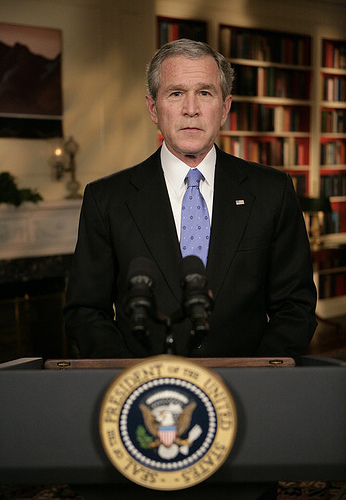 SALON– Halfway through Sunday’s “Meet the Press,” host Tim Russert, interviewing
Republican National Committee chairman Ken Mehlman, asked about a secret,
top-level British government memorandum. Consisting of minutes from a July 23,
2002, meeting attended by Prime Minister Tony Blair and his closest advisors,
the memo revealed their impression that the Bush administration, eight months
before the start of the Iraq war in 2003, had already decided to invade and
that Washington seemed more concerned with justifying a war than preventing
one.
SALON– Halfway through Sunday’s “Meet the Press,” host Tim Russert, interviewing
Republican National Committee chairman Ken Mehlman, asked about a secret,
top-level British government memorandum. Consisting of minutes from a July 23,
2002, meeting attended by Prime Minister Tony Blair and his closest advisors,
the memo revealed their impression that the Bush administration, eight months
before the start of the Iraq war in 2003, had already decided to invade and
that Washington seemed more concerned with justifying a war than preventing
one. 