Leaker of Wikileaks Massacre Video Arrested

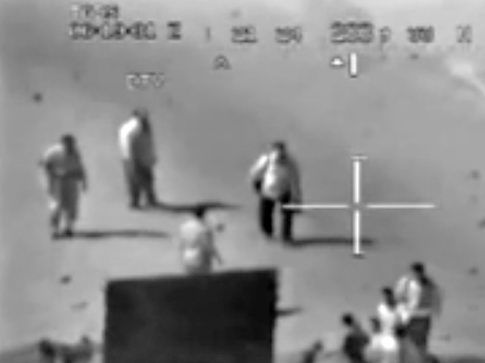
HUFFINGTON POST– According to Wired, federal officials have arrested 22-year-old SPC Bradley Manning, an intelligence analyst with the US Army, for allegedly leaking the “Collateral Murder” Wikileaks video. The controversial video, released in April 2010, shows a 2007 Apache helicopter attack that left several noncombatants dead, including two Reuters employees and three civilians.

Manning was reportedly arrested two weeks ago at Forward Operating Base Hammer near Baghdad, by the Army’s Criminal Investigation Division. “Manning was turned in late last month by a former computer hacker with whom he spoke online,” Wired divulges. The hacker, Adrian Lamo, who has also contributed to Wikileaks, notified the Army when Manning claimed “he leaked a quarter-million classified embassy cables.”

Wired reports:

Manning told Lamo that he enlisted in the Army in 2007 and held a Top Secret/SCI clearance, details confirmed by his friends and family members. He claimed to have been rummaging through classified military and government networks for more than a year and said that the networks contained “incredible things, awful things … that belonged in the public domain, and not on some server stored in a dark room in Washington DC.

“I wouldn’t have done this if lives weren’t in danger,” Lamo told Wired. “He was in a war zone and basically trying to vacuum up as much classified information as he could, and just throwing it up into the air.”

The US Army has called Wikileaks exposés “potentially actionable information” and the Pentagon labeled the organization a “national security threat.”

Read more at Wired.

© HUFFINGTON POST, 2010

Man Tried to Arrest George Bush, Found Guilty of Obstruction

WINNIPEG FREE PRESS– A man who tried to break through a barricade of Calgary police officers to get inside a building where a speech was being given by former U.S. president George W. Bush was found guilty Monday of obstructing a peace officer.

But following sentencing arguments that included remarks of support from former U.S. attorney general Ramsey Clark, John Boncore was released with a conditional discharge that would spare him a criminal record.

Boncore, an actor and carpenter who often uses his aboriginal name Splitting the Sky, was taken into custody when he tried push past a line of police officers outside the downtown building where Bush was speaking in March 2009.

Boncore was with a cluster of activists who were protesting the paid appearance by the former president, who they accuse of war crimes in Afghanistan and Iraq. It was Bush’s first public speech since leaving office.

Clark, who held office in the 1960s under President Lyndon Johnson, has since given legal advice to a number of controversial figures at odds with the U.S. government, including Saddam Hussein and Slobodan Milosevic.

He told court that he has known Boncore, 58, since he was a teenager growing up in the U.S. and that the anti-war activist has thousands of supporters in the country.

“There’s not much I wouldn’t do for John,” said Clark. “He is a passionate and committed man.”

However, Judge Manfred Delong said that Boncore’s testimony was inconsistent. The activist began by testifying that he was trying to put Bush under citizen’s arrest but later admitted that was unlikely and said that he was trying to serve him with papers.

Boncore also admitted that he wanted his actions filmed and that he didn’t truly expect to make it past security.

Boncore testified he only tried to break through the line once and was otherwise simply trying to urge RCMP officers to arrest Bush themselves. However, Delong said he found more credible the police testimony suggesting Boncore tried to force his way past the line multiple times.

Delong said that Boncore passionately believed in his case against Bush, but that doesn’t change his actions.

“His sincerity in holding these views is not at issue in this case,” he said.

Crown prosecutor Tracy Davis argued that Boncore should be fined $1,000. She said his actions were planned and deliberate, and that he should have a criminal record so that police know to watch out for him at future protests.

Defence lawyer Charles Davison said that an absolute discharge would be best, pointing out that Boncore has no criminal record and that even without a criminal record police will have his name and image on file.

Before being sentenced, Boncore said he was willing to accept the consequences of his actions and he still believed he was right about Bush’s need to take responsibility for his administration’s actions.

“If it’s only going to cost me $1,000 to make that point, bring it on,” he told the judge.

Delong gave Boncore a conditional discharge and ordered him to pay $1,000 to a charity of his choice. He will also be on probation for a year and must notify his parole officer if he changes his name, address or job. Once he’s served that time he will not have a criminal record.

Outside court, Boncore said that he plans to pick as his charity a group of architects and engineers who claim that residue from the twin towers following 9-11 proves that they were deliberately blown up. His choice of charity must be approved by his parole officer.

Boncore said he still stands by his actions and he can’t say what he’ll do in the future to protest the former and current U.S. administrations.

“I’m not so sure if I’ll make a citizen’s arrest, but you can believe wherever George Bush (and his former cabinet colleagues) … wherever they come I will be there to voice my opposition.”

© COPYRIGHT WINNIPEG FREE PRESS, 2010

Stonewalled by the C.I.A.

NY TIMES– More than five years ago, Congress and President Bush created the 9/11 commission. The goal was to provide the American people with the fullest possible account of the “facts and circumstances relating to the terrorist attacks of Sept. 11, 2001” — and to offer recommendations to prevent future attacks. Soon after its creation, the president’s chief of staff directed all executive branch agencies to cooperate with the commission.

The commission’s mandate was sweeping and it explicitly included the intelligence agencies. But the recent revelations that the C.I.A. destroyed videotaped interrogations of Qaeda operatives leads us to conclude that the agency failed to respond to our lawful requests for information about the 9/11 plot. Those who knew about those videotapes — and did not tell us about them — obstructed our investigation.

There could have been absolutely no doubt in the mind of anyone at the C.I.A. — or the White House — of the commission’s interest in any and all information related to Qaeda detainees involved in the 9/11 plot. Yet no one in the administration ever told the commission of the existence of videotapes of detainee interrogations.

When the press reported that, in 2002 and maybe at other times, the C.I.A. had recorded hundreds of hours of interrogations of at least two Qaeda detainees, we went back to check our records. We found that we did ask, repeatedly, for the kind of information that would have been contained in such videotapes.

The commission did not have a mandate to investigate how detainees were treated; our role was to investigate the history and evolution of Al Qaeda and the 9/11 plot. Beginning in June 2003, we requested all reports of intelligence information on these broad topics that had been gleaned from the interrogations of 118 named individuals, including both Abu Zubaydah and Abd al Rahim al-Nashiri, two senior Qaeda operatives, portions of whose interrogations were apparently recorded and then destroyed.

The C.I.A. gave us many reports summarizing information gained in the interrogations. But the reports raised almost as many questions as they answered. Agency officials assured us that, if we posed specific questions, they would do all they could to answer them.

So, in October 2003, we sent another wave of questions to the C.I.A.’s general counsel. One set posed dozens of specific questions about the reports, including those about Abu Zubaydah. A second set, even more important in our view, asked for details about the translation process in the interrogations; the background of the interrogators; the way the interrogators handled inconsistencies in the detainees’ stories; the particular questions that had been asked to elicit reported information; the way interrogators had followed up on certain lines of questioning; the context of the interrogations so we could assess the credibility and demeanor of the detainees when they made the reported statements; and the views or assessments of the interrogators themselves.

The general counsel responded in writing with non-specific replies. The agency did not disclose that any interrogations had ever been recorded or that it had held any further relevant information, in any form. Not satisfied with this response, we decided that we needed to question the detainees directly, including Abu Zubaydah and a few other key captives.

In a lunch meeting on Dec. 23, 2003, George Tenet, the C.I.A. director, told us point blank that we would have no such access. During the meeting, we emphasized to him that the C.I.A. should provide any documents responsive to our requests, even if the commission had not specifically asked for them. Mr. Tenet replied by alluding to several documents he thought would be helpful to us, but neither he, nor anyone else in the meeting, mentioned videotapes.

A meeting on Jan. 21, 2004, with Mr. Tenet, the White House counsel, the secretary of defense and a representative from the Justice Department also resulted in the denial of commission access to the detainees. Once again, videotapes were not mentioned.

As a result of this January meeting, the C.I.A. agreed to pose some of our questions to detainees and report back to us. The commission concluded this was all the administration could give us. But the commission never felt that its earlier questions had been satisfactorily answered. So the public would be aware of our concerns, we highlighted our caveats on page 146 in the commission report.

As a legal matter, it is not up to us to examine the C.I.A.’s failure to disclose the existence of these tapes. That is for others. What we do know is that government officials decided not to inform a lawfully constituted body, created by Congress and the president, to investigate one the greatest tragedies to confront this country. We call that obstruction.

Thomas H. Kean and Lee H. Hamilton served as chairman and vice chairman, respectively, of the 9/11 commission.

© COPYRIGHT NY TIMES, 2008

Posted in Uncategorized | 1 Reply

White Fungus #11- Editorial on the Obama Culture

May, 2010

WHITE FUNGUS– Welcome to White Fungus Issue #11 – some falling debris from Taichung City, Taiwan.

Well it’s been a pathetic year for hope, peace and change.

Despite the mood for self-congratulation among liberals and progressives following the election of Obama, the ones with real cause to celebrate were the marketing gurus who ushered in the new feeling of ‘Yes We Can.’

Pipping corporate luminaries such as Apple Computers and Dell, “Brand Obama” was named Advertising Age’s marketer of the year for 2008. The Age’s executives put it succinctly “as we have been marketing candidates like commodities ever since Ronald Reagan, I think this was the best we ever did.”

It was the triumph of feeling and spectacle over achievement of specific policy pronouncements. And despite escalating wars, the capitulation to Wall Street and pseudo posturing on the environment, for many the rallying cry is still ‘patience’, ‘give it time’ and ‘it’s not easy.’

In the face of massive global catastrophes the call is for measured incrementalism towards meager and unsubstantiated goals.

There’s been a tendency to view Obama – the kind of guy liberals would like to have a beer with – as some kind of friend, sweetheart or long lost family member, rather than as the one thing he ascertainably is, a politician.

And while liberals and progressives are now getting antsy, as their positions become increasingly untenable, and their fantasy turns into a nightmare. When it comes to criticizing Obama, the gloves are very much still on.

Talking to Larry King before the recent Afghanistan surge, Michael Moore, one of Bush’s most prominent critics, rallied against escalation but had nothing but praise for the new Decider in Chief.

“I think it’s impressive that he’s a thoughtful man. It’s great to have a smart person in the White House who really thinks about the cost of human life before making a big decision like this… I am so glad we have that man in the White House, even though I may have, whatever disagreements… I know this is weighing on him and I’m going to trust in all my heart that he’s going to make the right decisions….”

Even before the election, Naomi Klein warned Obama supporters that “if you’ve proven you’re a doormat, you can pretty much expect to get stomped on.”

And that has clearly been the pattern for this administration to date: dangle a carrot, such as the ‘public option’ to employ progressives as foot soldiers, then pull the rug out towards the end of the process, tout victory and enact corporate-friendly ‘reform.’

In his prescient article Are Liberals Pathetic?, Chris Hedges quotes Ralph Nadar who asks “What is the breaking point? The escalation of war in Afghanistan? The criminal war in Iraq? Forty-five thousand people dying a year because they can’t afford health insurance? The hollowing out of communities and sending jobs to fascist and communist regimes overseas that know how to put workers in their place? There is no breaking point.”

Hedge concludes: “So here we are again, begging Obama to be Obama. He is Obama. Obama is not the problem. We are.”

© WHITE FUNGUS, 2010

Are Cameras the New Guns?

GIZMODO– In response to a flood of Facebook and YouTube videos that depict police abuse, a new trend in law enforcement is gaining popularity. In at least three states, it is now illegal to record any on-duty police officer.

Even if the encounter involves you and may be necessary to your defense, and even if the recording is on a public street where no expectation of privacy exists.

The legal justification for arresting the “shooter” rests on existing wiretapping or eavesdropping laws, with statutes against obstructing law enforcement sometimes cited. Illinois, Massachusetts, and Maryland are among the 12 states in which all parties must consent for a recording to be legal unless, as with TV news crews, it is obvious to all that recording is underway. Since the police do not consent, the camera-wielder can be arrested. Most all-party-consent states also include an exception for recording in public places where “no expectation of privacy exists” (Illinois does not) but in practice this exception is not being recognized.

Massachusetts attorney June Jensen represented Simon Glik who was arrested for such a recording. She explained, “[T]he statute has been misconstrued by Boston police. You could go to the Boston Common and snap pictures and record if you want.” Legal scholar and professor Jonathan Turley agrees, “The police are basing this claim on a ridiculous reading of the two-party consent surveillance law – requiring all parties to consent to being taped. I have written in the area of surveillance law and can say that this is utter nonsense.”

The courts, however, disagree. A few weeks ago, an Illinois judge rejected a motion to dismiss an eavesdropping charge against Christopher Drew, who recorded his own arrest for selling one-dollar artwork on the streets of Chicago. Although the misdemeanor charges of not having a peddler’s license and peddling in a prohibited area were dropped, Drew is being prosecuted for illegal recording, a Class I felony punishable by 4 to 15 years in prison.

Continue reading at GIZMODO.

Wendy McElroy is the author of several books on anarchism and feminism. She maintains the iconoclastic website ifeminists.net as well as an active blog at wendymcelroy.com.

© COPYRIGHT GIZMODO, 2010

Page 66 of 82<<...6465666768...>>