COMPUTER WORLD– While everyone is concerned about privacy violations from Facebook Places, government agencies may be using powerful new technology to violate Fourth Amendment protection against unreasonable searches.
Here’s what the Fourth Amendment says: “The right of the people to be
secure in their persons, houses, papers, and effects, against
unreasonable searches and seizures, shall not be violated, and no
Warrants shall issue, but upon probable cause, supported by Oath or
affirmation, and particularly describing the place to be searched, and
the persons or things to be seized.”
The spirit of and the letter of this amendment is that government
agencies are not allowed to go on hunting expeditions looking for
violations or transgressions. If government officials want to search
your property, they have to demonstrate good reason why they suspect you
of committing a crime.
Let’s say a small town wanted to crack down on swimming pool permit
violations. If local police went house to house, telling people they
were going to look for swimming pools in everybody’s backyards, nobody
would accept this because it would clearly violate the Fourth Amendment.
However, if you do exactly the same thing using cameras in space, it’s
somehow OK.
The town of Riverhead on Long Island used Google Earth to search all back yards in the town for illegal swimming pools.
They found about 250 pools built without permits and collected about
$75,000 in fines. Critics say they did it for the money, but city
officials said they’re concerned mainly about safety.
There’s no such ambiguity in Greece. Greek officials are spotting
undeclared swimming pools — and they’re definitely doing it for the
money. Faced with a budget crunch, Greece’s government is using Google Earth to hunt for swimming pools, giving officials a justification for collecting extra taxes.
The idea is this: Hey, we need more money. Let’s go find some.
The Greece example is similar in that respect to the use of Google
Earth in the U.K. by fish thieves. In at least 12 documented cases,
exotic-fish thieves used Google Earth to find backyard ponds. The crooks broke into the yards and stole expensive live fish that they intended to sell for big bucks.
The purpose of the Fourth Amendment is to prevent the U.S. government
from doing what Greece’s government is doing, which is essentially what
U.K. fish thieves are doing: Using arbitrary searches to hunt for
opportunities to take something away from people.
Here’s the problem. If one town sets a precedent that’s it’s OK to
violate Fourth Amendment protections as long as you use satellite
imagery, then any government can do the same for any reason. And the
technologies and methods for doing so are becoming very sophisticated.
A company called Remote Sensing Metrics is buying satellite pictures
from privately owned satellite photography companies including
DigitalGlobe and GeoEye, then it’s using those images to count cars in
Wal-Mart parking lots and selling analysis of the data to hedge funds
and other analysts. They’re selling it as a package discreetly billed as
“satellite parking lot fill rate analysis.”
Other firms are monitoring crops to better predict commodity pricing for wheat, corn and so on.
The New York Police Department already uses satellite imagery to
fight crime. It tracks crimes, looks for clusters where many crimes are
occurring together and then floods those locations with police officers.
Those all sound like legitimate and creative uses for new technology. But where is it all going?
Once you combine all-seeing satellite imagery with sophisticated
computerized number-crunching, you end up with massive potential for
abuse — especially by government agencies.
One might imagine a dystopian future where automated systems
constantly scan every house in the country to find all kinds of things,
from heat escaping the house to backyard barbecues or the number of
people coming and going from every house.
It’s the ol’ slippery slope argument, but it must be taken seriously.
If it’s OK for municipal officials to peek into every backyard in
Riverhead to find a handful of pool-permit violators, why would it not
be acceptable for other agencies to look at all homes and businesses in
the nation for a much wider variety of potential violations?
And if it’s OK to do that using satellite imagery, what about using other technologies?
A company called American Science and Engineering sells a high-end, tricked-out security vehicle called the Z Backscatter Van. Its sole purpose, if used by government agencies, is to violate the Fourth Amendment.
The van sits there by the side of the road and X-rays cars passing
by. It’s like a full-body scan at the airport, but for cars. The
manufacturer brags about the fact that the van keeps a “low profile.”
The Web site says: “The system is unobtrusive, as it maintains the
outward appearance of an ordinary van.”
What the van does is conduct unreasonable searches without probable
cause and without the knowledge of the person who owns the property
being searched. That’s its only function.
American Science and Engineering would no doubt argue that it’s
selling the van to private companies, which raises yet another question.
Is it acceptable for private companies to engage in activity that would
be a Fourth Amendment violation if it were done by a government agency?
Private security companies can’t search your home without a warrant,
and they can’t pull you over and search your car. So why can they search
your car with an X-ray scanner?
Within a few years, we’ll have technology that can see through walls
on a large scale. We’ll be able to feed the data into supercomputers and
get information about trends and other analysis.
We need to figure out what’s OK and what isn’t. The first step is to
apply the Fourth Amendment to searches conducted without probable cause
via Google Earth.
Riverhead officials should be forced to give back all fees collected
for unpermitted swimming pools, for example, and banned from future
hunting expeditions.
Technology should not be used to exempt government agencies from the
Constitution. Unfortunately, technology empowers governments to violate
our rights with ruthless efficiency.
I wonder if satellites can detect America’s Founding Fathers rolling over in their graves?
Mike Elgan writes about technology and global tech culture. Contact Mike at [email protected], follow him on Twitter @mike_elgan, or read his blog, The Raw Feed.
© COMPUTER WORLD, 2010



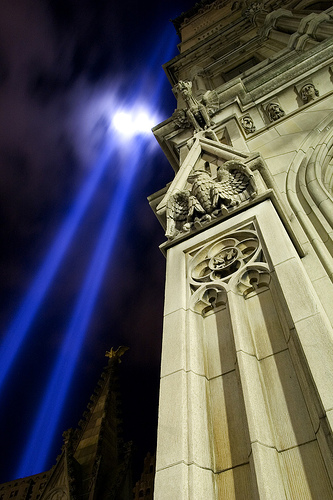 FORBES– On the eve of the 9th anniversary of 9/11, support for the war in
Afghanistan took a serious blow. Simultaneous press conferences
were held in New York and Los Angeles to present startling new information refuting the official 9/11
narrative, used to justify the war. Also announced were three major
professional groups which have joined the worldwide, and ever-growing,
“9/11 Truth Movement.”
FORBES– On the eve of the 9th anniversary of 9/11, support for the war in
Afghanistan took a serious blow. Simultaneous press conferences
were held in New York and Los Angeles to present startling new information refuting the official 9/11
narrative, used to justify the war. Also announced were three major
professional groups which have joined the worldwide, and ever-growing,
“9/11 Truth Movement.”