Corporations Show Largest Profit in History Amidst Crisis

FIREDOGLAKE–  According to revised statistics, the US economy grew at a faster rate than first expected, up to 2.5%. Earlier growth in Q3 2010 was estimated at 2%. But the entire problem with looking at this topline number is reflected in these three paragraphs:

photo by refracted moments/flickrBut the most recent increase in GDP still isn’t strong enough to make a dent in the country’s high unemployment rate, stuck at 9.6% in recent months. Analysts say GDP growth of at least 3% is needed to bring down the jobless figure, but many don’t expect the economy to perform that well in the fourth quarter or early next year.

The Federal Reserve’s latest economic outlook, to be released later Tuesday, is likely to reflect concerns among policymakers that unemployment will remain very high in the U.S. for the foreseeable future.

American corporations, on the other hand, have rebounded robustly from the recession. Tuesday’s report showed corporate profits jumped 28% in the third quarter from a year earlier, to an annualized total of $1.66 trillion. That’s a record high and reflects deep cost-cutting in the past and increases in demand for goods and services.

That’s right. Despite record unemployment, and no hope for reductions cleaa rerly in sight, corporations have experienced all-time record profits, the highest since the Commerce Department started tracking the figure 60 years ago. They’ve learned to produce as many or more goods without workers.

This is something of a dream for corporate America – bigger profits without those meddling workers to pay. This is the seventh straight quarter of corporate profit growth, with none of those benefits being shared with the working class. “Uncertainty” is blamed for the lack of job growth, but corporations are sitting on giant mounds of cash while they bask in the glow of their strategy to increase their profit margins by cost-cutting.

The other part of this is that multinational corporations are reaping profits from increased consumer spending in China and India. Their markets there have expanded greatly in the past few years.

In the other side of the funhouse mirror, American workers continue to have little hope for returning to the job. They are anxious about their future prospects, and while they continue to spend on necessities, they have trouble with the more substantive payments. Foreclosures and defaults continue unabated, and home sales have dropped, which will probably lead to lower home prices.

But capitalism is working, and the great malefactors of wealth are happy. Happy Thanksgiving.

article by David Dayen of Firedoglake.com

photograph by Refracted Moments/flickr

© 2010 Firedoglake.com


Torture, Secret Wars, U.S. Disdain for Justice & More

photo by jan kromerDemocracy Now! has spent this week examining the revelations behind the first installments of State cables released by WikiLeaks on Sunday. Below is a collection of the outlet’s interviews and broadcasts covering torture, renditions, secret U.S. War Ops in Pakistan, U.S. pressure on other countries to thwart justice, and the most startling leaks that have yet to come.


WikiLeaks Reveals U.S. Tried to Thwart Spanish Probes of Gitmo Torture and CIA Renditions

The latest disclosures from the massive trove of diplomatic cables published by WikiLeaks reveal U.S. officials tried to influence Spanish prosecutors and government officials to drop court investigations into torture at Guantánamo Bay and CIA extraordinary rendition flights. We speak to Scott Horton, an attorney specializing in international law and human rights and a contributing editor of Harper’s Magazine.


Leaked Cables Reveal U.S. Pressured Spain to Drop Case of Cameraman Killed in 2003 Attack on Journalists in Baghdad

Leaked U.S. embassy cables from Madrid reveal the United States pressured the Spanish government to close a court case brought by the family of a Spanish cameraman, José Couso. Couso was killed in Baghdad when a U.S. Army tank fired on the Palestine Hotel, which was filled with journalists, on April 8, 2003. Three U.S. soldiers have been indicted in Spanish court for Couso’s death. “I am outraged,” says Javier Couso, the brother of José Couso. “I can’t believe my government conspired with a foreign government… It seems we are citizens, or at least a small province, of the empire of the United States.”


Jeremy Scahill: WikiLeaks Cables Confirm Secret U.S. War Ops in Pakistan

Despite sustained denials by the Pentagon, the leaked cables from WikiLeaks confirm that U.S. military special operations forces have been secretly working with the Pakistani military to conduct offensive operations and coordinate drone strikes in the areas near the Afghan border. A U.S. embassy cable from October of 2009 states: “These deployments are highly politically sensitive because of widely-held concerns among the public about Pakistani sovereignty and opposition to allowing foreign military forces to operate in any fashion on Pakistani soil.” The cables confirm aspects of a story about the covert U.S. war in Pakistan published in The Nation magazine last year by investigative journalist and Democracy Now! correspondent Jeremy Scahill.


“We Have Not Seen Anything Yet”: Guardian Editor Says Most Startling WikiLeaks Cables Still to be Released

In the coming days, we are going to see some quite startling disclosures about Russia, the nature of the Russian state, and about bribery and corruption in other countries, particularly in Central Asia,” says Investigations Executive Editor David Leigh at the Guardian, one of the three newspapers given advanced access to the secret U.S. embassy cables by the whistleblower website, WikiLeaks. “We will see a wrath of disclosures about pretty terrible things going on around the world.” Leigh reviews the major WikiLeaks revelations so far, explains how the 250,000 files were downloaded and given to the newspaper on a thumb drive, and confirms the Guardian gave the files to the New York Times. Additional cables will be disclosed throughout the week.


U.N. Special Rapporteur Juan Méndez: Instead of Focusing on Assange, U.S. Should Address WikiLeaks Disclosure of Torture

One of the leaked U.S. State Department cables released by WikiLeaks urges diplomats to gather intelligence about “plans and intentions of member states or U.N. Special Rapporteurs to press for resolutions or investigations into U.S. counter-terrorism strategies and treatment of detainees in Iraq, Afghanistan or Guantanamo.” We speak to Juan Méndez, the new U.N. Special Rapporteur on Torture and Other Cruel, Inhuman and Degrading Treatment or Punishment. He has called on the United States to investigate and prosecute torture committed under former President George W. Bush. He also said he hopes to visit Iraq and Guantánamo Bay to probe widespread torture allegations. Méndez says, “We seem to be focusing on whether disclosing [the cables] merits some kinds of action against Julian Assange… I am very concerned about the documents that show that thousands of people first imprisoned by U.S. forces [were] transferred to the control of forces in Iraq and perhaps even in Afghanistan, where they knew they were going to be tortured.”


photograph by Jan Krömer 


FBI Apparently Set Up Teen Blamed for Fake Car Bomb

RAW STORY– A Somali-born, American teenager was apparently set up by federal law enforcement officials who posed as radical Islamic fighters and lured the young man into a plot he believed would lead him to detonate a car bomb at an Oregon Christmas tree lighting ceremony.

The bomb, provided by FBI agents, was “inert” and did not pose a threat to public safety, according to the US Attorney’s Office in Oregon.

Oddly enough, Arthur Balizan, an FBI agent in Oregon, contradicted the US Attorney’s Office, suggesting that the threat posed by 19-year-old Mohamed Osman Mohamud “was very real.”

Except: “[At] every turn,” he explained, “we denied him the ability to actually carry out the attack.”

The story rings devastatingly familiar when stacked next to the tale of Hosam Maher Husein Smadi, a Jordanian man arrested in 2009, at age 19, for allegedly planning to detonate a car bomb in a Dallas skyscraper.

Each boy was led down the path to imagined violence by federal agents, with authorities ultimately providing fake bombs in both cases. Smadi and Mohamud, officials claim, expressed a desire to engage in terrorist attacks before agents began luring them in.

Continue reading about the FBI setting up the teen blamed for the fake car bomb here.

Photograph by Flickr user dnewman8


$11,000 Fine, Possible Arrest to Refuse Scans, Pat Downs

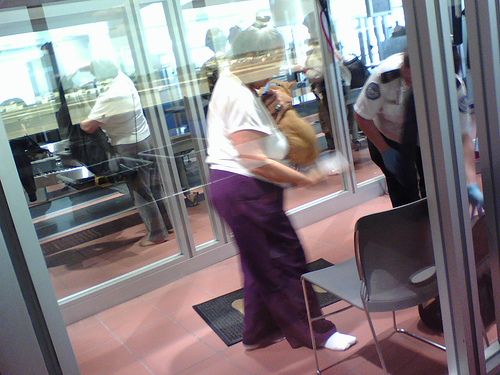
PALM BEACH POST– If you don’t want to pass through an airport scanner that allows security agents to see an image of your naked body or to undergo the alternative, a thorough manual search, you may have to find another way to travel this holiday season.

The Transportation Security Administration (TSA) is warning that any would-be commercial airline passenger who enters an airport checkpoint and then refuses to undergo the method of inspection designated by TSA will not be allowed to fly and also will not be permitted to simply leave the airport.

That person will have to remain on the premises to be questioned by the TSA and possibly by local law enforcement. Anyone refusing faces fines up to $11,000 and possible arrest.

“Once a person submits to the screening process, they can not just decide to leave that process,” says Sari Koshetz, regional TSA spokesperson, based in Miami.

Koshetz said such passengers would be questioned “until it is determined that they don’t pose a threat” to the public.

Palm Beach Sheriff’s Office spokesperson Teri Barbera said PBSO deputies stationed at the airport would become involved when requested by the TSA.

“We will handle each incident on a case-by-case basis,” she said.

Read full article HERE.

© PALM BEACH POST, 2010

Photo by The Consumerist on flickr

FACT SHEET: Know Your Passenger Rights on TSA Opt-Out Day

MR Original – Moves that Eliminate Rights and Privacy

photo by by charles fettinger/flickrMEDIA ROOTS- Two important news stories this past week illuminate a trend toward the crumbling privacy rights of the public, while corporations are expanding their rights to trump those of living, breathing American citizens.

Back in September, the New York Times reported that the Obama administration’s Internet Wiretapping Proposal was Met with Silence. Last week, the story continues with the report that FBI Director Robert Mueller met on Tuesday with top executives of several Silicon Valley firms including Google and Facebook, in an intensified push to expand government wiretapping of online communications.

This move would be carried out by an expansion of the 1994 Communications Assistance for Law Enforcement Act, which, at present, requires phone and broadband network providers to immediately comply with wiretapping orders.

In this story we learn that companies such as Google, Facebook, Yahoo, Microsoft and Research in Motion, as well as providers of encrypted email and messaging services like Skype, would be required to design systems to intercept and decode encrypted messages. Any services that are based overseas and accessed by users in the United States would also be mandated to re-route communications through a server on US soil for accessible wiretapping.

The second story comes from the independent press– As the government’s surveillance program further closes in on our privacy and threatens the constitutional rights of Americans, AT&T is making precedent setting challenge to the Freedom of Information Act (FOIA) in a Supreme Court battle that could remove what transparency is left regarding corporate activity. AT&T is doing this by invoking FOIA exemptions that are created to help protect an individual’s private data by claiming to be a “corporate citizen” entitled to “personal privacy.”

The Electronic Frontier Foundation (EFF) and a coalition of public interest groups urged the U.S. Supreme Court on Tuesday in an amicus brief to reject “privacy” protections for corporations under FOIA, arguing that the intent of FOIA’s privacy provisions have always been unmistakably interpreted by law to protect individuals, not corporations.

In an article for the EFF Rebecca Jeschke explains,

If AT&T is allowed to expand the law’s privacy protections to “corporate citizens” then broad new swaths of previously public records will be hidden from view. It’s not hard to imagine how documents on the BP oil spill, or coal mine explosions, or the misdeeds of Bernie Madoff’s investment firm might be significantly harder to find if AT&T’s misguided arguments prevail.

But this is only the most obvious problem with the idea of “personal privacy” for “corporate citizens.” Currently, government agencies routinely post reports and data about corporate activities on their websites without a specific FOIA request. But under the appeals court decision, this kind of free flow of information will be chilled by the fear of a lawsuit. Additionally, this interpretation of the FOIA would require government agencies to consult with corporations before the release of any information that arguably implicated their “privacy” interests. This would create more delays in an already lengthy FOIA process, and allow even more opportunities for corporations to block important records from the public eye. Tellingly, corporate entities would end up enjoying more privacy protections than the law currently affords individuals, who are not given any notice about potential record releases under FOIA.

Unfortunately, Citizens United v. Federal Elections Commission already set the legal precedent that AT&T will rely on to claim this victory. How will the Supreme Court be able to deny AT&T, and other corporations, the protections that human individuals receive under FOIA, when the Supreme Court has already baptized corporations as constitutionally protected individuals, like you or I?

Shadowed by the mainstream media’s studious disregard, corporations continue to claim victory over a fight to expand their power and domain, while the citizens of this country struggle to maintain their rights and increasingly eroded political clout.

Many democrats and progressives that helped to elect Obama through a record number of individual financial contributions believed that his administration would stop the corporate power push, while restoring our civil liberties. On the campaign trail, Obama promised to restrict the warrantless wiretaps of the Bush administration’s Orwellian Uniting and Strengthening America by Providing Appropriate Tools Required to Intercept and Obstruct Terrorism Act, also known as the USA PATRIOT ACT. Yet, when it comes to protecting our civil rights, this President is no different than his predecessor– in February, Obama signed the PATRIOT ACT extension without reform.

Then, as if Obama had never been educated in Constitutional Law or held qualm with the illegal wiretapping under Bush, he stood in defense of warrantless wiretapping while invoking the State Secrets Privilege. Thankfully, in March, a federal judge deemed the National Surveillance Agency’s program of warrantless wiretapping illegal, despite the Obama administrations attempts to dismiss the suit by claiming a trial would lead to the disclosure of “state secrets”.

Interestingly, attorney Steven Goldberg explains in an interview with DemocracyNow! that there have been warrantless wiretapping cases that have not been allowed to proceed in court, because people could not prove that they had been wiretapped. Goldberg represented an Islamic charity that filed suit against the government after receiving a classified document that proved them victims of warrantless eavesdropping. This is the case that brought forward the decision against the NSA, and it is the only case that has been able to prove wiretapping.

It is difficult to know how the government is using its extensive surveillance powers or what other privileges may be drafted and justified through propagandized fear and base emotion. As our government and courts paved the path for the expanding power and influence of corporations, elected leaders and unelected businessmen are working close together shaping policies and ideas as they share positions in think tanks, on boards of directors and in political cabinets. An authoritarian government begins to emerge when unelected leaders join government leaders to institute laws and policies that serve their interest above those of the people, whose rights and political influence are increasingly diminished to nothing more than the symbolic act of voting.

Article by alicia, editor for Media Roots

Image by charles fettinger/flickr


Page 58 of 82<<...5657585960...>>