Obama Seeks Patriot Act Extension

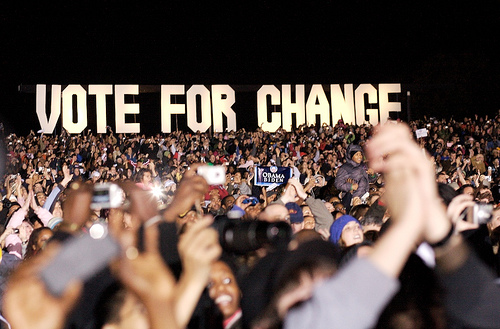
RAW STORY– Faced with a looming vote on a planned one-year extension of special powers authorized in the USA PATRIOT Act, the Obama White House did not object or propose reforms, as the president vowed to do as a candidate.

The Obama administration instead asked Congress to grant those powers for an additional three years.

As a US Senator and candidate for the presidency, Barack Obama never actually argued for a repeal of the Bush administration’s security initiatives. Instead, he’s consistently argued for enhanced judicial oversight and a pullback on the most extreme elements of the bill, such as the use of National Security Letters to search people’s personal records without a court-issued warrant.

While many in his own party opposed the PATRIOT Act outright, as president Obama has said repeatedly that the emergency measures remain a valuable tool for law enforcement engaged in national security prerogatives.

On Tuesday, ahead of a House vote to reauthorize the PATRIOT Act for another year, the White House did something unexpected: they asked for even more.

A prepared statement issued Tuesday afternoon said that President Obama “would strongly prefer enactment of reauthorizing legislation that would extend these authorities until December 2013.”

Read full article about Obama Seeking Patriot Act Extension.

© Copyright RAW STORY 2011

Photo by wiredbike flickr user

Lobbyists: Obama Cabinet Hides Meetings Off-Site

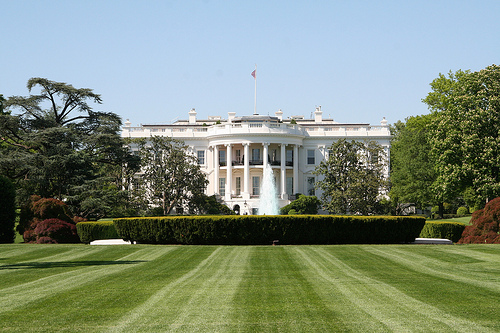
POLITICO– Caught between their boss’s anti-lobbyist rhetoric and the reality of governing, President Barack Obama’s aides often steer meetings with lobbyists to a complex just off the White House grounds – and several of the lobbyists involved say they believe the choice of venue is no accident.

It allows the Obama administration to keep these lobbyist meetings shielded from public view — and out of Secret Service logs collected on visitors to the White House and later released to the public.

“They’re doing it on the side. It’s better than nothing,” said immigration reform lobbyist Tamar Jacoby, who has attended meetings at the nearby Jackson Place complex and believes the undisclosed gatherings are better than none.

The White House scoffs at the notion of an ulterior motive for scheduling meetings in what are, after all, meeting rooms. But at least four lobbyists who’ve been to the conference rooms just off Lafayette Square tell POLITICO they had the distinct impression they were being shunted off to Jackson Place – and off the books – so their visits wouldn’t later be made public.

Obama’s administration has touted its release of White House visitors logs as a breakthrough in transparency, as the first White House team ever to reveal the comings and goings around the West Wing and the Old Executive Office Building.

The Jackson Place townhouses are a different story.

There are no records of meetings at the row houses just off Lafayette Square that house the White House Conference Center and the Council on Environmental Quality, home to two of the busiest meeting spaces. The White House can’t say who attended meetings there, or how often. The Secret Service doesn’t log in visitors or require a background check the way it does at the main gates of the White House.

Read more about Lobbyists: Obama White House Hides Meetings Off-Site.

Written by Chris Frates

© Copyright POLITICO, 2011

Photo by MCS@flickr flickr user

Serious Doubt Cast on FBI’s Anthrax Case Against Ivins

SALON.COM– For years, the FBI believed that it had identified the perpetrator of the 2001 anthrax attacks — former Army researcher Steven Hatfill — only to be forced to acknowledge that he wasn’t involved and then pay him $5.8 million for the damage he suffered from those false accusations.   In late July, 2008, the FBI announced that, this time, it had identified the Real Perpetrator:  Army researcher Bruce Ivins, who had just committed suicide as a result of being subjected to an intense FBI investigation.  Ivins’ death meant that the FBI’s allegations would never be tested in a court of law.

From the start, it was obvious that the FBI’s case against Ivins was barely more persuasive than its case against Hatfill had been.  The allegations were entirely circumstantial; there was no direct evidence tying Ivins to the mailings; and there were huge, glaring holes in both the FBI’s evidentiary and scientific claims.  So dubious was the FBI’s case that even the nation’s most establishment media organs, which instinctively trust federal law enforcement agencies, expressed serious doubts and called for an independent investigation (that included, among many others, the editorial pages of The Washington Post, The New York Times, and The Wall Street Journal) Mainstream scientific sources were equally skeptical; Nature called for an independent investigation and declared in its editorial headline:  “Case Not Closed,” while Dr. Alan Pearson, Director of the Biological and Chemical Weapons Control Program at the Center for Arms Control and Non-Proliferation — representative of numerous experts in the field — expressed many scientific doubts and also demanded a full independent investigation.  I devoted much time to documenting just some of the serious flaws in the FBI’s evidentiary claims, as well as the use of anonymous FBI leaks to unquestioning reporters to convince the public of their validity (see here, here, here, and here).

Doubts about the FBI’s case were fully bipartisan.  In August, 2008, The New York Times documented “vocal skepticism from key members of Congress.”  One of the two intended Senate recipients of the anthrax letters, Sen. Patrick Leahy, flatly stated at a Senate hearing in September, 2008, that he does not believe the FBI’s case against Ivins, and emphatically does not believe that Ivins acted alone.  Then-GOP Sen. Arlen Specter, at the same hearing, told the FBI they could never have obtained a conviction against Ivins in court based on their case — riddled, as it is, with so much doubt — and he also demanded an independent evaluation of the FBI’s evidence.  And in separate interviews with me, GOP Sen. Charles Grassley and Democratic Rep. Rush Holt (a physicist who represents the New Jersey district from which the anthrax letters were mailed) expressed substantial doubts about the case against Ivins and called for independent investigations.

Continue reading about Serious Doubt Cast on FBI’s Anthrax Case Against Bruce Ivins.

Written by Glenn Greenwald

Copyright ©2011 Salon Media Group, Inc.

Photo of Bruce Ivins from Wikipedia

Obama Suggests Mubarak Regime Didn’t Abuse Protesters

DEMOCRACY NOW! – Obama Suggests Mubarak Regime Didn’t “Shoot, Beat, Arrest” Protesters

On Tuesday, President Obama addressed the protests in Iran and across the Middle East at a news conference in Washington, D.C. Comparing the Iranian government’s crackdown on protesters with Egypt’s, Obama appeared to suggest the U.S.-backed Mubarak regime did not also try to violently repress the recent uprising.

President Obama: “What has been true in Egypt should be true in Iran, which is, is that people should be able to express their opinions and their grievances and seek a more responsive government. What’s been different is the Iranian government’s response, which is to shoot people and beat people and arrest people. And my hope and expectation is, is that we’re going to continue to see the people of Iran have the courage to be able to express their yearning for greater freedoms and a more representative government.”

Obama also defended his administration’s handling of the Egyptian uprising, claiming he wanted to avoid the appearance of meddling in pushing for a transition. But Obama refused to acknowledge that two top officials—Secretary of State Hillary Clinton and special envoy Frank Wisner—voiced support for Mubarak’s regime.

President Obama: “What we didn’t do was pretend that we could dictate the outcome in Egypt, because we can’t, so we were very mindful that it was important for this to remain an Egyptian event, that the United States did not become the issue, but that we sent out a very clear message that we believed in an orderly transition, a meaningful transition, and a transition that needed to happen not later, but sooner, and we were consistent on that message throughout.”

Democracy Now! also reports that as the Mideast “rolling revolution” grows, the U.S. dounces the Iranian crackdown, while remaining silent on the brutal repression and death of protestors in Bahrain, a key ally.


The transcript of this story can be found here: U.S. stays silent on key ally, Bahrain.

For more on the Bahrain crackdown, see the story by Democracy Now! – “People Are Bleeding in the Streets:” Bahrain Police Wage Brutal Overnight Attack on Hundreds of Pro-Democracy Protesters.

Check out Democracy Now! for more coverage of the Mideast ‘Rolling Revolution’.

© Copyright Democracy Now!, 2011

Obama Suggests Mubarak Gov Didn’t Abuse Protesters

DEMOCRACY NOW! – Obama Suggests Mubarak Regime Didn’t “Shoot, Beat, Arrest” Protesters

On Tuesday, President Obama addressed the protests in Iran and across the Middle East at a news conference in Washington, D.C. Comparing the Iranian government’s crackdown on protesters with Egypt’s, Obama appeared to suggest the U.S.-backed Mubarak regime did not also try to violently repress the recent uprising.

President Obama: “What has been true in Egypt should be true in Iran, which is, is that people should be able to express their opinions and their grievances and seek a more responsive government. What’s been different is the Iranian government’s response, which is to shoot people and beat people and arrest people. And my hope and expectation is, is that we’re going to continue to see the people of Iran have the courage to be able to express their yearning for greater freedoms and a more representative government.”

Obama also defended his administration’s handling of the Egyptian uprising, claiming he wanted to avoid the appearance of meddling in pushing for a transition. But Obama refused to acknowledge that two top officials—Secretary of State Hillary Clinton and special envoy Frank Wisner—voiced support for Mubarak’s regime.

President Obama: “What we didn’t do was pretend that we could dictate the outcome in Egypt, because we can’t, so we were very mindful that it was important for this to remain an Egyptian event, that the United States did not become the issue, but that we sent out a very clear message that we believed in an orderly transition, a meaningful transition, and a transition that needed to happen not later, but sooner, and we were consistent on that message throughout.”

Democracy Now! also reports that as the Mideast “rolling revolution” grows, the U.S. dounces the Iranian crackdown, while remaining silent on the brutal repression and death of protestors in Bahrain, a key ally.


The transcript of this story can be found here: U.S. stays silent on key ally, Bahrain.

For more on the Bahrain crackdown, see the story by Democracy Now! – “People Are Bleeding in the Streets:” Bahrain Police Wage Brutal Overnight Attack on Hundreds of Pro-Democracy Protesters.


Check out Democracy Now! for more coverage of the Mideast ‘Rolling Revolution’.


© Copyright Democracy Now!, 2011


Page 54 of 82<<...5253545556...>>