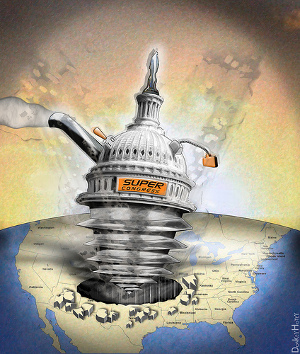
Wall Street Donated $41 Million to Supercommittee

MEDIA ROOTS- It’s not very comforting to know that Wall Street lobbyists have been paying off members of the very committee in charge of finding $1.5 trillion worth of deficit measures. Can’t count much on “shared sacrifice” from the banks with bribery like this taking place on the hill.

Abby

***

TRUTHOUT– Wall Street has given $41 million in campaign contributions to the members of the Congressional “supercommittee” charged with finding $1.5 trillion worth of deficit reduction measures, according to a report released today by two watchdog groups.

The finance, insurance and real estate sector spent $3.7 billion on lobbying and campaign contributions from 1999 to 2008, according to the report, and the 12 members of the bipartisan Joint Select Committee on Deficit Reduction have all reaped the benefits.

Congressional veterans Sen. John Kerry (D-Massachusetts) and Sen. Max Baucus (D-Montana) top the list, having each received about $6 million in contributions from the financial sector during the course of their careers in Washington. The top GOP recipient on the committee, Sen. Jon Kyl (R-Arizona), has received $5.2 million from the sector.

Donations from the political action committees and executives of Bank of America, JPMorgan Chase and Wells Fargo – banks that received $95 billion in federal bailout funds – account for one-fifth of the $4.3 million in campaign cash donated by commercial banking interests to the 12 supercommittee members.

The report also identifies 27 former or current aides to supercommittee members who have worked as lobbyists for the financial industry. Manny Rossman, for example, was Kyl’s chief of staff before landing a position at the Breaux Lott Leadership Group, where his clients include Citigroup, Goldman Sachs and Prudential Financial.

“Wall Street bought the deregulation that led to our economic collapse and the American public has paid the price,” said Nick Nyhart, president and CEO of Public Campaign, the group that co-authored the report. “The supercommittee should not give Wall Street and big banks another free ride because of their campaign cash.”

Wall Street has given $41 million in campaign contributions to the members of the Congressional “supercommittee” charged with finding $1.5 trillion worth of deficit reduction measures, according to a report released today by two watchdog groups.
The finance, insurance and real estate sector spent $3.7 billion on lobbying and campaign contributions from 1999 to 2008, according to the report, and the 12 members of the bipartisan Joint Select Committee on Deficit Reduction have all reaped the benefits.
Congressional veterans Sen. John Kerry (D-Massachusetts) and Sen. Max Baucus (D-Montana) top the list, having each received about $6 million in contributions from the financial sector during the course of their careers in Washington. The top GOP recipient on the committee, Sen. Jon Kyl (R-Arizona), has received $5.2 million from the sector.
Donations from the political action committees and executives of Bank of America, JPMorgan Chase and Wells Fargo – banks that received $95 billion in federal bailout funds – account for one-fifth of the $4.3 million in campaign cash donated by commercial banking interests to the 12 supercommittee members.
“Wall Street bought the deregulation that led to our economic collapse and the American public has paid the price,” said Nick Nyhart, president and CEO of Public Campaign, the group that co-authored the report. “The supercommittee should not give Wall Street and big banks another free ride because of their campaign cash.”

Read more about Wall Street Donated $41 Million to Supercommittee Members

© 2011 Truthout

Photo by Flickr user DonkeyHotey


Obama: A Candidacy Based on Failed Promises

MEDIA ROOTS- After seeing this pro Obama ‘gangsta’ meme circulating on facebook this morning, we felt the need to provide a quick rebuttal to the alleged accomplishments it touts.

Here’s what I promised again and again to do that I didn’t do:

I didn’t close Guantanamo Bay. Sure, it was a cornerstone of my campaign, but still. Terrorists gonna terrorize.

I didn’t repeal the Bush tax cuts. In fact, I extended them.

I didn’t negotiate the health care reform ideas in public or televised sessions, as promised.

In fact, remember when I said this in 2007? “I will sign a universal health care bill into law by the end of my first term as president that will cover every American” – Yeah, I was just kidding. What we’re going to do instead is force you to BUY insurance, or we’ll fine you – and if you don’t pay that fine, you’ll go to jail.

I didn’t sign the Employee Free Choice act, making it easy for workers to unionize and protect themselves from thug political bullying, like what happened in Wisconsin.

I didn’t forbid companies going into bankruptcy from giving executive bonuses.

I didn’t allow imported prescription drugs to save citizens money.

I didn’t form an international group to help the millions of displaced Iraq refugees who were pushed out of their country because of a decade long bombing campaign for a terrorist act they had nothing to do with.

I didn’t withdraw from Afghanistan– instead I added more troops. In the case of Iraq, I replaced some troops with corporate thugs-for-hire. Now private military contractors make up half of our force in both countries.

I didn’t double funding for afterschool programs, as I repeatedly promised to do.

I didn’t instill tougher rules against lobbyists. In fact, I did the opposite, and even hired a couple for cabinet positions!

I didn’t use any revenue from cap and trade to support clean energy and environmental restoration.

But yeah, I gave the order to kill a guy in Pakistan and dump his body in the ocean mafia style.

And yeah, I gave the order to drop some million dollar missiles in Libya.

And yeah, I bailed out Wall Street with taxpayer money and then offered nothing to the people, while those same swindling fatcats showered one another with “job creation” money – without creating a single fucking job.

Awesome choices we are given by the establishment: choose between hysterical and unthinkably dangerous creationist caricatures or a lying right wing Republican in Democrat’s clothes who solely serves corporate America while breaking off tiny token crumbs in perfect sync with the election cycle. Obama is just Bush with an iPod. And we are duped into thinking that the sliver of hardened shit might turn to gold if we ‘hope’ hard enough.

Written by Johnny Firecloud, Founder, Managing Editor of Antiquiet.com


In California, Much Is Officially Secret

MEDIA ROOTS- There are some things that are justifiably kept secret within the state bureaucracy, like personal data and information about residents. However, the expansion of secrecy in every avenue of California’s government has made it increasingly difficult to gauge its efficiency and affect change at the legislative level.

Surprisingly, lawmakers’ schedules are withheld from public record, widening the divide between the people and the government by limiting a constituency’ ability to shape policy or voice their opinions to representatives. The OC Register recently compiled a report detailing the era of secrecy that reveals how much is actually being kept secret, and why.

Abby

***

OC REGISTER– Secrecy has seeped into every corner of state government, making it difficult to gauge Sacramento’s effectiveness and discretion. An Orange County Register review of the Government Code found at least 500 provisions that exempt specific records or information from public disclosure while another 16 code sections prohibit the release of broad categories of documents, including every complaint filed with a licensing body or investigatory agency, all communications with members of the Legislature and any document whose release does not serve the public interest.

Official secrets are held in every office and department in state government, from food and agriculture, public health and the DMV to corrections, social services and the Legislature, where the Assembly recently made headlines (and drew a lawsuit) over its refusal to release documents related to members’ current budgets.

California’s deference to secrecy is often couched as a public service, and indeed much of the information held in confidence actually protects residents. Nobody wants the government giving out Social Security numbers or publicly releasing the results of AIDS tests. But the Government Code is also littered with exemptions that freedom of information advocate Terry Francke criticizes as “hard to justify.” Why are the names of asparagus producers, red light camera photos and the urine tests of race horses confidential?

CAPITOL’S BLACK BOX

Nothing is more valuable in Sacramento than access. If you can get a meeting with a lawmaker, you can influence votes and shape public policy. Among Capitol insiders, the personal meeting is thought to be among the most important parts of the legislative process.

How do you get a meeting with a lawmaker? Many legislators pride themselves on taking meetings with any constituent who asks, but it’s widely believed that most lawmakers reserve their time for campaign contributors. In fact, some insiders say lawmakers make no effort to hear both sides of an issue, that they only take meetings with the side that gave them money.

It’s difficult to see if that’s true, however, because both houses of the Legislature say that lawmakers’ schedules are secret – even if legislators want to release them. The Rules Committees of the Senate and the Assembly prevented lawmakers from disclosing their schedules when reporters asked for them earlier this year, saying that the committees, not the lawmakers themselves, actually have possession of the documents.

Secrecy has seeped into every corner of state government, making it difficult to gauge Sacramento’s effectiveness and discretion. An Orange County Register review of the Government Code found at least 500 provisions that exempt specific records or information from public disclosure while another 16 code sections prohibit the release of broad categories of documents, including every complaint filed with a licensing body or investigatory agency, all communications with members of the Legislature and any document whose release does not serve the public interest. Official secrets are held in every office and department in state government, from food and agriculture, public health and the DMV to corrections, social services and the Legislature, where the Assembly recently made headlines (and drew a lawsuit) over its refusal to release documents related to members’ current budgets.
California’s deference to secrecy is often couched as a public service, and indeed much of the information held in confidence actually protects residents. Nobody wants the government giving out Social Security numbers or publicly releasing the results of AIDS tests. But the Government Code is also littered with exemptions that freedom of information advocate Terry Francke criticizes as “hard to justify.” Why are the names of asparagus producers, red light camera photos and the urine tests of race horses confidential?
CAPITOL’S BLACK BOX
Nothing is more valuable in Sacramento than access. If you can get a meeting with a lawmaker, you can influence votes and shape public policy. Among Capitol insiders, the personal meeting is thought to be among the most important parts of the legislative process.
How do you get a meeting with a lawmaker? Many legislators pride themselves on taking meetings with any constituent who asks, but it’s widely believed that most lawmakers reserve their time for campaign contributors. In fact, some insiders say lawmakers make no effort to hear both sides of an issue, that they only take meetings with the side that gave them money.
It’s difficult to see if that’s true, however, because both houses of the Legislature say that lawmakers’ schedules are secret – even if legislators want to release them. The Rules Committees of the Senate and the Assembly prevented lawmakers from disclosing their schedules when reporters asked for them earlier this year, saying that the committees, not the lawmakers themselves, actually have possession of the documents.

Read more about In California, Much Is Officially Secret.

© 2011 The Orange Country Register

Photo by Flickr user Mark Luethi

America’s Rampant Inequality Impossible to Deny

MEDIA ROOTS- This segment from the Daily Show breaks down how class warfare is perpetrated by the rich to phase out the middle class in this country. Stewart explains that the government could raise $700 billion by either taking half of everything earned by the bottom 50% or by raising the marginal tax rate on the top two percent. The video is followed by a great article from In These Times that further details the war being waged on the poor.

Abby

***


IN THESE TIMES– For years, America’s super-rich and their allies in Congress and the media have tried to deny that a tiny elite was growing astronomically wealthy at the expense of the vast majority of Americans.

But the vast gaping canyon between the richest 1 percent and Corporate America, on the one hand, and the rest of us on the other, has become so large and well-documented that denial no longer works. The ideological combat gets especially intense when it turns to the relatively minimal taxes that corporations and the rich pay.
What defense can be offered when billionaire investor Warren Buffet admits that he pays a 15 percent capital-gains rate on most of his income, while everyone else in his office (including the secretary) pays a considerably higher rate?

Significantly, the plight of the broad American middle class has been closelylinked to the fate of the labor movement as it has come under siege in the last 35 years. While many middle-class people have long resented the gains made by blue-collar workers who often lacked higher education, the fact remains that as labor has lost ground in terms of real wages, so has the middle class.

Prof. Bruce Western of Harvard concluded in a study this month:

From 1973 to 2007, wage inequality in the private sector increased by more than 40 percent among men, and by about 50 percent among women. […] deunionization—the decline in the percentage of the labor force that is unionized—and educational stratification each explain about 33 percent of the rise in within-group wage inequality among men. Among women, deunionization explains about 20 percent…

Having invested in union-busting lawyers, private police, and anti-union politicians, America’s rich benefit immensely from such de-unionization. The most affluent Americans and big corporations have enjoyed a spectacular recovery from the deepest recession in 80 years.

While effects of the recession linger for working-class families in America—joblessness and insecure employment, loss of health coverage, exhausted unemployment benefits, falling home values, the threat of home foreclosure, to name a few—the prosperous and Corporate America have almost entirely avoided this pain. In fact, corporations saw their profits soar 243 percent in 2009 and another 61 percent in 2010. The wealthiest 10 percent nowaccount for 60 percent of all consumer spending.

For years, America’s super-rich and their allies in Congress and the media have tried to deny that a tiny elite was growing astronomically wealthy at the expense of the vast majority of Americans.
But the vast gaping canyon between the richest 1 percent and Corporate America, on the one hand, and the rest of us on the other, has become so large and well-documented that denial no longer works. The ideological combat gets especially intense when it turns to the relatively minimal taxes that corporations and the rich pay.
What defense can be offered when billionaire investor Warren Buffet admitsthat he pays a 15 percent capital-gains rate on most of his income, while everyone else in his office (including the secretary) pays a considerably higher rate?
Significantly, the plight of the broad American middle class has been closelylinked to the fate of the labor movement as it has come under siege in the last 35 years. While many middle-class people have long resented the gains made by blue-collar workers who often lacked higher education, the fact remains that as labor has lost ground in terms of real wages, so has the middle class.
Prof. Bruce Western of Harvard concluded in a study this month:
From 1973 to 2007, wage inequality in the private sector increased by more than 40 percent among men, and by about 50 percent among women. […] deunionization—the decline in the percentage of the labor force that is unionized—and educational stratification each explain about 33 percent of the rise in within-group wage inequality among men. Among women, deunionization explains about 20 percent…
Having invested in union-busting lawyers, private police, and anti-union politicians, America’s rich benefit immensely from such de-unionization. The most affluent Americans and big corporations have enjoyed a spectacular recovery from the deepest recession in 80 years.
While effects of the recession linger for working-class families in America—joblessness and insecure employment, loss of health coverage, exhausted unemployment benefits, falling home values, the threat of home foreclosure, to name a few—the prosperous and Corporate America have almost entirely avoided this pain. In fact, corporations saw their profits soar 243 percent in 2009 and another 61 percent in 2010. The wealthiest 10 percent nowaccount for 60 percent of all consumer spending.
With most U.S. consumers having little money to spend, American corporations see little reason to crank up production and hire new workers in America. Corporations are sitting on at least $2 trillion in savings (plus another $1 trillion or more stashed outside the country) but have no reason to invest in the U.S. The consumer demand simply doesn’t exist in America, and corporations can sell to the engorged elites of emerging nations like China, India, Brazil, and Mexico.
Perhaps that explains why major corporate leaders seem perfectly complacent with the obstructive hijinks of Congressional Republicans, in whom they invested so heavily with campaign contributions (out-spending labor in 2008 by a ratio of 15-1) and who are committed to crushing any and all programs that might serve as a badly-needed economic stimulus.

Read more about America’s Rampant Inequality Impossible to Deny

© 2011 In These Times

Photo by Flickr user daliphoto

President Obama’s Lack of Transparency

MEDIA ROOTS- What happened to all that talk about transparency, Mr. President? Oh right, it was all just empty rhetoric. One of the first things Obama did once he elected was promise an “unprecedented level of transparency” in government. He was even given a transparency award which was ironically delivered to him in a private Oval Office ceremony off the public record. However, his administration has exacerbated some of the most egregious policies regarding secrecy and censorship.

The Obama administration has not only prosecuted more whistleblowers than any other president combined. Officials in this administration are also responsible for classifying 77 million documents in 2010—a shocking one-year jump of 40 percent. Furthermore, this cabinet has misguidedly used the Espionage Act in five cases of news media disclosures, when previously there were no more than four in all of White House history.

Abby

***

NEW YORK TIMES– A former top official in charge of ensuring that real secrets are kept secret has delivered a stunning repudiation of the Obama administration’s decision to use the Espionage Act against a whistle-blower attempting to expose government waste and abuse.

J. William Leonard, who directed the Information Security Oversight Office during the George W. Bush administration, filed a formal complaint about the prosecution with the Justice Department and the National Security Agency, and urged punishment of officials who needlessly classify documents that contain no actual secrets.

In the case in question, Thomas Drake, an N.S.A. employee, faced 35 years in prison for espionage after he leaked information to a reporter about a potential billion-dollar computer boondoggle. The case collapsed last month with Mr. Drake walking away after a token misdemeanor plea to providing information to an unauthorized person. The government was deservedly berated by Judge Richard Bennett of Federal District Court in Maryland for an “unconscionable” pursuit of the accused across “four years of hell.”

Prosecutors dropped the felony charges at the 11th hour after Judge Bennett ordered them to show allegedly classified material to the jury. But Mr. Leonard said he was willing to testify for Mr. Drake that there were no secrets at issue and that he had never seen “a more deliberate and willful example of government officials improperly classifying a document.”

The Obama administration has misguidedly used the Espionage Act in five such cases of news media disclosures; previously there were no more than four in all of White House history. This comes as officials classified nearly 77 million documents last year — a one-year jump of 40 percent. The government claim that this was because of improved reporting is not reassuring.

Two years ago, President Obama ordered all agencies to review secret material by June 2012 with a goal of promoting more declassification. Unfortunately, the administration’s emphasis since then has all been in the opposite direction. Treating potentially embarrassing information as a state secret is the antithesis of healthy government.

A former top official in charge of ensuring that real secrets are kept secret has delivered a stunning repudiation of the Obama administration’s decision to use the Espionage Act against a whistle-blower attempting to expose government waste and abuse.
Related in News
J. William Leonard, who directed the Information Security Oversight Office during the George W. Bush administration, filed a formal complaint about the prosecution with the Justice Department and the National Security Agency, and urged punishment of officials who needlessly classify documents that contain no actual secrets.
In the case in question, Thomas Drake, an N.S.A. employee, faced 35 years in prison for espionage after he leaked information to a reporter about a potential billion-dollar computer boondoggle. The case collapsed last month with Mr. Drake walking away after a token misdemeanor plea to providing information to an unauthorized person. The government was deservedly berated by Judge Richard Bennett of Federal District Court in Maryland for an “unconscionable” pursuit of the accused across “four years of hell.”
Prosecutors dropped the felony charges at the 11th hour after Judge Bennett ordered them to show allegedly classified material to the jury. But Mr. Leonard said he was willing to testify for Mr. Drake that there were no secrets at issue and that he had never seen “a more deliberate and willful example of government officials improperly classifying a document.”
The Obama administration has misguidedly used the Espionage Act in five such cases of news media disclosures; previously there were no more than four in all of White House history. This comes as officials classified nearly 77 million documents last year — a one-year jump of 40 percent. The government claim that this was because of improved reporting is not reassuring.
Two years ago, President Obama ordered all agencies to review secret material by June 2012 with a goal of promoting more declassification. Unfortunately, the administration’s emphasis since then has all been in the opposite direction. Treating potentially embarrassing information as a state secret is the antithesis of healthy government.

Read more about Why Is That A Secret?

© 2011 The New York Times

Photo by Flickr user Animation Concept

Page 42 of 82<<...4041424344...>>