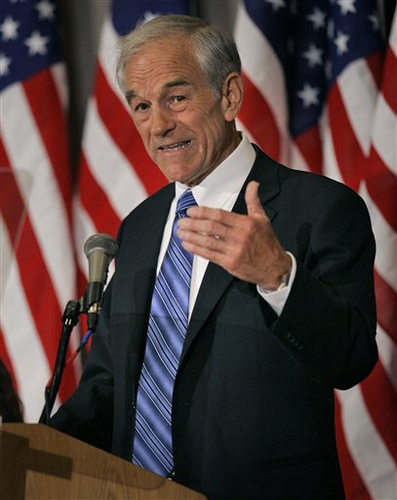
 MEDIA ROOTS — As Republican Presidential Candidate Ron Paul seduces progressives, we take a look at some perspectives and analyses of Ron Paul’s rhetoric as well as Paul’s published political agenda, such as the $1 Trillion ‘Restore America‘ Austerity Plan— to cut the Pentagon 15%, but Food Stamps 63%, S-CHIP 44%, Medicaid 35%, WIC 33%.
Also, the Fed; militarism bait-and-switch question; opposition to Davis-Bacon Act and its impact on trade union movements; Taft-Hartley; union-busting right-to-work agenda; states’ rights contradictions; the gold standard reality; deflation; and tax policy.
Economic historian Webster Griffin Tarpley warns progressives may be misreading Ron Paul as a progressive with compatible ideals, such as the Occupy Movement. Recently, Tarpley offered a “Critique of Ron Paul’s Austerity Plan” on Guns & Butter. Tarpley also elaborated upon his critique of Ron Paul’s austerity plan during a visit on The Jeff Rense Program.
Messina
***
GUNS & BUTTER — “Critique of Ron Paul’s Austerity Plan with Webster Griffin Tarpley.” December 28, 2011. Ron Paul’s “Plan to Restore America” includes $1 trillion in cuts to the federal budget in one year. We take a look at what this would mean for the American people. Ron Paul is the Republican front-runner to win the Iowa Caucus on January 3rd, 2012.
“I think it’s fair to say Ron Paul’s economic policy is an immediate deflationary crash and the more severe the better. Everything should crash down. And then after this orgy of creative destruction, then there’ll be a recovery. And, of course, the problem with that is, what if you starve to death in the meantime? What if you don’t survive the creative destruction? What if you die?
To fight a depression, for the Austrian School, is a contradiction in terms. You can’t do that. You’ve gotta let the depression wash over you, play itself out. And then there’ll be a recovery. And, of course, if you ask where are the empirical examples, historically, of letting a depression burn itself out. They can’t give you any.” –Webster Tarpley
“I’m Bonnie Faulkner. Today on Guns & Butter: Webster Tarpley. Today’s show: Critique of Ron Paul’s austerity plan. Webster Tarpley is an economic historian, author, lecturer. He is author of Against Oligarchy, Surviving the Cataclysm, a study of the world financial crisis, 9/11 Synthetic Terror: Made In the USA, and co-author of George Bush: The Unauthorized Biography. His latest books are Obama – The Postmodern Coup: Making of a Manchurian Candidate and Obama: the Unauthorized Biography.
“On today’s programme, we discuss the Restore America budget proposal of current Republican front-runner Congressman Ron Paul, leading up to the Iowa Caucus, on January 3rd, 2012.
Bonnie Faulkner: “Webster Tarpley, welcome.”
Webster Tarpley (c. 2:37): “Thank you so much. It’s good to be with you.”
Bonnie Faulkner (c. 2:40): “The next U.S. Presidential Election is November 2012. Obama doesn’t appear to have any serious challenge in the Democratic Primaries, but there are quite a few Republican Primary contenders. The Iowa Caucus is January 3rd. What exactly is the Iowa Caucus? And how important is it or isn’t it?”
Webster Tarpley (c. 3:05): “Well, the Iowa Caucus, for Republicans, as distinct from Democrats, are that you show up at a caucus location, which really amounts for the Republicans to a polling place. And you indicate your preference on, I think, a paper ballot and then you walk out. It does not seem to imply for the Republicans the caucus building, like the horse-trading or negotiation or short speeches or other things that a caucus would suggest. So, that’s going to be the first Tuesday of the New Year. And it’s all very much front-loaded.
“And according to the polls, as we are recording this programme, Ron Paul seems to be the leading candidate for the Ohio Republican caucus. And, of course, he had run there before in 2008 when, I believe, he came in third. And now he has shown as likely to come in first. I would just like to caveat that in two senses. A caucus, even a Republican caucus, is not quite the same thing as an election. If you wanna go vote, you can usually get in and out within five or ten minutes, depending on where you vote and what time. The caucus takes a little bit longer. So, it may not be possible for the polling to predict what’s gonna happen in that way.
“The other thing is that the recent winners in a place like Iowa have included Pat Robertson, the televangelist, in 1998. And it included, preacher, Huckabee in 2008. So, there’s a very strong voting block of Christian fundamentalists and they may not like Ron Paul for some reason. But maybe we can go through at the end Ron Paul’s social policies.
“But I would suggest the following: People who consider themselves left of centre, or progressive or anti-war or civil libertarian, may have gotten a positive impression of Ron Paul over the years because he’s been certainly a gadfly in the Republican Party opposing the prevalent Bush/Cheney/neocon warmonger line, which is certainly a merit. And it remains, right? Those are things that he’s done that cannot be denied. He’s also pretty reliable, as a vote, against things like the P.A.T.R.I.O.T. Act and so forth. Although, I must say, he did vote for the 9/11 Resolution, which led to the war in Afghanistan. So, he’s not exactly a man for all seasons in opposing aggressive war. He went along with the post-9/11 hysteria to that extent.
“But I would suggest, now, that we take a look at the most detailed policy paper that he has put out for this Election Cycle, which is his Restore America programme, which is a fairly detailed economic programme, not as detailed as some, but certainly something to go on. It’s called Plan to Restore America. It was issued around the middle of October. And I noticed that, in the run-up to the Iowa Caucus, scant attention is paid to this. The news media, especially those that wanna oppose Ron Paul, are interested in his old newsletters from the 1990s and the various racist, anti-Black or other, remarks that are contained in there. I would simply say, Ron Paul really ought to say who wrote those. If he didn’t write them, then he should really be in a position to say who did.
“But I would say, ‘Put that aside. Let’s go on the basis of what he says he wants to do if elected President this time around.”
Bonnie Faulkner (c. 6:57): “Now, Ron Paul is the front-runner at this point.”
Webster Tarpley: “22%”
Bonnie Faulkner (c. 7:01): “Yeah. And this caucus is gonna happen quite soon on January 3rd. Now, what is his Restore America budget proposal that he’s actually now saying what he would do.”
Webster Tarpley (c. 7:11): “Right. Well, let’s take a look at this. I think this is, by now, eminently fair game. And fairer to him than his newsletters, as disturbing that those certainly are. He starts off with a plan to cut $1 Trillion dollars out of the U.S. Federal Budget in one year. And I stress the idea of one year. You have perhaps heard during the course of the Super Committee, otherwise known as the 12 tyrants, that group of six Republicans and six Democrats I guess it was. This came down to cutting $1.2 Trillion. But that $1.2 Trillion was spread out over ten years. And at a certain point they talked about a grand bargain of cutting $4 Trillion or more. That was also spread out over 10 years.”
Bonnie Faulkner (c. 8:05): “That whole committee never came to any agreement, right?”
Webster Tarpley (c. 8:08): “Thank god. They struck out. Now, obviously, we have the automatic guillotine, the sequestering. And it’s not clear when that will happen or if it will ever happen ‘cos the Congress may head it off.
“But, again, let’s focus on Ron Paul because this is gonna be the big news item, I think. He’s either gonna win the Iowa Caucus or he’s gonna come in second or third, I would think is a fair prognostication.
“Think of $1 Trillion dollars. That’s one thousand Billion U.S. dollars in one year. This is, again, it’s ten times more concentrated than what the Super Committee was talking about—right?—those twelve tyrants, bad as they were. We’re talking about something much more gradual. For Ron Paul, it’s cut $1 Trillion of spending during the first year of the presidency and balance the budget, bring the Federal Budget into balance by the end of the four-year term.
“Now, that’s already the most radical austerity plan of any candidate. And it’s also the most radical austerity that any modern industrial, or even post-industrial, society has ever experienced. If you want a comparison, I compared it to, sort of, the landmark austerity of the 20th Century—Chancellor Heinrich Brüning in Germany between 1930 and 1932. My estimate, just comparing these things in a kind of rough proportionality is that Ron Paul’s cut of $1 Trillion dollars of the U.S. Federal budget, which amounts to 27%, something like that, a little bit more than one-quarter in one year, that this is, on the whole, four times more severe than what Brüning did between 1930 and 1932. And Brüning did it over two years. And that’s included in my calculations.
“So, with Ron Paul, you’re getting something four times more severe than Brüning. And I think that ought to give us pause because I think it’s generally understood that, whether Brüning had alternatives or not, the net effect of his austerity programme was to destroy the German economy, with rising unemployment and falling tax revenue; and to destroy the political system, such that within about six months after Brüning left office, Hitler became Chancellor. So, this is basically what prepared the ground for the worst kind of fascism seen so far. So, I think that ought to get us to pause.
“27% austerity in one year, the Government in Britain—Cameron and Osbourne and Clegg—they had talked about cutting spending by 25% when they came in May of 2010. But they haven’t come anywhere near that. So, here we have Ron Paul saying that he’s actually gonna do it.
“Now, I think what people may be interested in is, ‘where did these spending cuts occur?’ So, 27% would be the norm across the board. Given the fact that Ron Paul has made his name as an opponent of militarism and foreign adventurism and foreign bases and so forth, we would certainly expect, I think, that if everybody’s gonna get cut 27% across the entire Federal budget, as a general rule, that the Pentagon would get cut at least as much or maybe more. But I’m afraid we find that’s not the case. The 27% across the board cut goes together with a 15% cut in the Pentagon. So, the Pentagon is asked to give up about half of what the Federal Budget is as a whole is being asked to give up—a 15% Pentagon cut, not very radical. That is not even radical compared to other proposals that are now going around.
“But I think you can also, then, look at certain social programmes that I think raise the relevant doubt concerning what Ron Paul is up to. Suppose we look at an area like child nutrition. This is largely the WIC programme, women, infants, and children. And it comes down to things like high-protein meals for pregnant women, nursing mothers, young mothers, and infants. And it’s a very, very effective programme. And the United States is spending all of $21 Billion dollars on that. Right? A few days of the Afghan War. $21 Billion dollars is spent on WIC. Ron Paul would cut one-third of that programme. That is a $7 Billion dollar cut—33%. So, again, Pentagon gets cut 15%. Women, infants, and children get cut 33%. And this comes down to things like cheese and dairy foods and things like this that are high-protein. The costs incurred with such a programme, I think, allow us to ask whether this is not a false economy because you’re talking about things like cognitive impairments due to insufficient protein consumption in infancy and early childhood. And I think that’s a very, very short-sighted cut to put it mildly.
(13:51) “And then let’s go on. S-CHIP, the State Children’s Health Insurance Program, one of the things that Senator Kennedy had championed, well, right now, the budget for that is $9 Billion dollars. Ron Paul wants to cut $4 Billion. That brings it down to $5 Billion. So, Ron Paul would cut 44% of the S-CHIP programme. And, again, Federal Budget as a whole, 27%, Pentagon gets cut 15%. But, for some reason, child health insurance gets cut 44%. Now, these are small amounts, but the effect of this, I think, is quite remarkable because with S-CHIP you are dealing with parents who are so poor that they can’t afford any healthcare for themselves. But they can get it for their children just about automatically if they meet the poverty tests for this, the means test for S-CHIP.”
Bonnie Faulkner (c. 14:48): “I’m speaking with economic historian and author Webster Tarpley. Today’s show: Critique of Ron Paul’s Austerity Plan. I’m Bonnie Faulkner. This is Guns & Butter.
“What other important programmes is he suggesting be cut?”
Webster Tarpley (c. 15:07): “The two big things that Ron Paul would cut are also very disturbing. One is Medicaid. This is not Medicare; this is not people over 65. This is Medicaid. And this is the health programme that is run through the states for poor people, basically. The current budget: $276 Billion. Ron Paul would cut $95 Billion out of that. So, that’s a 35% cut.
“Again, Pentagon cut 15%; Medicaid cut 35%, by comparison. And I think that is a very destructive cut because, what it goes to is, people who are on Medicaid are already at their last resort.
“The only thing that’s left after Medicaid is private charity, which may be there or may not be there, depending on where you are, and who are you are, and so forth.
“The other thing that Medicaid does is that it protects the resources, the property—and Ron Paul likes to talk a lot about property—the property of the U.S. middle-class in the age of Alzheimer’s and increasing cost for nursing home care. This actually protects. And I was at a party, just before Christmas, where a guy brought this up that his mother had passed away after a long illness. And part of the care for her was covered by Medicaid, although he was firmly in the middle-class, living in a home in Bethesda, Maryland. This protected him from going destitute with his wife and his son. So, it’s a very, very big cut for the health of poor people where, obviously, we still have 40 or 50 million uninsured unless, and until, something else kicks in, which we’re not sure of. And this protection for families who have an elderly parent, say, in a nursing home, so that doesn’t eat your entire asset pool that you’ve got.
“And then, probably the most extreme and maybe the most characteristic, food stamps: Now, food stamps have been used by, I’m afraid, Republican demagogues to characterise Obama. I think, Gingrich says, Obama is the food stamp president and Gingrich wants to be the jobs president. Well, I think the scandal is not that the programme exists, but that it’s actually needed. Right now about 50 million Americans live on food stamps. And this is not a generous benefit. If you’re one person, the maximum food stamp benefit is $180. And that’s the maximum. If you have a little bit of property or a little bit of savings, then it becomes less than that.
“So, Ron Paul wants to cut $50 Billion out of an $80 Billion dollar programme, in other words, a cut of 63%, almost two-thirds.
“So, again, Pentagon 15%, food stamps cut 63%. And if you just do the arithmetic, it means that the maximum benefit would not be in the area of $180 per person. It would go down to something like $60 a month or $15 a week. Now, try living, eating, anything that can keep body and soul together for $15 a week. I think if we look at, in particular, the inherent problems of the child nutrition and child health on one side. And then, if we look at the broad-based impact on the poor because the people who get Medicaid and the people who get food stamps are likely to be, quite a few of them, the same people. And they’re getting cut between one-third and two-thirds.
“I think you can see a tendency. And what I mean by that is this. We’ve been burned by Obama. Obama said vote for me, I’m not Bush. I’ll put an end to the wars and the abuses of the Bush Administration. And, instead, he basically starts a war with Pakistan, certainly starts a war with Libya, claims the right to assassinate U.S. citizens, carries that out in one case. He claims he can incarcerate you in Guantanamo Bay and, indeed, torture you if you have opinions that he considers dangerous. So, instead of what we were promised, we got something quite different.
“Now, if we look at the Republicans, Boehner, and the House Tea Party majority, they ran talking about jobs, jobs, jobs. But instead when they got in, it was tax cuts for the rich and their strange ideas about social policy. So, I think we have to ask: Is a bait-and-switch in progress here? Where Ron Paul talks about peace and opposition to dictatorship and totalitarianism on the home front, but instead seems to be getting a draconian, brutal series of budget cuts.
“And one or two other things about this: There is the Davis-Bacon Act, landmark legislation. And what it proscribes is if you have a Federal construction project, then that has to pay union wages. It’s called the Prevailing Wage Standard. Prevailing wage is interpreted to mean union wages, union pay scales. So, you’re not gonna get a Federal construction job and then be expected to work for the Federal minimum wage. It’s significantly higher.
“If you wipe out the Davis-Bacon Act, then this, essentially, destroys a whole series of trade unions. And the savings on this: $6 Billion dollars. But, at the same time, look at the social impact. The trade unions would cease to exist.
“The combination of Ron Paul, the father, and Senator Rand Paul, the son, Senator from Kentucky, what they both want to do is to change the Taft-Hartley law, which currently governs union policies, at least at the Federal level. They want to change that, so that instead of having a state’s right to choose to be a union state or, to put it the other way, instead of having some states that have chosen to be right-to-work states where organising unions is almost impossible, this is the Southern belt, in general. Rand Paul and Ron Paul, too, they want to, essentially, have a compulsion at the Federal level that everybody has to be a right-to-work state.
“So, between the abolition of the Davis-Bacon Act and the universal right-to-work status there would be no trade union movement left. So, I wonder about this.
“First of all, Ron Paul talks about state’s rights all the time. But right now we have a state’s right to choose not to be a right-to-work state. And my interpretation of Ron Paul’s policy, and his son, is that they want to change that, so that you’re no longer allowed to be anything but a right-to-work state. So, a state’s rights in their interpretation goes out the window. Interesting contradiction, wouldn’t you say?
“The other thing is if you wanna have resistance to totalitarianism, and we saw this, for example, in the Occupy Wall Street Movement. Right? The point at which that took off was the moment when the Communication Workers of America, the Transport Workers Union, the American Federation of Teachers, and others, when they showed up to swell the ranks of the protesters there at Zuccotti Park, you could see the idea that if you had a some kind of a fascist coup or if some president went over the line, bonkers in terms of crushing civil liberties, the only hope for organising a general strike and other forms of resistance against that would be a union, would be a trade union movement, even such as it is, would be the starting point.
“But, somehow, between Ron Paul and Rand Paul, they wanna wipe out the only institutions that could mount a resistance against totalitarian measures of that sort. So, on the whole, rather strange, wouldn’t you say?
“The other thing here is if we look at Ron Paul’s tax policy that goes with this, and I’m now basically making the transition into the tax side of the ledger.”
Bonnie Faulkner (c. 23:59): “Well, he wants to keep the Bush Tax Cuts, right? Permanently.”
Webster Tarpley (c. 24:04): “Absolutely, he wants to keep the Bush Tax Cuts. And he wants to add, well, he wants to keep these Bush Tax Cuts, which everybody knows inordinately favour the rich. He wants to keep the Bush Tax Cuts. And he wants to abolish the Capital Gains Tax.
“Now, if you look at the U.S. economy, you would have to say that the principal, one of the principal problems of the U.S. economy is this over-financialisation. The extreme emphasis on financial services, non-productive financial services, speculation, moving paper around, the $1.5 quadrillion or so of derivatives, much of it focused here in the United States. Ron Paul would, essentially, subsidise further parasitical speculation and related activities by simply abolishing the Capital Gains tax. But if you were a full-time speculator you would pay no taxes at that level, in terms of the capital gains. That money would be for you; you wouldn’t pay income tax on it. But if you were a worker, you would pay a tax.
“So, no Capital Gains Tax and no Estate Tax, he would call it ‘no Death Tax.’ So, it means that if you were a speculator that made out like a bandit in the Reagan bubbles of the ‘80s and the irrational exuberance of Greenspan in the ‘90s and into the current bubble economy of the wealth effect and so forth, that the last chance to have you contribute to the public treasury would be gone because Ron Paul wants to give you an absolute free ride.
“The interesting thing is he wants to cut the corporate income tax down to 15%. The Corporate Income Tax is, really, not paid by a whole lot of very large entities. Right? General Electric, notoriously on their…paid zero corporate income tax in the most recent year that I’m aware of. But Ron Paul says, even, bring that down. I think the current level is 35%. ‘Bring that down to 15%.’
“So, this is tax relief for speculators, tax relief for those who are already rich and who wanna inherit and tax relief for corporations, including banks. So, is there any tax relief for the average person? The answer is no. There is no proposal to cut anybody’s taxes beyond that. You could imagine somebody saying, ‘Well, I’d like to increase the size of the personal deduction. The standard reduction could go up. The personal exemption could go up. That would be the rising tide that would lift all boats from below. But with Ron Paul, there’s absolutely nothing like that. There’s no tax relief for anybody, except the speculator, if you are already rich, or a corporation.”
Bonnie Faulkner (c. 27:05): “Well, isn’t he also proposing to eliminate taxes on foreign profits?”
Webster Tarpley (c. 27:10): “Yes! Yes. Of course, in other words, he wants to, essentially, reward corporations that have horded money abroad, essentially, evading U.S. Taxes. He wants to, basically, have an amnesty allowing them to bring this home with no mechanism to be sure that this got invested in plant and equipment, as distinct from derivatives or speculation and no taxation of it. So, this would be in addition to all these other cuts.
“So, you’d have to look at this and say ‘If you’re the Koch Brothers, the richest man in New York City—Koch. Or Coke, as he likes to call himself, putting on airs. The Coke brothers, or the Koch Brothers, as I think it says in the spelling that I could see. They would be delighted.
“Soros would be delighted. Soros was also delighted with Ron Paul’s drug policy. We’ll maybe get to that later on.
“But, generally speaking, this is precisely what Wall Street demands. And there are, indeed, reports that in the 1990s, if not more recently, Ron Paul was financed by the Koch Brothers. Right? The Koch Brothers, the people who founded the Cato Institute, or who made important contributions at the beginning to make the CATO Institute. It’s possible that’s the leading Libertarian think-tank here in Washington, D.C., quite plausible that they would have given some money to a leading Libertarian candidate going back there—Ron Paul.”
Bonnie Faulkner (c. 28:47): “I’m speaking with economic historian and author Webster Tarpley. Today’s show: Critique of Ron Paul’s Austerity Plan. I’m Bonnie Faulkner. This is Guns & Butter.
“What five cabinet departments is Ron Paul proposing to eliminate?”
Webster Tarpley (c. 29:07): “Right. This is his fight with Rick Perry. Rick Perry wanted to eliminate three of them, but couldn’t remember the third. And Ron Paul said, no, that’s not enough. So, they had a bidding war. Who was going to destroy more departments of the Federal Executive?
“Well, it’s basically these. It’s the Department of Energy, goes to zero. The Department of Housing and Urban Development goes to zero. The Department of Commerce goes to zero. The Department of the Interior goes to zero. The Department of Education goes to zero.
“Now, I should also mention this is within the framework of what he wants, a 10% cut in the total number of Federal workers. I think the employees of the Federal Government are about four and a half million. So, if it’s 10%, we’re talking about half a million new unemployed, which would create severe depressed areas. Well, Washington, D.C. would certainly go. And Maryland, Virginia would all become a depressed area. And not just those, some other ones would, too.
“If you look at The Department of Energy, this has to do with, well, it has to do with maintaining all kinds of standards on, say, nuclear reactors, things like this. It has national laboratories in there. Housing and Urban Development, right? There’s not a lot of public housing being built. But what there is relies to some extent on subsidies coming from HUD, Housing and Urban Development.
“The Department of Commerce: That’s, among other things, the U.S. Weather Service and its intent to maintain U.S. exports abroad, in other words, to create jobs that way.
“The Department of the Interior: The National Parks. But also important things that have to do with Resource Management and part of that.
“The Department of Education: Now, here we’re talking about things like Pell Grants, the various student loans that are offered, which, unfortunately, people have to rely on too much. And then the Pell Grant side of it, in other words, if you’re a low-income student and you wanna go to college, virtually, you’re only hope is to get a Pell Grant, which is not generous. I forget what it is right now. It’s a couple of thousand dollars a year; you could check the amount. But it’s hardly enough to get by at a community college or a public institution. But that’s what there is.
“So, for all of that, for public housing, for Pell Grants, for poor kids to go to college, for various things to do with energy, the promotion of exports, weather forecasting, there’s nothing left. It all goes to zero. That would be a colossal impact on the Federal Government. He thinks that all of these, of course, are unconstitutional and so forth. And we’ll talk about his constitutional theories, too.
“The other thing that I would stress is all foreign aid in the State Department, the State Department takes a big hit because all foreign aid is terminated. Now, that’s about $50 or $60 Billion dollars. And, certainly, there are things in there. For example, we are told that the U.S. claims that they paid $10 Million dollars to try to hijack the latest Russian elections to get people to vote against Putin, to get them to vote for candidates, in some cases, who are national Bolsheviks, anybody but Putin seems to be the idea. Now, in reality, it’s more than $9 or $10 Million. It might be $100 Million.
“There are things in the foreign defence budget that are reprehensible and should be cut. But then let’s not throw the baby out with the bath water. If you look at emergency food in the world, emergency food aid, available on Planet Earth, the United States, in spite of everything, still provides 57%, well over half, of all the food aid in this world. And it comes down to, in particular, about two and a half metric tonnes of food aid, costing $2.6 Billion dollars a year.
“Now, in 44 countries, and you could think of some dramatic examples, in Somalia, in South Sudan, in Northern Kenya, across the Sahel Belt, go to some place like Mali where the Libyan food operations have now been destroyed by the attack on Libya where famine is presumably spreading. Places like Bangladesh, places like Pakistan in the recent flood, Haiti, to be sure, make a catalogue of all the disaster and famine areas across the world, and you will see that the U.S. is there. This is food for peace, as Kennedy called it. The Kennedy Food for Peace programme would simply cease to exist. Now, I don’t have statistics to back this up. But I would invite somebody to consider, to score this, not in terms of deficits, but in terms of human lives, as indeed all of these, everything we’ve talked about so far has implications for morbidity, mortality, longevity, all kinds of effects on human life, all of them generally negative.
“That if you simply take two and a half metric tonnes of food aid out of a world where there’s about 5 million metric tonnes of food aid. Or I should say a little bit less. People will die because of that. And maybe it’s not generally difficult to guess that more people can die through the economics of famine and epidemic that were related, than say through military operations. That’s generally a truism. Robert McNamara killed more people at the World Bank than he ever killed at Vietnam simply because that’s the power of economics.
“Well, in Ron Paul’s case it’s not just the five Departments, but it’s also the entire USAID and it’s also the United States Department of Agriculture Food for Peace that would simply cease to exist. And I think this would shock the world.”
Bonnie Faulkner (c. 38:42): “Now, I read that Ron Paul wants to repeal Dodd-Frank and Sarbanes-Oxley. What are these?”
Webster Tarpley (c. 35:49): “Right. He wants to deregulate everything. This has to do with his ideology, the so-called Austrian School, which is that government intervention in any form in economic life is inadmissible. It’s wrong. He tries to argue that this is unconstitutional. I don’t think that he has any case at all for that, given U.S. history as well as just the U.S. Constitution as a document. But he wants to get rid of these things.
“Now, these are not good laws, in general. On the other hand, the wholesale deregulation is what got us where we are. Right? Just take two examples: deregulation and privatisation.
“Well, privatisation of what? The Republican debates, in general, say, ‘Oh, Fannie Mae and Freddie Mac and subprime lending to minority groups in rundown neighbourhoods, those people buying homes, that’s what caused the depression. Well, even if you want to take that seriously, which I don’t, you’d have to say, ‘How did Fannie Mae and Freddie Mac that were founded as Government organisations, agencies, back in the New Deal, or more recently, how did they become private entities? Well, they were privatised.
“So, you had the worst of all possible worlds. You had a private management, for-profit, but with an implicit guarantee from the Federal Government for the agency bonds that they put up, the Fannies and the Freddies. So, if you wanna know, even in terms of the reactionaries in an argument where the depression comes from, you’d have to say, number one, from privatisation.
“Now, of course, Fannie and Freddie are a tiny, tiny part of the real story. The real story is derivatives, in other words, that colossal edifice of credit-default swaps, collateralised debt obligations, structured investment vehicles, repos, and so forth, that immense castle of $1.5 quadrillion of derivatives built on top, in many cases of subprime loans, that’s what caused the actual depression.
“And where did that come from? Well, from 1936 through 1982 derivatives were strictly illegal in the United States under the Commodity Exchange Act of Franklin D. Roosevelt. And it was the deregulation of derivatives from 1982 to the Bush, the elder, Administration to Rubin and Greenspan and Summers, and these people in the late ‘90s. That’s what opened the door to the derivatives bubbles.
“So, we’re in a depression caused by deregulation and privatisation. And Ron Paul says we need more deregulation and privatisation, which I don’t think makes any sense.
“The other thing that’s worth pointing out is, in terms of economic policy, Ron Paul was against the bailout. And, certainly, it was a fine thing to be against the bailout proposed by Bush and Paulson back in October of 2008. But at the same time, Ron Paul is very much against doing anything to maintain economic growth or development or, really, any kind of government intervention into economics. And this is, once again, because of the Austrian School.
“I think it’s fair to say Ron Paul’s economic policy is an immediate deflationary crash and the more severe the better. This people probably recognise. This is Schumpeter’s Creative Destruction. It’s associated in American History with Andrew Mellon, the arch-reactionary Secretary of the Treasury under whom as we say Harding, Coolidge, and Hoover served. Andrew Mellon who’s litany was liquidate stocks, liquidate bonds, liquidate labour, liquidate the farmer, liquidate real estate, liquidate everything, in other words, everything should crash down. And then after this orgy of creative destruction, then there’ll be a recovery. And, of course, the problem with that is, what if you starve to death in the meantime? What if you don’t survive the creative destruction? What if you die?
“This is an argument that appeals to people who have money. And who believe that they will continue to have money because it allows them to say, ‘I’ll be sitting here with my stash of cash. And when everything else goes down, I can buy up everybody and everything at a small fraction of the current rates after the panic.’ And I think that this thinking is characteristic of Ron Paul’s inner circle.
“I think we could argue, based on some things that Peter Schiff talked about recently. Peter Schiff was the economics advisor for Ron Paul in the 2008 campaign. He then went to Connecticut or he went back to Connecticut where his hedge fund is located. And then he ran for Senate and he was defeated in 2010. And Schiff was on CNBC in the last six months or so seriously arguing that unemployment in the United States needed to go much higher, that the levels of unemployment reached in the U.S. are not enough. Again, this is the idea that the crisis has to play itself out, burn itself out. It has to bottom out and there’s nothing you can do about it.
“This is one of the features of the Austrian School is that it’s practically sacrilegious to try to fight a depression. To fight a depression, for the Austrian School, is a contradiction in terms. You can’t do that. You’ve gotta let the depression wash over you, play itself out. And then there’ll be a recovery. And, of course, if you ask where are the empirical examples, historically, of letting a depression burn itself out. They can’t give you any. The one that comes closest, I guess, is the Brüning one, once again, 1930 to 1932 in Germany.
“But you’ll see that under concrete social conditions, in the presence of some kind of a state, i.e., a government, that there’ll be some form of political development that will overtake this crisis before it reaches absolute bottom. It simply has to be that way. It’s hard to imagine it any other way.
“So, that’s what you’re dealing with. It’s nice to be against the bailout. But then to say I’m against the bailout and I’m against anything that might be done. I think this, for many people, this is maybe not so evident, but I think it is implicit in what Ron Paul is arguing.
“Austrianism basically says that it’s impossible to have a jobs programme. And I would point to this as maybe an element of pessimism in the entire thing. Scientific, technological, industrial progress cannot be fostered by any government activity, according to these Austrians. Right? It cannot be done. And, therefore, they would say, ‘You can’t have a jobs programme; all you can do is let the market go, in other words, let the market find its own way. So, that there’s really nothing you can do.
“And, indeed, when you ask these Republicans, in general, what’s your jobs programme? They’ll say, ‘tax cuts, deregulation, and cut government employment, and so forth, in other words, deflation and austerity. And you’d say, ‘Well, where’s the jobs programme in that?’ And they’d say, ‘Well, there can’t be a jobs programme because jobs created by government, in any form, are simply not allowable.
“So, it’s a very strange universe this Austrian School.”
Bonnie Faulkner (c. 43:44): “I’m speaking with economic historian and author Webster Tarpley. Today’s show: Critique of Ron Paul’s Austerity Plan. I’m Bonnie Faulkner. This is Guns & Butter.
“Now, is there anything else in Ron Paul’s Restore America budget that we should mention?”
Webster Tarpley (c. 44:08): “Well, maybe deflation. This is another one of his, I guess that is fair to say, he wants a strong dollar. Sounds good, but if you think about that concretely, if you look at American history, the big social issue from about 1870 to about 1910 was deflation. Right? The cost of gold. Right? A gold-backed currency that turned out to be the worst possible thing for the farmers, for the South, for the Midwest, for the Far West, large parts of the U.S. were sacrificed on this cost of gold, as a result of the Specie Resumption Act and The Coin Act of the 1870s. So, that when farmers looked at the world, the prices they got were going down, down, down and the dollars they had to pay back were going up, up, up ‘cos the dollar was getting very strong. Is that really what you want?
“If you look at the United States today, what’s the first thing you see? The student loan debt of the current generation is about $1 Trillion dollars and its rising fast. And you have consumer credit card and related charge plate debt, another trillion. So, we got $2 Trillion dollars of debt plus mortgage debt plus all kinds of other things. You got a lot of American families underwater. So, that their net worth is actually negative and the main problem they have is debt.
“So, Ron Paul wants a strong dollar. He wants to have an international credit policy that would strengthen the dollar. Then I think that’s gonna be very bad for a lot of people because you will be paying back, ultimately, he doesn’t say he wants to make the transition to a gold standard in this programme. He’s talked about that, though. And, presumably, he’d like to strengthen the dollar to the point that a high dollar would have an easier transition into a gold standard.
“I think a gold standard for most people in the United States would be an unmitigated disaster. If you have a lot of debt or if you had really any debt, any significant debt at all, that would be very bad for you.
“The examples of returning back to a gold standard, just to get historical, too. After the Napoleonic Wars, the British went back on the gold standard. And that gives you the world of Dickensian cruelty that you’ve heard about during the holidays. The British then went back, again, on the gold standard in the 1920s and they had three to four million unemployed. It was the largest unemployment in any advanced, industrial country in all of history.
“The United States went back on the gold standard in the 1870s with the bad results that I’ve just said.
“So, the three examples of going back on a gold standard that we’ve had so far are bad, that deflation is bad, especially, if you do it that way. So, the other thing is you look and see, ‘what does Ron Paul say about things like corporate welfare? And he promises in the introduction that he will end corporate subsidies. So, then you’d say, ‘Alright, I’m gonna look and see where we change the tax laws to change these things like the oil depletion allowance to various subsidies given to Exxon mobile and things like that. You don’t find any details. So, I really wonder whether there’s anything serious in there about getting rid of corporate welfare, in particular some of the more egregious examples, like the oil company.”
Bonnie Faulkner (c 47:39): “So, then who’s interests are served by the Ron Paul Restore America budget?”
Webster Tarpley (c. 47:45): “Well, I think you have to distinguish. There’s a certain ideological appeal. If you think that debt is the equivalent of original sin, and that what you’ve got do is somehow cleanse yourself of all debt as a matter of ideological purity. If you wanna define interest in those ways, I would say it’s about a 15% slice of the U.S. population who are in favour of these programmes. But I’m afraid that for most of them this would be destructive. They’re buying something where the implications go far beyond what they think and would actually be harmful to them.
“I guess the easiest way, in the current ideological climate, is to say this is a programme for the 1%, for sure. This is the interest of the 1%.
“Again, no Capital Gains Tax, no Estate Tax, Corporate Income Tax of 15%, keep the Bush Tax Cuts, but NO tax relief for working people, for the lower middle-class, the middle-middle.
“Taking away these important—what can we call them—subsidies, sure, subsidium. Right? Help. That’s all that means—help. For example, that poor kids can go to college with Pell Grants or that there might be some public housing going on. Right? All of that removed. So, you could say that this would hit the middle-class quite hard. And the beneficiaries would, really, be the 1%.
Bonnie Faulkner (c. 49:22): “How do you account for Ron Paul’s appeal? What is making him so popular among his supporters?”
Webster Tarpley (c. 49:30): “Well, it has to do with his track record, again, of being a gadfly and being very heretical concerning the orthodoxy of the Republican Party during 2007-2008 being anti-war during the era of Bush, Cheney, and the neocons. Ron Paul was anti-war.
“The problem with this is that we have to raise the question of election promises and then the delivery on those promises. I don’t see how you can talk about any politician without doing this. So, I would suggest looking into this.
“Concerning September 11, 2001, there’s a significant amount of Ron Paul’s base that somehow still have this idea that Ron Paul is the guy who’s gonna bring truth and clarity into the inside job of 9/11 Truth. Now, I’ve written a book about this myself. So, 9/11 Synthetic Terror: Made in USA, the Fifth Edition is pretty much my view of the subject.
“But when Ron Paul was running in 2007/2008, speaking off the record to small groups of supporters, he made, I think it’s fair to say, some significant promises about what he was gonna do to speak up about 9/11 truth or at least to speak up for a new investigation of some sort. And this carried on all through the 2007 season of the Republican Presidential Debates. Right? They had quite a few with all those candidates. And there was always this constant subtext that Ron Paul was the 9/11 Truth Candidate.
“Finally, in the South Carolina Debate, January 10, 2008, Fox News and I think this was Carl Cameron asked Ron Paul: ‘Many of your supporters call themselves 9/11 Truthers. They believe that the U.S. Government was in some way complicit with the 9/11 attacks or covered it up. Are you tonight prepared to either embrace that rhetoric or ask those supporters to abandon it or to divorce themselves from your candidacy?’
“And Ron Paul’s answer is: ‘I can’t tell people what to do. But I’ve abandoned those viewpoints. I don’t believe that and that’s all. That’s the only thing that’s important. So, I don’t endorse anything they say.’
“And then he goes on saying: ‘This kind of talk doesn’t do me any good. If they care about it they should stop,’ basically, implicit in the question. ‘I can only control what I say. I don’t endorse what they say. I don’t believe that. Can I please get back to the current debate now, rather than talking about this anymore.’
“So, that’s I think a pretty clear repudiation of any idea of 9/11 truth. And the thing that makes it significant is that he had made these promises, somewhat off the record, but some of them you can find in old YouTube clips made by individuals and smaller groups.
“And that goes together with some other things. He says that he’s against earmarks. Well, it turns out in 2009, you remember, after we had the Stimulus, we had the Supplemental. It was about $450 Billion dollars. Ron Paul, in the dead of night, inserted about $250 Million dollars for the renovation of the Port of Galveston, Texas. That’s the District he represents. So, he managed to insert that into the Supplemental, and then when the Supplemental came up, he voted against it. And the Supplemental passed with a Democratic vote. So, he inserted it. And then he voted against it.
“Now, I would certainly say, ‘Don’t go through all of that strange dance. Stand up and say, ‘the Port of Galveston is an American national interest. We need it. We need Mobile. We need New Orleans. And we need Galveston, Houston ‘cos that’s part of the economic viability of a huge hinterland. It’s a national interest to have that infrastructure up to date.’ Now, Ron Paul can’t say that because he doesn’t believe it. But, nevertheless, he goes ahead and does this thing with inserting the entitlements in the dead of night and then voting against them in the light of noon day.
“Another one is the Fed. He talks about ending the Fed. He’s written a book called End the Fed. Well, we look in the economic programme the Plan to Restore America programme and all we have in there about the Fed is to audit the Fed. Well, I think that’s pretty tame. I mean, is there some confusion that what the Fed is doing is wrong? I think that’s pretty clear. Right? The Trillions and Trillions of dollars that have been lent at very low rates to foreign banks, we don’t need to go through the whole list. This stuff has come out. It’s also, of course, outrageous that the Fed is not regularly audited. It should really be audited every evening by some competent authority.
“But you see that Ron Paul talks a good game about doing something about the Fed. But he’s not proposing any institutional change for the Fed. So, that’s, I think, one of the three points—and I guess we could add more points—that allow you to ask, ‘Is Ron Paul campaigning on an anti-war and anti-dictatorship programme? And is he gonna give you something that’s very different in the way that Obama did and Boehner did?”
Bonnie Faulkner (c. 55:22): “And then why do you think it’s so important to go over all of the things that Ron Paul stands for?”
Webster Tarpley (c. 55:30): “Again, because I think people need to know what they’re actually gonna get. He has said it. This is his programme. I think you have to be aware of what’s coming.
“We had those important polls that I think they were the NBC polls back in the springtime, which showed that despite everything, despite Obama, and despite Clinton, all the propaganda coming from the Koch Brothers and the Republicans, that the level of the support of the American population for the main New Deal, New Frontier, and Great Society programmes, in particular, Social Security and Medicare, that just about everybody sees themselves needing. The support for this is somewhere in the area of 65 to 70%. When you get down to specifics, do you support a surtax for millionaires? Which Ron Paul would, of course, oppose. That’s about 81% of the American people were in favour of that. So, you’d have to say this is New Deal America, in spite of everything. So, that Ron Paul’s ceiling, if we go by his economic programme, is really about 15 or, perhaps, 20% at the very, very most.
“But that, of course, doesn’t rule out bait-and-switch. That somebody would run for office saying: ‘I will end the wars. I will liberate you from being harassed in airports by these crazy transportation people.’ You might have a situation where, under conditions of breakdown, something very surprising might happen. A lot of people might vote for Ron Paul who really don’t favour the kinds of economic programmes that we were talking about. So, I think it’s important to make sure that people realise what they are getting because these things are never completely secret. They can hardly be. And in the case of Ron Paul, he has put out now The Plan to Restore America that tells us about these things.”
Bonnie Faulkner (c. 57:42): “Webster Tarpley, thank you very much.”
Webster Tarpley (c. 57:43): “Thank you.”
Bonnie Faulkner (c. 57:44): “I’ve been speaking with Webster Tarpley. Today’s show has been: Critique of Ron Paul’s Austerity Plan. Webster Tarpley is an economic historian, author, and lecturer. He is author of Against Oligarchy, 9/11 Synthetic Terror: Made in the USA, and co-author of George Bush: the Unauthorized Biography. His prescient economic work Surviving the Cataclysm: A Study of the World Financial Crisis is now out in paperback. Visit his website at www.tarpley.net Email him at [email protected]
“Guns & Butter is produced and edited by Bonnie Faulkner and Yara Mako. To make comments or order copies of shows, email us at [email protected] Visit our website at www.gunsandbutter.org ”
Transcript by Felipe Messina
***
TARPLEY.NET — “Ron Paul’s $1 Trillion of Austerity Cuts Would Ravage US, Bust Unions, but Cannot Balance Federal Budget” January 4, 2012. Webster G. Tarpley on The Jeff Rense Program.
Listen to this interview with Webster Griffin Tarpley.
© 2012 Tarpley.net
***
 MEDIA ROOTS — The Electronic Privacy Information Center has obtained documents through an FOIA request detailing how the Department of Homeland Security’s (DHS) domestic spying program focuses primarily on media reports that are “critical of the agency and the U.S.
government more broadly.”
MEDIA ROOTS — The Electronic Privacy Information Center has obtained documents through an FOIA request detailing how the Department of Homeland Security’s (DHS) domestic spying program focuses primarily on media reports that are “critical of the agency and the U.S.
government more broadly.” MEDIA ROOTS — For those born with melanin or a mind critical of the establishment, throughout the education system and beyond, ethnic studies have offered crucial perspectives from which to contextualise ethnic tensions within the U.S. and its caucasian dominant monoculture.
  MEDIA ROOTS — A neutral Internet’s First Amendment rights to free speech, dissent, and political activity face serious