


Democracy Now Part 1/3
Democracy Now Part 2/3
Democracy Now Part 3/3
DEMOCRACY NOW– AMY GOODMAN: The US military has confirmed the authenticity of newly released video showing US forces indiscriminately firing on Iraqi civilians. On Monday, the website WikiLeaks.org posted footage taken from a US military helicopter in July 2007 as it killed twelve people and wounded two children.
The voices on the tape appear to believe their targets are carrying weapons, but the footage unmistakably shows some of the victims holding camera equipment. The dead included two employees of the Reuters news agency, photographer Namir Noor-Eldeen and driver Saeed Chmagh.
The Pentagon has never publicly released the footage and has previously cleared those involved of wrongdoing. WikiLeaks says it managed to de-encrypt the tape after receiving it from a confidential source inside the military who wanted the story to be known.
In a moment, we’re going to hear from WikiLeaks co-founder Julian Assange, who oversaw the video’s release. But first we turn to the footage itself. For our television audiences, some may find these images disturbing. This clip captures the moments leading up to when US forces first opened fire.
US SOLDIER 1: See all those people standing down there?
US SOLDIER 2: Stay firm. And open the courtyard.
US SOLDIER 1: Yeah, roger. I just estimate there’s probably about twenty of them. There’s one, yeah.
US SOLDIER 2: Oh, yeah.
US SOLDIER 1: I don’t know if that’s—
US SOLDIER 3: Hey Bushmaster element, Copperhead one-six.
US SOLDIER 2: That’s a weapon.
US SOLDIER 1: Yeah. Hotel two-six, Crazy Horse one-eight .
US SOLDIER 4: Copperhead one-six, Bushmaster six-Romeo. Roger.
US SOLDIER 1: Have individuals with weapons. Yep, he’s got a weapon, too. Hotel two-six, Crazy Horse one-eight. Have five to six individuals with AK-47s. Request permission to engage .
US SOLDIER 5: Roger that. We have no personnel east of our position. So you are free to engage. Over.
US SOLDIER 2: All right, we’ll be engaging.
US SOLDIER 1: Roger, go ahead. I’m gonna—I cant get ‘em now, because they’re behind that building.
US SOLDIER 3: Hey Bushmaster element, Copperhead one-six.
US SOLDIER 1: He’s got an RPG!
US SOLDIER 2: Alright, we got a guy with an RPG.
US SOLDIER 1: I’m gonna fire. OK.
US SOLDIER 2: No, hold on. Let’s come around.
US SOLDIER 1: Behind building right now from our point of view.
US SOLDIER 2: OK, we’re going to come around.
US SOLDIER 1: Hotel two-six, I have eyes on individual with RPG, getting ready to fire. We won’t—yeah, we got a guy shooting, and now he’s behind the building. God damn it!
US SOLDIER 5: Uh, negative. He was right in front of the Brad, about there, one o’clock. Haven’t seen anything since then.
US SOLDIER 2: Just [expletive]. Once you get on, just open up.
US SOLDIER 1: I am.
US SOLDIER 4: I see your element, got about four Humvees, out along this—
US SOLDIER 2: You’re clear.
US SOLDIER 1: Alright, firing.
US SOLDIER 4: Let me know when you’ve got them.
US SOLDIER 2: Let’s shoot. Light ‘em all up.
US SOLDIER 1: Come on, fire!
US SOLDIER 2: Keep shootin’. Keep shootin’. Keep shootin’. Keep shootin’.
US SOLDIER 6: Hotel, Bushmaster two-six, Bushmaster two-six, we need to move, time now!
US SOLDIER 2: Alright, we just engaged all eight individuals.
AMY GOODMAN: The video now shows around eight Iraqis lying on the ground, dead or badly wounded. The soldiers again claim the victims have weapons and now laugh about the shooting.
US SOLDIER 1: We saw two birds. We’re still firing.
US SOLDIER 2: Roger.
US SOLDIER 1: I got ‘em.
US SOLDIER 3: Two-six, this is two-six, we’re mobile.
US SOLDIER 2: Oops, I’m sorry. What was going on?
US SOLDIER 1: God damn it, Kyle.
US SOLDIER 2: Sorry, hahaha, I hit ‘em—Roger. Currently engaging approximately eight individuals, KIA, RPGs and AK-47s. Hotel two-six, Crazy Horse one-eight.
US SOLDIER 1: Oh, yeah, look at those dead bastards.
US SOLDIER 2: Nice. Good shootin’.
US SOLDIER 1: Thank you.
AMY GOODMAN: Reuters driver Saeed Chmagh survived the initial attack. Here he’s seen trying to crawl away as the helicopter flies overhead. A voice from the cockpit hopes that Saeed brandishes a weapon to justify more shooting.
US SOLDIER 2: One individual appears to be wounded, trying to crawl away.
US SOLDIER 3: Roger, we’re going to move down there.
US SOLDIER 2: Roger, we’ll cease fire.
US SOLDIER 1: Yeah, we won’t shoot anymore. He’s getting up.
US SOLDIER 2: If he has a weapon, though, in his hand?
US SOLDIER 1: No, I haven’t seen one yet. I see you guys got that guy crawling right now on the curb. Yeah, I got him. I put two rounds near him, and you guys were shooting over there, too, so we’ll see.
US SOLDIER 3: Yeah, roger that.
US SOLDIER 4: Bushmaster three-six Element, this is Hotel two-seven. Over.
US SOLDIER 3: Hotel Two-Seven, Bushmaster Seven. Go ahead.
US SOLDIER 4: Roger. I’m just trying to make sure that you guys have my turf. Over.
US SOLDIER 3: Roger, we got your turf.
US SOLDIER 2: Come on, buddy. All you gotta do is pick up a weapon.
AMY GOODMAN: The US forces notice a van pulling up to evacuate the wounded. They again open fire, killing several more people and wounding two children inside the van.
US SOLDIER 1: Where’s that van at?
US SOLDIER 2: Right down there by the bodies.
US SOLDIER 1: OK, yeah.
US SOLDIER 2: Bushmaster, Crazy Horse. We have individuals going to the scene, looks like possibly picking up bodies and weapons.
US SOLDIER 1: Let me engage. Can I shoot?
US SOLDIER 2: Roger. Break. Crazy Horse one-eight, request permission to engage.
US SOLDIER 3: Picking up the wounded?
US SOLDIER 1: Yeah, we’re trying to get permission to engage. Come on, let us shoot!
US SOLDIER 2: Bushmaster, Crazy Horse one-eight.
US SOLDIER 1: They’re taking him.
US SOLDIER 2: Bushmaster, Crazy Horse one-eight.
US SOLDIER 4: This is Bushmaster seven, go ahead.
US SOLDIER 2: Roger. We have a black SUV—or Bongo truck picking up the bodies. Request permission to engage.
US SOLDIER 4: Bushmaster seven, roger. This is Bushmaster seven, roger. Engage.
US SOLDIER 2: One-eight, engage. Clear.
US SOLDIER 1: Come on!
US SOLDIER 2: Clear. Clear.
US SOLDIER 1: We’re engaging.
US SOLDIER 2: Coming around. Clear.
US SOLDIER 1: Roger. Trying to—
US SOLDIER 2: Clear.
US SOLDIER 1: I hear ‘em—I lost ’em in the dust.
US SOLDIER 3: I got ’em.
US SOLDIER 2: Should have a van in the middle of the road with about twelve to fifteen bodies.
US SOLDIER 1: Oh yeah, look at that. Right through the windshield! Ha ha!
AMY GOODMAN: Video footage from a July 2007 attack on Iraqi civilians by US troops, released Monday by the website WikiLeaks.org.
Well, we’re joined now by two guests. Julian Assange is the co-founder of WikiLeaks.org, oversaw the release of this top-secret US military footage. He’s joining us from Washington, DC. And by video stream from Brazil, we’re joined by Glenn Greenwald, the constitutional law attorney and blogger for Salon.com. We called the Pentagon and the US Army, but they didn’t respond to our request for them to be on the broadcast.
Julian Assange, tell us how you got this footage.
JULIAN ASSANGE: We got this footage sometime last year. We don’t disclose precise times for reasons of source protection. When we first got it, we were told that it was important and that it showed the killing of journalists, but we didn’t have any other context, and we spent quite some months after breaking the decryption looking closely into this. And the more we looked, the more disturbing it became.
This is a sequence which has a lot of detail and, I think, in some ways covers most of the bad aspects of the aerial war in Iraq and what we must be able to infer is going on in Afghanistan. So we see not only this initial opening shot on a crowd, which is clearly mostly unarmed. There may be some confusion as to whether two people are armed or whether there’s a camera or arm, but it’s clear that the majority of the people are in fact unarmed. And as it later turns out, two of those people are simply holding cameras. But we go on from there into seeing the shooting of people rescuing a wounded man, and none of those people are armed.
What’s important to remember is that every step that the Apache takes in opening fire is authorized. It does pause before shooting. It explains the situation, sometimes exaggerating a little to its commanders, and gets authorized permission.
These are not bad apples. This is standard practice. You can hear it from the tones of the voices of the pilots that this is in fact another day at the office. These pilots have evidently and gunners have evidently become so corrupted, morally corrupted, by the war that they are looking for excuses to kill. That is why you hear this segment, “Come on, buddy! Just pick up a weapon,” when Saeed, one of the Reuters employees, is crawling on the curb. They don’t want him for intelligence value to understand the situation. The man is clearly of no threat whatsoever. He’s prostate on the ground. Everyone else has been killed. They just want an excuse to kill. And it’s some kind of—appears to me to be some kind of video game mentality where they just want to get a high score, get their kill count up. And later on you’ll hear them proudly proclaiming how they killed twelve to fifteen people.
AMY GOODMAN: Julian, how has the Pentagon responded to this footage?
JULIAN ASSANGE: It’s very interesting. So yesterday, the Pentagon stated that the original investigation that it did into whether the acts broke the rules of engagement, the rules that soldiers must obey before shooting, they came to the conclusion then that there was no violation of those rules, that all the pilots, in fact, acted properly, and gunners. They reiterated that last night, that in fact it was their view that that original investigation came to the right conclusion and that they would not be reopening the investigation. However, we hear that that may be about to change. That hasn’t been confirmed yet, but our sources in CENTCOM say that there may be a change.
Also, late last night, the Pentagon suddenly decided it liked the Freedom of Information Act, after all. Reuters put in the Freedom of Information request for this video in August 2007 and did not receive any response whatsoever for over a year and never has received, to our knowledge, the video. But yesterday, the Pentagon released on the CENTCOM website six files relating to this event. There is one that is the most important, which is the investigative report into whether this action broke the rules of engagement, really quite a telling report. So the tone and language is all about trying to find an excuse for the activity. I mean, this as if your own lawyer wrote a report for you to submit to the court. It’s very clear that that is the approach, to try and find any mechanism to excuse the behavior, and that is what ended up happening.
Something that has been missed in some of the press reportage about this is that there is a third attack, just twenty minutes later, by the same crew, involving three Hellfire missiles fired onto an apartment complex where the roof was still under construction. We have fresh evidence from Baghdad that there were three families living in that apartment complex, many of whom were killed, including women. And we sent a team down there to collect that evidence. So that is in the full video we released, not in the shortened one, because we didn’t yet have that additional evidence. Innocent bystanders walking down the street are also killed in that attack.
AMY GOODMAN: Do you know who these Apache helicopter teams—what this unit is?
JULIAN ASSANGE: We don’t have the names of the teams. However, we have details about the unit, and there was a chapter, or half-chapter, in a book called The Good Soldiers by a Washington Post reporter released late last year that does cover the ground unit that moved in to collect the bodies and was the unit who also called in the Apaches to that area.
Important thing that we know from classified documentation is that there were reports of small arms fire in the general vicinity. This was not an ongoing battle. The Pentagon released statements implying that this was a firefight and the Apaches were called in, into the middle of a firefight, and the journalists walked into this firefight. That is simply a lie. At 9:50 a.m. Baghdad time, Pentagon—sorry, US military documentation states that there was small arms fire in the general vicinity, in the suburb somewhere of New Baghdad, and that there was no PID, there was no positive identification of who the shooter was. So, in other words, some bullets were received in a general area, no US troops were killed, or they were heard, could have even been cars backfiring. There was no positive identification of where those shots were coming from. And the Apaches were sent up to scout out the general region, and they saw this group of men milling around in a square, showing the Reuters photographer something interesting to photograph. So the claim that this was a battle and the Reuters guys were sort of caught in the crossfire, or it was some kind of active attack that it needed an immediate response by the Apaches, is simply a lie.
AMY GOODMAN: We’re going to come back to this discussion and, well, what’s happening to WikiLeaks.org, not only as a result of releasing this, but other sensitive documents. Julian Assange is our guest, co-founder of WikiLeaks. Also Glenn Greenwald will join us, who has been writing about this. This is Democracy Now!, democracynow.org. Back in a minute.
[break]
AMY GOODMAN: Our guest Julian Assange, co-founder of WikiLeaks, has just posted on WikiLeaks.org this 2007 footage from the helicopter gunships that opened fire on Iraqi civilians in Baghdad.
I want to play another clip, this the voices of the cockpit laughing as a Bradley tank drives over the dead body of one of the Iraqi victims.
US SOLDIER 1: I think they just drove over a body.
US SOLDIER 2: Did he?
US SOLDIER 1: Yeah!
AMY GOODMAN: And here the cockpit learns from soldiers on the ground that the victims include children. One voice says, “Well, it’s their fault for bringing their kids to battle.”
US SOLDIER 3: I’ve got eleven Iraqi KIAs . One small child wounded. Over.
US SOLDIER 1: Roger. Ah, damn. Oh, well.
US SOLDIER 3: Roger, we need—we need a—to evac this child. She’s got a wound to the belly. I can’t do anything here. She needs to get evaced. Over.
US SOLDIER 1: Well, it’s their fault for bringing their kids into a battle.
US SOLDIER 2: That’s right.
AMY GOODMAN: After discovering the wounded children, a soldier on the ground says they should be taken to a nearby US military hospital, but an order comes in to instead first hand the children over to Iraqi police, possibly delaying their treatment.
US SOLDIER 3: Negative on evac of the two civilian kids to Rusty. They’re going to have the IPs link up with us over here. Break. IPs will take them up to a local hospital. Over.
AMY GOODMAN: Julian Assange, co-founder of WikiLeaks, explain what happened to the children, the children that you show in the video footage by circling their heads, that they are in the van.
JULIAN ASSANGE: Yeah, something important to remember is that the video we obtained and released is of substantially lower quality than what the pilots saw. This is because it was converted through many stages to digital. But even so, we can just see that there are in fact two children sitting in the front seat of that van. And subsequent witness reports also confirm that.
So those children were extremely lucky to survive. The Apache helicopter was firing thirty-millimeter shells. That’s shells this wide, normally used for armor piercing, and they shoot straight through buildings.
Those children—the medic on the scene wanted to evacuate those children to the US military base at Rustamiyah, approximately eight kilometers away from the scene. The base has excellent medical facilities. Higher command denied that. We don’t know the reason. Perhaps there was a legitimate reason, but it seems like the medic would be the person best placed to know what to do. Instead, he is told to meet up and hand the children over to local police.
We don’t know what happens then. But our team that was in Baghdad, we partnered with the Icelandic state broadcasting service, RÚV, found the children over the weekend, this weekend, and interviewed them and took their hospital records, and we have photographs of the scars of the stomach wounds and the chest wounds and arm wounds for those children. The boy, in particular, was extremely lucky to survive. He had a wound that came from the top of his body down his stomach, so very, very, very lucky.
The mother says that she has been offered no compensation for the death of her husband, who was the driver of that van, and no assistance with the medical expenses of her children. And she says that there are ongoing medical expenses related to the daughter.
AMY GOODMAN: Julian Assange, what is happening now to WikiLeaks.org? What kind of response have you gotten? Can you talk about surveillance or possibly attempting to shut you down?
JULIAN ASSANGE: Well, a few weeks ago, we released a 2008 counterintelligence report from the United States Army, thirty-two pages, that assessed quite a few articles that I had written and some of the other material we had released—so that includes the main manuals for Guantánamo Bay, which revealed falsification of records there and deliberate hiding of people from the Red Cross, a breach of the Geneva Conventions, and psychological torture, many other things, and a report we released on the battle of Fallujah, once again a classified US military report into what happened there—and clearly concerned that we were causing embarrassment to the US military by exposing human rights abuses and some concern—doesn’t seem to be legitimate, but some concerns that the fine details of some material that we were releasing could, in theory, when combined with other detail, pose a threat to soldiers if insurgents got hold of that information. So that report sort of looks at different ways to destroy WikiLeaks.org or fatally marginalize it.
And because our primary asset is the trust, that sources have enough—we have a reputation for having never had a source publicly exposed, and as far as I know, that reputation is true—it looks to see whether they can publicly expose some of our sources, prosecute US military whistleblowers—and, in fact, it uses the phrase “whistleblowers,” not people who are leaking indiscriminately—but prosecute US military whistleblowers in order to destabilize us and destroy what it calls our “center of gravity,” the trust that the public and sources have in us.
It also looks at some other methods—again, it’s careful to fine-tune the language, but says that perhaps we could be hacked into and destabilized that way, or perhaps we could be fed information that was fraudulent, and therefore our reputation for integrity could be destroyed. The report is careful on these last two to suggest that maybe other governments could do this. It seems like it’s some kind of license for their claims. They speak about how Iran has blocked us on the internet and China has blocked us on the internet and other governments of a similar type have condemned us, and it lists Israel. And it also lists the case that we had against a Swiss bank in San Francisco in February 2008, a case which we conclusively won.
But in the production of this video in Iceland, where most of the team was over the last month, we did get a number of very unusual surveillance events. So we—I personally had people filming me covertly in cafes, who, when confronted, run off so scared that they even drop their cash, and not Icelanders, outsiders, although there also was some surveillance from Iceland.
Our feeling is now that that surveillance may not have been related to this video. It may more likely have been related to leaks from the US embassy in Iceland that we released. We’re not sure of that. But there was—appears to have been a following of me on an Icelandic air flight out of Iceland to an investigative journalism conference in Norway. We’re not sure that—there are records of two State Department employees on that plane with no luggage. Our suspicion is these are probably the Diplomatic Security Service investigating a leak at the embassy.
We did have a volunteer arrested for some other reason and asked questions in Iceland about WikiLeaks, but there are now two sides to this story. So our volunteer says that they asked questions about WikiLeaks, and the police say that they asked questions about WikiLeaks, but the police say this was because of a sticker on a laptop. Volunteer says that this wasn’t true. And at the moment, we’re unable to confirm whether the police had inside information about the video or whether the volunteer is not telling the truth.
AMY GOODMAN: We’re also joined, Julian Assange, by Glenn Greenwald, blogger for Salon.com. He’s a constitutional lawyer. Glenn, the significance of what this videotape is showing, from the helicopter gunship, of the helicopter gunship opening fire on Iraqi civilians?
GLENN GREENWALD: I think, in one sense, that WikiLeaks has done an extraordinarily valuable service, because it has exposed what it is that war actually is, what we’re actually doing in Afghanistan and Iraq on a day-to-day basis.
My concern with the discussions that have been triggered, though, is that there seems to be the suggestion, in many circles—not, of course, by Julian—that this is some sort of extreme event, or this is some sort of aberration, and that’s the reason why we’re all talking about it and are horrified about it. In fact, it’s anything but rare. The only thing that’s rare about this is that we happen to know about it and are seeing it take place on video. This is something that takes place on a virtually daily basis in Iraq and Afghanistan and other places where we invade and bomb and occupy. And the reason why there are hundreds of thousands of dead in Iraq and thousands of dead in Afghanistan is because this is what happens constantly when we are engaged in warfare in those countries.
And you see that, as Julian said, in the fact that every step of the way they got formal approval for what they wanted to do. And if you read the Defense Department investigations, which cleared the individuals involved, in every sense, and said that they acted complete [no audio]—
AMY GOODMAN: We may have just lost—
GLENN GREENWALD: —operating procedure.
AMY GOODMAN: There it is. Go ahead.
GLENN GREENWALD: And you see that this is standard operating procedure. The military was not at all concerned about what took place. They didn’t even think there were remedial steps needed to prevent a future reoccurrence. They concluded definitively that the members of the military involved did exactly the right thing.
This is what war is. This is what the United States does in these countries. And that, I think, is the crucial point to note, along with the fact that the military fought tooth and nail to prevent this video from surfacing, precisely because they knew that it would shed light on what their actual behavior is during war, and instead of the propaganda to which we’re typically subjected.
AMY GOODMAN: And then the attacks on WikiLeaks, the surveillance of WikiLeaks, Glenn?
GLENN GREENWALD: Well, the problem, of course, is that there are very few entities left that actually provide any meaningful checks or oversight on what the military and intelligence communities do. The media has fallen down almost completely. There’s occasional investigative reports and journalism that expose what they do, but media outlets, for a variety of reasons, including resource constraints, are hardly ever able to perform these kind of functions, even when they’re willing. Congress, of course, which has principal oversight responsibility to ensure things like this don’t happen, and that they see the light of day when they do, is almost completely impotent, by virtue of their own choices and desires and as well as by a whole variety of constraints, institutional and otherwise.
And so, there are very few mechanisms left for figuring out and understanding as citizens what it is that our government and our military and our intelligence community do. And unauthorized leaks and whistleblowing is one of the very few outlets left, and WikiLeaks is providing a safe haven for people who want to expose serious corruption and wrongdoing. And so, of course the Pentagon and the CIA sees them as an enemy and something to be targeted and shut down, because it’s one of the few avenues that we have left for meaningful accountability and disclosure.
AMY GOODMAN: Julian Assange, you have video of Afghanistan that you have yet to release?
JULIAN ASSANGE: Yes, that’s correct. We have a video of a May 2009 attack which killed ninety-seven in Afghanistan. We are still analyzing and assessing that information. We—
AMY GOODMAN: Last comments, Julian? Go ahead.
JULIAN ASSANGE: Yes. I must agree with Glenn, and I’d also like to speak a little bit about the media focus on this. We have seen some straw manning in relation to this event. So quite a few people have simply focused on the initial attack on Namir, the Reuters photographer, and Saeed, the other one, this initial crowd scene, and gone, “Well, you know, camera, RPG, it can look a bit similar. And there do appear to be two other—two people in that crowd having weapons. A heat-of-the-moment situation. Even if the descriptions were false previously, maybe there’s some excuse for this. I mean, it’s bad, but maybe there’s some excuse.” This is clearly a straw man. We can see, over these three events—the initial attack on the crowd; the attack on the people rescuing a completely unarmed man, themselves completely unarmed; to the Hellfire missile attack on an apartment complex, which killed families—all in the course of one hour, that something is wrong.
And the tone of the pilots is another day at the office. This is not, as Glenn said, an extraordinary event. This outlines that this is an everyday event. It’s another day at the office. They get clearance for everything that they do from higher command before they do it.
There was an investigative report in response to Reuters, so it’s not a minor incident. There was pressure from Reuters to produce an investigative report. There was an investigative report. It cleared everyone of wrongdoing. You can read that report that was released. It is clearly designed to come to a particular conclusion, the suppression of the FOI material, non-response to Reuters. And now we hear yesterday from the Pentagon an attempt to keep the same line, that everything was done correctly.
I don’t think that can hold, but I think it gives important lessons as to what you can believe. Even the number—everyone was described initially as insurgents, except for the two wounded children. A blanket description. It was only from pressure from the press that changed that number to there being civilians amongst the crowd. But we also see that the total death count is wrong. There were people killed in the buildings next to this event who were just there living in their houses. There were additional bystanders killed in the Hellfire missile attack, and those people weren’t even counted, let alone counted as insurgents. So you cannot believe these statements from the military about number of people who were killed, whether people are insurgents, whether an investigation into rules of engagement was correct. They simply cannot be believed and cannot be trusted.
AMY GOODMAN: Well, after the footage was released, Nabil Noor-Eldeen, the brother of the slain Reuters cameraman Namir Noor-Eldeen, spoke out in an interview with Al Jazeera.
NABIL NOOR-ELDEEN: Is this the democracy and freedom that they claim have brought to Iraq? What Namir was doing was a patriotic work. He was trying to cover the violations of the Americans against the Iraqi people. He was only twenty-one years old. Other innocent colleagues and other innocent people, who were just standing out of curiosity when they see a journalist in a scene, and they were all killed. This is another crime that should be added to the record of American crimes in Iraq and the world. Is the pilot that stupid, he cannot distinguish between an RPG and a camera? They claim he was carrying an RPG. When was the RPG this small, small as a camera? He was carrying a small camera. An RPG is more than one meter long. Yes, it was an RPG because it shows the acts against Iraq and its people that still suffer from their crimes. We demand the international organizations to help us sue those people responsible for the killings of our sons and our people.
AMY GOODMAN: Nabil Noor-Eldeen is the brother of the photographer Namir Noor-Eldeen—and his driver Saeed Chmagh, they both worked for Reuters news agency. The overwhelmingly sad tributes to them online are very important. I want to thank Julian Assange, co-founder ofWikiLeaks.org. Glenn Greenwald, stay with us, because we want to go quickly to that story on Afghanistan, which we will also talk about tomorrow.
This is Democracy Now!, democracynow.org, the War and Peace Report. And we’ll talk about the worst mining disaster in twenty-five years, in West Virginia. Stay with us.
Photo by flickr user Espenmoe
 SALON
SALON AMERICAN PROSPECT
 With
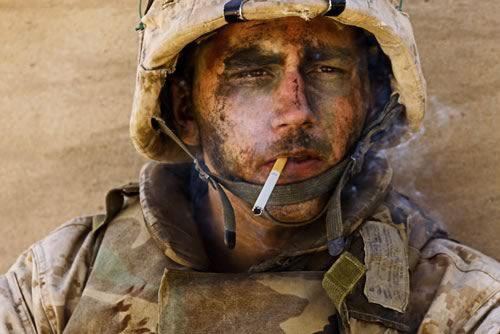
the click of a shutter, Marine Lance Corporal James Blake Miller, a
country boy from Kentucky, became an emblem of the war in Iraq. The
image would change two lives – his and mine.
With
the click of a shutter, Marine Lance Corporal James Blake Miller, a
country boy from Kentucky, became an emblem of the war in Iraq. The
image would change two lives – his and mine.