CIA Makes Payments to Members of Karzai’s Administration

WASHINGTON POST– The CIA is making secret payments to multiple members of President Hamid Karzai’s administration, in part to maintain sources of information in a government in which the Afghan leader is often seen as having a limited grasp of developments, according to current and former U.S. officials.

The payments are long-standing in many cases and designed to help the agency maintain a deep roster of allies within the presidential palace. Some aides function as CIA informants, but others collect stipends under more informal arrangements meant to ensure their accessibility, a U.S. official said.

The CIA has continued the payments despite concerns that it is backing corrupt officials and undermining efforts to wean Afghans’ dependence on secret sources of income and graft.

The U.S. official, speaking on condition of anonymity, said a significant number of officials in Karzai’s administration are on the payroll. Paul Gimigliano, a CIA spokesman, disputed that characterization, saying, “This anonymous source appears driven by ignorance, malice or both.”

A former agency official said the payments were necessary because “the head of state is not going to tell you everything” and because Karzai often seems unaware of moves that members of his own government make.

The disclosure comes as a corruption investigation into one of Karzai’s senior national security advisers – and an alleged agency informant – puts new strain on the already fraying relationship between Washington and Kabul.

Top American officials including Secretary of State Hillary Rodham Clinton and Sen. John F. Kerry (D-Mass.) have expressed concern about Karzai’s efforts to rein in anti-corruption teams, as well as intervention in the case against the security adviser. The aide, Mohammad Zia Salehi, is accused of accepting a $10,000 car as a bribe in exchange for his assistance in quashing a wide-ranging corruption probe.

The issue carries enormous stakes for the Obama administration. Concerns that the Afghan government is hopelessly corrupt have prompted a congressional panel to withhold billions of dollars in aid, and threaten to erode American support for the war.

Read full article about the CIA Making Payments to Karzai

© COPYRIGHT WASHINGTON POST, 2010

View From Laos: U.S. Ducks Cluster Bomb Ban as Laotians Still Die From Buried U.S. Explosives

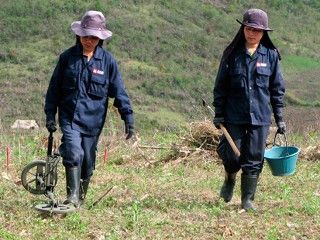
ABC NEWS– The young woman brushes her metal detector over coarse, dry grass in a field near a primary school. Against the sound of children playing, the machine beeps as she searches for unexploded bombs dropped by American aircraft four decades ago.

Most of those were cluster bombs — shells that open midair scattering tennis-ball-sized “bombies,” as they are known all over Laos. About 30 percent of them failed to explode upon impact, and instead remained buried in the earth. On average, one person a day is injured or killed in some part of the country by unexploded ordnance.

Cluster bombs affect about two dozen nations, from Afghanistan to Zambia. But it was Israel’s use of the weapon in Lebanon in August 2006, causing more than 200 casualties over the following year, that spurred members of the international community to act.

On Aug. 1, the Convention on Cluster Munitions came into force under international law. Countries that have ratified the treaty are required to cease production of cluster munitions, dispose of stockpiles and clear contaminated areas. The first gathering of the 106 member states will be held in the Laotian capital in November.

Neither Israel nor the United States will attend. In fact, the U.S., Russia, China, India, Pakistan, Brazil, and Israel are not signatories to the treaty.

The U.S., among others, has argued that cluster bombs are an effective military tool that saves their soldiers’ lives. The U.S. also has argued that it’s shifting to “smart” cluster bombs that self-destruct or deactivate, reducing the risk to civilians.

Laos, the most bombed country in the world per capita, strongly backs the treaty.

Between 1964 and 1973, the U.S. dropped more than 2 million tons of ordnance in a campaign kept hidden from Congress and the public.

Since then, about 20,000 civilians have been maimed or killed by unexploded bombs, according to Legacies of War, a Washington-based group that raises awareness about America’s “secret war” in Laos.

Read full article HERE.

Photo by Nguyen Van Vinh/Reuters

© COPYRIGHT ABC, 2010

250,000 “Contractors” Remain in Iraq and Afghan Wars

REBEL REPORTS– A couple of years ago, Blackwater executive Joseph Schmitz seemed to see asilver lining for mercenary companies with the prospect of US forces being withdrawn or reduced in Iraq. “There is a scenario where we could as a government, the United States, could pull back the military footprint,” Schmitz said. “And there would then be more of a need for private contractors to go in.”

When it comes to armed contractors, it seems that Schmitz was right. According to new statistics released by the Pentagon, with Barack Obama as commander in chief, there has been a 23% increase in the number of “Private Security Contractors” working for the Department of Defense in Iraq in the second quarter of 2009 and a 29% increase in Afghanistan, which “correlates to the build up of forces” in the country.

In Iraq, the Pentagon attributes the increase to better accounting. But, these numbers relate explicitly to DoD security contractors. Companies like Blackwater and its successor Triple Canopy work on State Department contracts and it is unclear if these contractors are included in the over-all statistics. This means, the number of individual “security” contractors could be quite higher, as could the scope of their expansion.

Overall, contractors (armed and unarmed) now make up approximately 50% of  the “total force in Centcom AOR [Area of Responsibility].” This means there are a whopping 242,657 contractors working on these two US wars. These statistics come from two reports just released by Gary J. Motsek, the Assistant Deputy Under Secretary of Defense (Program Support): “Contractor Support of U.S. Operations in USCENTCOM AOR, IRAQ, and Afghanistan and “Operational Contract Support, ‘State of the Union.’”

“We expect similar dependence on contractors in future contingency operations,” according to the contractor “State of the Union.” It notes that the deployment size of both military personnel and DoD civilians are “fixed by law,” but points out that the number of contractors is “size unfixed,” meaning there is virtually no limit (other than funds) to the number of contractors that can be deployed in the war zone.

At present there are 132,610 in Iraq and 68,197 in Afghanistan. The report notes that while the deployment of security contractors in Iraq is increasing, there was an 11% decrease in overall contractors in Iraq from the first quarter of 2009 due to the “ongoing efforts to reduce the contractor footprint in Iraq.”

Both Pentagon reports can be downloaded here.


Jeremy Scahill is the author of the international best-seller Blackwater: The Rise of the World’s Most Powerful Mercenary Army. He is a frequent contributor to The Nation magazine and a correspondent for the national radio and TV program Democracy Now! He is currently a Puffin Foundation Writing Fellow at The Nation Institute. Scahill has won numerous awards for his reporting, including the prestigious George Polk Award, which he won twice. While a correspondent for Democracy Now!, Scahill reported extensively from Iraq through both the Clinton and Bush administrations.


US to Rely on Private Military Contractors in Iraq

SYDNEY MORNING HERALD– The US State Department is to more than double the number of security contractors it employs in Iraq to around 7000, filling a gap left by departing troops, the New York Times reported on Thursday.

The newspaper said the contractors would be deployed to defend five fortified compounds that will be left behind as US combat forces exit Iraq and the US mission switches from a military-led to a civilian-headed operation.

Citing unnamed administration officials, the Times said private security contractors would operate radar to warn of enemy fire, search for roadside bombs, and fly surveillance drones.

They could also staff “quick reaction forces” dispatched to rescue civilians in trouble.

The massive increase in security contractors is an indication of the unusually large role that will be assumed by US diplomatic staff after combat troops leave Iraq.

The last US combat brigade left Iraq at dawn on Thursday, leaving behind some 56,000 US soldiers who will gradually be drawn down over the coming year.

The Times said more than 1200 specific tasks currently handled by US troops have been identified for handover to US civilians or Iraqis or to be phased out.

The State Department meanwhile, seeking to outfit its employees for the next phase of their mission, plans to purchase 60 mine-resistant vehicles from the Pentagon and to expand its inventory of armoured cars to 1,320.

It also plans to add three planes to the sole aircraft it has now, and expand its helicopter fleet – to be piloted by contractors – to 29 from 17.

The increased reliance on security contractors could cause conflict with Iraq’s government, which is sensitive to the use of foreign security personnel because of their alleged involvement in incidents involving civilian deaths.

But the forces employed by the State Department will not have immunity from Iraqi prosecution, will be required to register with the country, and will be trailed by State Department regional security officers for extra oversight.

Photo by flickr user US Army

© COPYRIGHT SYDNEY MORNING HERALD, 2010

General Petraeus Goes to Media War

August 16,2010

COMMON DREAMS– It’s already history. In mid-August 2010, the U.S. commander in Afghanistan launched a huge media campaign to prevent any substantial withdrawal of military forces the next summer.

The morning after Gen. David Petraeus appeared in a Sunday interview on NBC’s “Meet the Press” to promote the war effort, the New York Times front-paged news of its own interview with him — reporting that the general “suggested that he would resist any large-scale or rapid withdrawal of American forces.”

In fact, the general signaled that he might oppose any reduction of U.S. troop levels in Afghanistan a year from now. During the NBC interview, the Times noted, “Petraeus even appeared to leave open the possibility that he would recommend against any withdrawal of American forces next summer.”

On Monday, the Washington Post also published the twisty line of the suddenly interview-hungry Petraeus, reporting that “he remains supportive of President Obama’s decision to begin withdrawing troops next July, but he said it is far too soon to determine the size of the drawdown.” The newspaper observed that “the general’s presence in Kabul, as opposed to the U.S. Central Command headquarters in Tampa, could make him a far more forceful voice for attenuating the drawdown if he chooses to make that case.”

“Attenuating the drawdown” means keeping the war machinery at full throttle.

Let’s be clear about what’s happening here. The top U.S. military commander in Afghanistan, with the evident approval of the White House, has launched a fierce media blitz to cripple the policy option of any significant military withdrawal a year from now. Riding high in what is supposed to be a civilian-run military, Petraeus is engaging in strategic media operations to manipulate what should be a democratic process on matters of war and peace.

Who bears ultimate responsibility for this manipulative, anti-democratic behavior? The commander in chief.

Ominously, the Petraeus media offensive got underway just days after presidential spokesman Robert Gibbs picked a fight with the progressive wing of the Democratic Party — a wing that has been strengthening its opposition to the war in Afghanistan.

More than four decades after President Johnson used the term “nervous Nellies” to disparage the growing number of Democrats who voiced dissent about the war in Vietnam, the Obama White House is now disparaging progressive dissenters with terms like “the professional left.”

Every week, President Obama is sacrificing billions of dollars and uncounted lives in the service of what Martin Luther King Jr. called — at a time of another horrific war effort — “the madness of militarism.” Then, as now, a Democrat in the White House augmented the momentum of the Pentagon’s war train, boosting it with eagerness to appear tough and avoid Republican charges of weakness.

While history is not exactly repeating, it is rhyming. Like a dirge.

Now, as in the era of Dr. King’s final years, war is escalating while the lures of silence or equivocation are widely viewed as prudent. Rationales for muting dissent keep pitching for complicity.

The immediate problem is one of political acquiescence. Right now, it’s time to speak up against the efforts by a top general to stampede this country into more war. No matter who is willing to go along with the madness of militarism, we must not.

Norman Solomon is a journalist, historian, and progressive activist. His book “War Made Easy: How Presidents and Pundits Keep Spinning Us to Death” has been adapted into a documentary film of the same name. His most recent book is “Made Love, Got War.” He is a national co-chair of the Healthcare NOT Warfare campaign. In California, he is co-chair of the Commission on a Green New Deal for the North Bay; www.GreenNewDeal.info.

ISAF Photo By U.S. Air Force Staff Sgt. Bradley Lail

Page 63 of 79<<...6162636465...>>