Barack Obama to Authorize Record $60 Billion Saudi Arms Sale

GUARDIAN– Barack Obama is to go ahead with plans to sell Saudi Arabia advanced aircraft and other weapons worth up to $60bn (£39bn), the biggest arms deal in US history, in a strategy of shoring up Gulf Arab allies to face any military threat from Iran.

According to the Wall Street Journal, the administration is also in talks with the Saudis about possible naval and missile-defence upgrades that could be worth tens of billions of dollars more over five to 10 years.

Plans to go ahead with the package, which has been under secret negotiation since 2007, have been known for some time and have raised angry objections from Iran and to a lesser extent from Israel, an even closer US ally which is anxious to maintain its strategic edge over any potential adversary in the Middle East.

In its notification to Congress, the administration will authorise the Saudis to buy as many as 84 new F-15 fighters, upgrade 70 more, and purchase three different types of helicopters – 70 Apaches, 72 Black Hawks and 36 Little Birds, the Wall Street Journal reported. The package would be subject to a review by Congress.

According to earlier reports, the administration has already decided out of deference to the Israelis not to sell Saudi Arabia so-called stand-off systems, advanced long-range weapons that can be attached to F-15s for use in offensive operations.

The US is the world’s largest arms supplier and the Saudi deal alone is said to support up to 75,000 jobs, according to firms such as Boeing, Northrop Grumman, Lockheed Martin and General Electric. Last year, despite a recession that hit global arms sales, the US increased its share to more than two-thirds of all foreign armaments deals, according to a congressional study.

Read full article about Obama’s Saudi Arms Deal.

© COPYRIGHT GUARDIAN, 2010

Soldiers Face Charges Over Secret “Kill Team”

Andrew Holmes, Michael Wagnon, Jeremy Morlock and Adam Winfield are four of the five Stryker soldiers who face murder charges. Photograph: Public Domain


GUARDIAN– Twelve American soldiers face charges over a secret “kill team” that allegedly blew up and shot Afghan civilians at random and collected their fingers as trophies.

Five of the soldiers are charged with murdering three Afghan men who were allegedly killed for sport in separate attacks this year. Seven others are accused of covering up the killings and assaulting a recruit who exposed the murders when he reported other abuses, including members of the unit smoking hashish stolen from civilians.

In one of the most serious accusations of war crimes to emerge from the Afghan conflict, the killings are alleged to have been carried out by members of a Stryker infantry brigade based in Kandahar province in southern Afghanistan.

According to investigators and legal documents, discussion of killing Afghan civilians began after the arrival of Staff Sergeant Calvin Gibbs at forward operating base Ramrod last November. Other soldiers told the army’s criminal investigation command that Gibbs boasted of the things he got away with while serving in Iraq and said how easy it would be to “toss a grenade at someone and kill them”.

One soldier said he believed Gibbs was “feeling out the platoon”.

Investigators said Gibbs, 25, hatched a plan with another soldier, Jeremy Morlock, 22, and other members of the unit to form a “kill team”. While on patrol over the following months they allegedly killed at least three Afghan civilians. According to the charge sheet, the first target was Gul Mudin, who was killed “by means of throwing a fragmentary grenade at him and shooting him with a rifle”, when the patrol entered the village of La Mohammed Kalay in January.

Morlock and another soldier, Andrew Holmes, were on guard at the edge of a poppy field when Mudin emerged and stopped on the other side of a wall from the soldiers. Gibbs allegedly handed Morlock a grenade who armed it and dropped it over the wall next to the Afghan and dived for cover. Holmes, 19, then allegedly fired over the wall.

Later in the day, Morlock is alleged to have told Holmes that the killing was for fun and threatened him if he told anyone.

Read full article about the Secret Kill Team.

© COPYRIGHT GUARDIAN, 2010

U.S. Military’s War on the Earth

Top 25 of 2004

PROJECT CENSORED– The U.S. military is waging a war on planet Earth. “Homeland security” has become the new mantra since , and has been the justification for increasing U.S. military expansion around the world. Part of this campaign has been the varied and persistent appeals by the Pentagon to Congress for exemptions from a range of environmental regulations and wildlife treaties.

The world’s largest polluter, the U.S. military, generates 750,000 tons of toxic waste material annually, more than the five largest chemical companies in the U.S. combined. This pollution occurs globally as the U.S. maintains bases in dozens countries. In the U.S. there are 27,000 toxic hot spots on 8,500 military properties inside Washington’s Fairchild Air Force Base is the number one producer of hazardous waste, generating over 13 million pounds of waste in 1997. Not only is the military emitting toxic material directly into the air and water, it’s poisoning the land of nearby communities resulting in increased rates of cancer, kidney disease, increasing birth defects, low birth weight, and miscarriage.

The military currently manages 25 million acres of land providing habitat for some 300 threatened or endangered species. Groups such as Defenders of Wildlife have sued the military for damage done to endangered animal populations by bomb tests. The testing of Low-Frequency Sonar technology is accused of having played a role in the stranding death of whales around the world.

Rather than working to remedy these problems, the pentagon claims that the burden of regulations is undercutting troop readiness. The Pentagon already operates military bases in and outside of the U.S. as “federal reservations” which fall outside of normal regulation. Yet the DOD is seeking further exemptions in congress from the Migratory Bird Treaties Act, the Wildlife Act, the Endangered Species Act, the Clean Air Act and the National Environmental Policy Act.

The Pentagon now employs 10,000 people with an annual budget of 2 billion dollars to deal with the legalities that arise from the Military’s toxic droppings. New Justice Department policies frustrate attempts by the public to obtain knowledge. In one case the U.S. Navy demanded $1500 for the release of documents related to compliance with environmental laws at the Trident nuclear submarine base in the Puget Sound. Other requests are simply not processed and attempts at legal countermeasures are thwarted. The Pentagon has also won reductions in military whistleblower protection laws. These measures disregard the Freedom of Information Act and obstruct the notion of a Democratic State.

UPDATE BY AUTHORS DAVID S. MANN AND GLEN MILNER: Since our article appeared in the Washington Free Press in September 2002 there have been numerous attempts by the U.S. military and the Bush administration to secure military exemptions from environmental law. In a rare defeat, the Pentagon failed in 2002 to win concessions from Congress for exemptions from the Endangered Species Act, Marine Mammal Protection Act and other environmental laws.

A December 10, 2002 document, Sustainable Ranges 2003 Decision Briefing to the Deputy Secretary of Defense, unleashed a three year campaign to systematically exempt all U.S. military activity from every perceived environmental restriction. Included in the briefing is a “2002 Lessons Learned” section, citing the need for better quantification of encroachment impacts and a sustained aggressive campaign addressing concerns of the GAO and Congress. Other targeted critics are state attorneys general, media, industry and Non-Governmental Organizations.

In a March 7, 2003 memo, Deputy Defense Secretary Paul Wolfowitz asked the Army, Navy and Air Force secretaries for examples of military readiness hindered by compliance to environmental law. Even though current law has never been used, allowing the President to invoke environmental exemptions deemed necessary for national defense.

Other attempts for environmental exemption for the military have been less than obvious. An April 2003 proposal by Defense Secretary Rumsfeld, “The Defense Transformation for the 21st Century Act”, suspended whistleblower protections for Department of Defense personnel. In another, an executive order from President Bush is being considered establishing the Department of Defense as the first among equals in any disagreement between agencies. Added to this are new restrictions on the implementation of the Freedom of Information Act and a reduced budget for the Environmental Protection Agency for FY 2004.

Efforts for environmental justice continue. In the Pacific Northwest, we have begun a mix of public education and legal action concerning the U.S. Navy and environmental compliance. We have found that coalitions of long-time “peace” and “environmental” organizations make effective action groups.

In March 2001, two environmental organizations and three peace organizations filed a 60 Day Notice against the Navy’s Trident II (D-5) missile upgrade at the Trident nuclear submarine base at Bangor, Washington. The case, by David Mann, is now in the 9th Circuit Court of Appeals with a decision expected in Fall 2003.

Two other lawsuits involving David Mann and Glen Milner and the Freedom of Information Act (FOIA) have gone to court. In the first, filed in April 2002, concerning explosive Trident rocket motor shipments, the Navy conceded it had lost the case. The Navy then paid attorney fees and reclassified the documents exempt under national security. This case and another filed in March 2003, involving accident assessments for explosive material at the Bangor submarine base, are still pending.

In December 2002, a FOIA request by Glen Milner revealed the Navy has been firing 20mm depleted uranium rounds into prime fishing waters off the coast of Washington State during routine calibration and testing of the Navy’s Close-In Weapons System (CIWS). Numerous FOIA requests have shown the Navy is not in compliance with Nuclear Regulatory Commission (NRC) licensing agreements. A preliminary complaint has been filed with the NRC. Our goal is a NEPA lawsuit and injunction against the Navy over the firing of depleted uranium rounds into U.S. waters.

For information on our lawsuit against the U.S. Navy visit www.gzcenter.org. Organizations involved are Waste Action Project, Washington Physicians for Social Responsibility, and Peace and Justice Alliance, all based in Seattle, Washington; Ground Zero Center for Nonviolent Action in Poulsbo, Washington; and Cascadia Wildlands Project in Eugene, Oregon.

UPDATE BY BOB FELDMAN: Despite the increased size of recent anti-war protests around the globe, the Pentagon’s “war on the earth” still continues. Since the story was published, a new wave of environmental destruction in Iraq was produced by the U.S. war machine’s March and April 2003 missile attacks and its bombardment, invasion and occupation of that country.

A report on Iraq of the United Nations Environmental Program [UNEP]’s Post-Conflict Assessment Unit noted that the heavy Pentagon bombing and the movement of large numbers of Pentagon military vehicles and troops in Iraq “further degraded natural and agricultural ecosystems.”

The UNEP Post-Conflict Assessment Unit report also observed that the Pentagon’s intensive use of Depleted Uranium [DU] weapons. Significant levels of radioactive contamination were found at four sites in Baghdad in May 2003, by Christian Science Monitor reporter Scott Peterson (CSM, 5/15/03). Much of this radioactive contamination was likely produced by the DU bullets fired into the center of Baghdad at the Iraqi Ministry of Planning by the Pentagon’s A-10 Warhog aircraft, Abrams tanks or Bradley fighting vehicles. According to the Monitor, Pentagon figures indicate that about 250,000 DU bullets were fired by A-10 Warhog aircraft in March and April 2003, leaving an estimated additional 75 tons of DU in Iraq, as a result of the Pentagon’s attack.

Local air pollution and soil contamination in Iraq also increased, as a result of the recent war. The Pentagon’s bombing of Baghdad, for instance, ignited fires which toxic, black smoke that contained dangerous chemicals, which caused harm to Iraqi children and to Iraqi adults with respiratory problems, and further polluted Iraqi ecosystems.

The mainstream press showed no interest in Dollars & Sense’s “War on the Earth” story. But U.S. alternative media outlets responded with some interest. WMBR-Cambridge’s “No Censorship Radio” invited me to appear on its weekly show to talk about the “War On The Earth” article, as did a producer at the Making Contact radio show. Alternet’s environmental editor selected this D&S article for posting on the Alternet web site and there was some mention in the Utne Reader.

The impact of the article among green/anti-war readers was due, I think, in large part to the Dollars & Sense magazine editors’ decision to use maps to visually reflect the domestic and global extent of the Pentagon’s pollution activity. Also, the article initially appeared just a few days before the U.S. Warfare State launched its attack on Iraq. So the article’s implied argument, that to be a friend of the Earth a green activist must also mobilize against U.S. global militarism, probably seemed like an historically timely one.

Since the article appeared in Dollars & Sense, the U.S. Navy – in response to years of protest – has finally closed its base on Puerto Rico’s Isla de Vieques. But the environmentally destructive target practice that the U.S. Navy used to do on the Isla de Vieques has been transferred to Florida.

To both get more information contact the Military Toxics Project, P.O. Box 558, Lewiston, ME 04243; call 207-783-5091; http://www.miltoxproj.org or e-mail [email protected] . Seth Shulman’s early 1990s book, “The Threat At Home: Confronting the Toxic Legacy of the U.S. Military,” also contains information about the Pentagon’s “War on the Earth” within the US’s borders.

DOLLARS & SENSE, March/April, 2003
Title: “War on Earth”
Author: Bob Feldman

WASHINGTON FREE PRESS, Sep/Oct 2002
Title: “Disobeying Orders”
Author: David S. Mann and Glenn Milner

WILD MATTERS, October 2002
Title: “Military Dumping”
Author: John Passacantando

Faculty Evaluators: Bill Crowley Ph.D., Mary Gomes Ph.D.
Student Researchers: Jen Scanlan, Grayson Kent

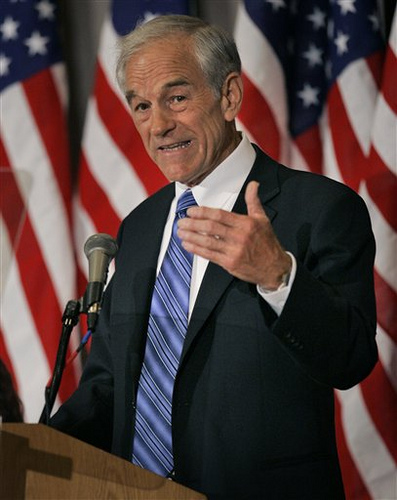
Ron Paul on Iraq: Mission Not Accomplished

BUSINESS WIRE– Congressman Ron Paul today released the following statement on President Obama’s speech from the Oval Office last night:

“Once again, we are being told the mission has been accomplished and our brave men and women are coming back home. Though the people are hopeful they remain skeptical, and rightfully so.”

“The President’s announcement that all U.S. combat troops have left Iraq is no more believable than the ‘Mission Accomplished’ declaration was in 2003.

“The biggest problem is that success in Iraq is undefinable since the mission was never defined. The reasons given for the invasion were based on misinformation. Now, the war has cost us hundreds of billions of dollars and this has contributed significantly to our economic woes.

“Forty-four hundred Americans are dead, thirty thousand severely wounded, and more than a hundred thousand are suffering from serious health problems related to Post Traumatic Stress Syndrome. This alone should tell us that it was not worth the investment and the needless sacrifice of our young people and the taxpayers.

“It is deceitful to imply we will avoid hostilities with this new policy. We still have to contend with:

  • the 50,000 troops carrying weapons remain in Iraq

  • the 100,000 contractors that remain with more expected to go to Iraq

  • the 9,000 special ops personnel trained in assassinations that remain in Iraq

  • a huge embassy, bigger than the Vatican, that will remain

  • Dozens of military bases that will stay

  • Al Qaeda organizations that did not exist before the war

  • Muqtada al Sadr, a strong nationalist who has gained much political power

  • The fact that Iran benefits tremendously with the Shiites now in power in Iraq and is a close ally of al Sadr

“Osama bin Laden wins by ‘proving’ that America has an agenda of occupation in the Middle East. And, we continue to walk into his trap and hand him up his best recruitment tool in his efforts to incite hatred and terrorism against the United States.

“What’s worse, President Obama made it clear last night that the troops and resources leaving Iraq will not come home to defend our country or ease our economic woes. They will instead be diverted to Afghanistan, perhaps also Pakistan and, I fear, even Iran.

“From my viewpoint we are the losers in this fool’s errand of endless war. Tragically, this new policy is not one of peace but merely a charade that will severely undermine our national security and continue us down the path to bankruptcy—a threat that we best not long ignore.”

Photo by Flickr user JohnE777

© COPYRIGHT BUSINESS WIRE, 2010

A Nation That Spends More Money on War Than Life is Approaching Spiritual Death

BUZZFLASH– The August 9 announcement by Secretary of Defense Robert Gates of cost-containment measures at the Defense Department should not obscure two underlying facts.  First, as he conceded, these proposed economies will not result in cutting the overall Pentagon budget, which is slated for expansion.  And, second, as a Washington Post article reported, “defense officials characterized them as a political preemptive strike to fend off growing sentiment elsewhere in Washington to tackle the federal government’s soaring deficits by making deep cuts in military spending.”

But why should anyone want to cut the U.S. military budget?

One reason is that—with $549 billion requested for basic military expenditures and another $159 billion requested for U.S. wars in Iraq and Afghanistan—the record $708 billion military spending called for by the Obama administration for fiscal 2011 will be nearly equivalent to the military spending of all other nations in the world combined. When it comes to military appropriations, the U.S. government already spends about seven times as much as China, thirteen times as much as Russia, and seventy-three times as much as Iran.

Is this really necessary?  During the Cold War, the United States confronted far more dangerous and numerous military adversaries, including the Soviet Union.  And the U.S. government certainly possessed an enormous and devastating military arsenal, as well as the armed forces that used it.  But in those years, U.S. military spending accounted for only 26 percent of the world total.  Today, as U.S. Congressman Barney Frank has observed, “we have fewer enemies and we’re spending more money.” / Where does this vast outlay of U.S. tax dollars—the greatest military appropriations in U.S. history—go?  One place is to overseas U.S. military bases.  According to Chalmers Johnson, a political scientist and former CIA consultant, as much as $250 billion per year is used to maintain some 865 U.S. military facilities in more than forty countries and overseas U.S. territories.

The money also goes to fund vast legions of private military contractors.  A recent Pentagon report estimated that the Defense Department relies on 766,000 contractors at an annual cost of about $155 billion, and this figure does not include private intelligence organizations.  A Washington Post study, which included all categories, estimated that the Defense Department employs 1.2 million private contractors.

Of course, enormously expensive air and naval weapons systems—often accompanied by huge cost over-runs—account for a substantial portion of the Pentagon’s budget.  But exactly who are these high tech, Cold War weapons to be used against?  Certainly they have little value in a world threatened by terrorism.  As Congressman Frank has remarked:  “I don’t think any terrorist has ever been shot by a nuclear submarine.”

Furthermore, when bemoaning budget deficits, Americans should not forget the enormous price the United States has paid for its wars in Iraq and Afghanistan.  According to the highly-respected National Priorities Project, their cost, so far, amounts to $1.06 trillion. (For those readers who are unaccustomed to dealing with a trillion dollar budget, that’s $1,060,000,000,000.)

When calculating the benefits and losses of these kinds of expenditures, we should also include the opportunities forgone through military spending.  How many times have government officials told us that there is not enough money available for health care, for schools, for parks, for the arts, for public broadcasting, for unemployment insurance, for law enforcement, and for maintenance of America’s highway, bridge, and rail infrastructure?

Admittedly, there are other reasons for America’s failure to use its substantial wealth to provide adequate care for its own people.  Some Americans, driven by mean-spiritedness or greed, resent the very idea of sharing with others.  Furthermore, years of tax cuts for the wealthy have diminished public revenues.

Even so, it is hard to deny that there is a heavy price being paid for making military power the nation’s top priority.  With more than half of U.S. government discretionary spending going to feed the Pentagon, we should not be surprised that—in America, at least—it is no longer considered feasible to use public resources to feed the hungry, heal the sick, or house the homeless.

We would do well to recall an observation by one of the great prophets of our time, Martin Luther King, Jr.:  “A nation that continues year after year to spend more money on military defense than on programs of social uplift is approaching spiritual death.”

~~~~~~~~~~~~

Dr. Wittner is Professor of History at the State University of New York/Albany. His latest book is Confronting the Bomb: A Short History of the World Nuclear Disarmament Movement (Stanford University Press).

© COPYRIGHT BUZZFLASH, 2010

Page 62 of 79<<...6061626364...>>