UN Clears Way for Attack on Libya

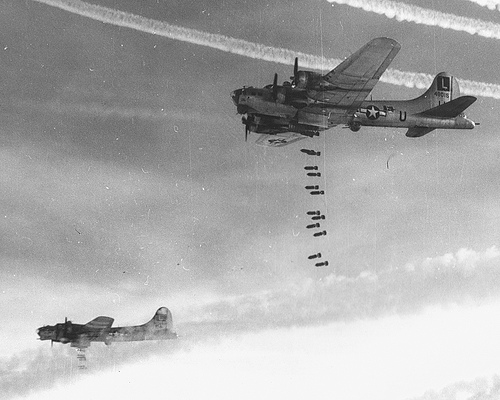
WALL STREET JOURNAL– The United Nations Security Council authorized military force Thursday against Libyan leader Col. Moammar Gadhafi’s security forces, opening the way for European and U.S. airstrikes within days.

The U.N. action, pushed aggressively by France and the U.K., came as Col. Gadhafi’s security forces continued their assault toward Benghazi, the de-facto capital of rebels trying to end his 42-year rule.

European and American officials argued on the Security Council floor that an international campaign to stop Col. Gadhafi’s forces was required immediately to stave off a potential massacre of opposition forces and civilians.

French officials have indicated that military strikes could take place within hours of the resolution’s passage. Others were more cautious about how quickly any attacks would begin.

Continue reading about U.N. Clears Way for Attack on Libya.

© Copyright Wall Street Journal, 2011

Photo by flickr user foqus

US Sold $7 Billion in Arms to Libya and Egypt in 2009

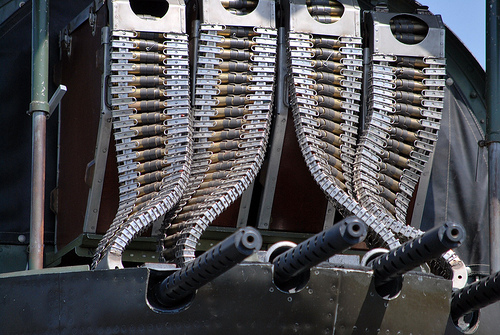
BUSINESS WEEK– The U.S. government approved $40 billion in worldwide private arms sales in 2009, including more than $7 billion to Mideast and North African nations that are struggling with political upheaval, the State Department reported.

From 2008 to 2009, the U.S. authorized increasing sales of military shipments to the now-toppled Egyptian government of Hosni Mubarak and the embattled kingdom of Bahrain. But the U.S. reduced its defense sales approvals in 2009 to Moammar Gadhafi’s Libyan government, which is now under a blanket weapons ban imposed last month by the Obama administration.

The $40 billion figure during the first year of the Obama administration reflects a rise in total approved arms sales over the final year of the Bush administration in 2008, when the State Department licensed $34.2 billion.

The latest figures describe sales of military hardware from missile systems to bullets that the State Department authorizes from private U.S. defense companies to other countries. The figures do not include direct U.S. military aid to other nations, providing a limited snapshot of the ebb and flow of American arms abroad. The figures also detail only proposed sales — not actual shipments.

The new numbers issued in a report from State’s Directorate of Defense Trade Controls indicate that international sales sought by U.S. defense firms have surged in the last two years after holding steady for most of the 2000s in the range of $20 billion. And the report’s details show the willingness of the Obama administration, like preceding White Houses, to sometimes provide military and crowd-control weaponry to regimes with little popular support.


Photo by DCB Prime

Afghan Civilian Deaths Hit New High

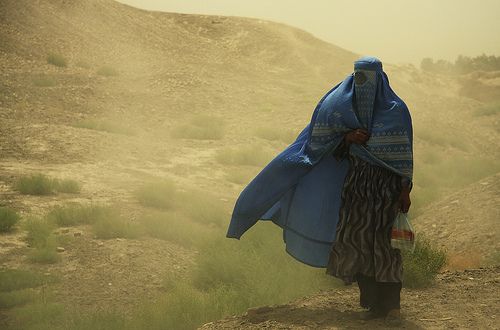
RAW STORY– Last year was the deadliest yet for civilians in the Afghan war with a 15 percent jump in the death toll, the UN said in a report Wednesday which laid bare the conflict’s impact on ordinary people.

The 2,777 deaths underscore the level of violence in the country as foreign troops prepare to start handing control of security to Afghan forces in some areas from July ahead of a full transition due by 2014.

Insurgents were responsible for 75 percent of all civilian deaths, up 28 percent on 2009, the figures said.

That compared to 16 percent for international and Afghan government forces, down 26 percent on the previous year, while responsibility for the remaining deaths could not be attributed.

Large numbers of children and women were among the dead — 1,175 and 555 respectively.

The issue of civilian deaths caused by coalition forces, long a thorny question for the US-led troops, is particularly sensitive in Afghanistan at the moment.

Last week, nine young boys were mistakenly killed while out collecting firewood in an air strike in eastern Afghanistan.

Read more about Afghan Civilian Deaths Hit New High.

© RAW STORY 2011

Photo by flickr user Afghanistan Matters

US ‘Secret War’ Expands Globally with Special Ops

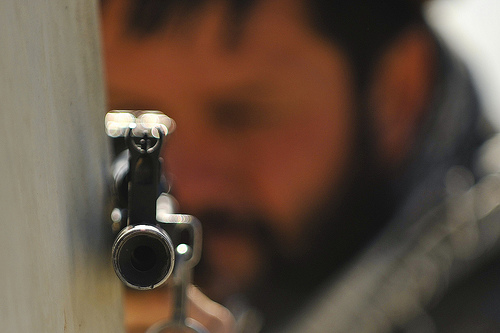
WASHINGTON POST– Beneath its commitment to soft-spoken diplomacy and beyond the combat zones of Afghanistan and Iraq, the Obama administration has significantly expanded a largely secret U.S. war against al-Qaeda and other radical groups, according to senior military and administration officials.

Special Operations forces have grown both in number and budget, and are deployed in 75 countries, compared with about 60 at the beginning of last year. In addition to units that have spent years in the Philippines and Colombia, teams are operating in Yemen and elsewhere in the Middle East, Africa and Central Asia.

Commanders are developing plans for increasing the use of such forces in Somalia, where a Special Operations raid last year killed the alleged head of al-Qaeda in East Africa. Plans exist for preemptive or retaliatory strikes in numerous places around the world, meant to be put into action when a plot has been identified, or after an attack linked to a specific group.

The surge in Special Operations deployments, along with intensified CIA drone attacks in western Pakistan, is the other side of the national security doctrine of global engagement and domestic values President Obama released last week.

One advantage of using “secret” forces for such missions is that they rarely discuss their operations in public. For a Democratic president such as Obama, who is criticized from either side of the political spectrum for too much or too little aggression, the unacknowledged CIA drone attacks in Pakistan, along with unilateral U.S. raids in Somalia and joint operations in Yemen, provide politically useful tools.

Obama, one senior military official said, has allowed “things that the previous administration did not.”

Continue reading about the U.S. ‘secret war’ expanding globally as Special Operations forces take a larger role.

Photo by Flickr user DVIDSHUB

© COPYRIGHT WASHINGTON POST, 2011

Posted in Uncategorized | 1 Reply

In Tunisia, US Backing Dictatorship

INSTITUTE FOR PUBLIC ACCURACY – PRESS RELEASE: CNN is reporting: “Police in Tunisia’s capital city used batons and tear gas to clear a peaceful demonstration on Friday. … [This occurs] after days of riots that have killed at least 21 people.”

STEPHEN ZUNES
Zunes just wrote the piece “Pro-Democracy Uprising Fails to Keep Washington From Backing Tunisian Dictatorship.”

Zunes is professor of politics at the University of San Francisco and senior policy analyst for Foreign Policy in Focus.

CHRISTOPHER ALEXANDER

Alexander is director of the Dean Rusk International Studies Program at Davidson College in North Carolina and a specialist on Tunisia. He is author of Tunisia: Stability and Reform in the Modern Maghreb.

He said today: “Until this week, I was betting that [Tunisian President] Ben Ali would ride this out. But the regime’s traditional tools can no longer address the situation.

“There’s broad-based social unrest, people have no faith in the government given the mafia-type corruption around the president’s family, human rights abuses, and until yesterday, his refusal to make any kind of political reform.

“Economics is huge in this. In mid-December, a university graduate lit himself on fire after police busted him for selling vegetables. The economy has generally been unable to generate good jobs for university graduates and has gotten even worse since the global recession, especially since Tunisia is largely dependent on exporting to Europe.

“The U.S. government has been predictably quiet given that Tunisia  has been pro-U.S. Some WikiLeaks revelations regarding Tunisia became public in November. What struck many Tunisians was that U.S. diplomats seemed to privately have the same conception of Ben Ali that they did. Another aspect of what is happening is the role  social media, such as Facebook and Twitter, has played in protesters organizing themselves.

“General strikes now underway in Tunisia are particularly significant given how hard Ali has worked to co-opt the unions.”

Earlier this month, Foreign Policy published a piece by Alexander titled “Tunisia’s protest wave: where it comes from and what it means

Graphic video and regular information about Tunisia is available via: angryarab.blogspot.com

Twitter feed about Tunisia

Twitter feed from Tunisiatranslation plug-in available

For more information, contact at the Institute for Public Accuracy:
Sam Husseini, (202) 347-0020; or David Zupan, (541) 484-9167

Page 57 of 79<<...5556575859...>>