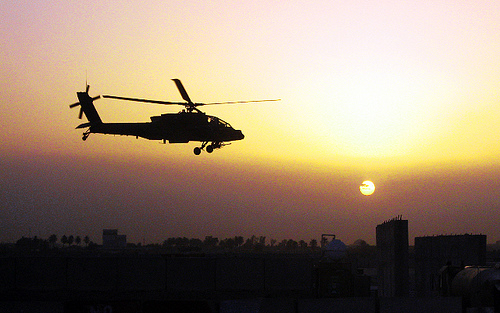
 MEDIA ROOTS – The Pentagon’s budget has grown from $267 billion in 2000 to $708.2 billion in 2011. In addition to budgetary increases, the Pentagon is expanding its arrogation of global jurisdiction. The Unified Combatant Command of USAFRICOM (est. 2007) is of particular concern.
The Pentagon spins AFRICOM’s presence as a boon for all parties. According to former AFRICOM commanding General William “Kip” Ward, AFRICOM allows African nations to first choose “African solutions to African problems.” Other U.S. military leaders emphasize the benefits African countries receive from the United States’ implicit dedication to helping local communities.
U.S. military officials also claim AFRICOM allows for the relentless pursuit of shadowy, devious terrorists. “Violent extremist organizations [residing in Africa] have very clearly articulated an intent to attack the United States, its allies, its citizens and its interests both within Africa and also more broadly, in Europe,” according to AFRICOM commanding General Carter Ham. To help shape public discourse, various militant groups are presented as terrifying, inexplicable threats to the United States. Among these “threats” are Ash-Shabaab in Somalia, Boko Haram in Nigeria, al-Qa’ida in the Islamic Maghreb (AQIM), anti-Western rulers in Libya, and the Lord’s Resistance Army (LRA) in central Africa.
AFRICOM officials cite Ash-Shabaab’s proximity to the Middle East and links with al-Qa’ida as reason to pursue them relentlessly. In pursuing Ash-Shabaab, Washington uses CIA assets, drone strikes, U.S. special mission units, and African proxy forces.
General Ham referred to Boko Haram in Nigeria as a “growing threat to Western interests,” while Admiral William McRaven, Commander of USSOCOM, called them a “terrorist group.” Such allegations from top U.S. military officials serve to expand U.S. military activity across Africa, while keeping an eye on oil in Nigeria, from which USA receives 8% of its petroleum imports.
The Pentagon’s press service hinted at the importance of oil in the Defense Department’s strategic calculus when stating Boko Haram’s challenge to the Nigerian government is troubling, considering how “Africa’s vast natural resources compound the region’s strategic importance… particularly oil that’s exported to the United States.” Since Boko Haram has yet to display a sufficiently threatening posture, General Ham ties it to AQIM in terms of training, funding, and activities in order to take Boko Haram’s profile to the next level and implicate it as a threat to the USA. By wrapping up Boko Haram in the same ball as AQIM, which according to General Ham has “very clearly” shown an intent and desire to attack U.S. citizens, AFRICOM is able to spread its forces across the rest of the Sahel without raising questions from the U.S. citizenry.
General Carter Ham asserts “each of those three [Ash-Shabaab, Boko Haram, and AQIM] pose a significant threat not only in the nations where they primarily operate, but regionally, and I think they pose a threat to the United States.” In addition to gross hyperbole, Ham points to these groups’ potential to collaborate and coalesce as further rationale for the Pentagon to assist African nations with “anti-terrorist capabilities” [read: spread U.S. forces throughout Africa]. Ham reiterated these same points earlier this summer.
In order to counter the inflated “terror” threat, General Ham follows a “theater engagement strategy,” which includes a wide variety of exercises, operations, “security cooperation programs,” training programs, and equipment sequences. Admiral Eric T. Olson (ret.), former Commander of USSOCOM, framed it as shifting the Pentagon’s “strategic focus” “largely to the south… certainly within the special operations community, as we deal with the emerging threats from the places where the lights aren’t,” referencing what is often referred to prejudicially as the “dark continent.” Hence, Pentagon strategists aim to “turn the lights on” across Africa.
Seizing upon any excuse and justification to expand AFRICOM’s jurisdiction, General Ham cites successful military operations in Libya, specifically Operation Odyssey Dawn. Even though Colonel Qaddafi is deceased, General Ham uses AFRICOM to try and fill the vacuum, which Qaddafi left behind:
“It’s very clear that extremist organizations, notably al-Qaida, with some direction from al-Qaida’s senior leaders, would seek to undermine that good governance that the Tunisians and the Libyans seek… And so I think that’s the real threat that is posed… I think we need to partner very closely with the security forces [and] armed forces of Tunisia and Libya to prevent the reestablishment of those networks [and] to prevent those violent extremist organizations from undermining the progress that both countries are seeking.”
Ham recently succeeded in normalizing military relations with the new Libyan leaders. Ham recalled how he visited Tripoli “a number of times, and has had “Libyan officials visit us in our headquarters in Germany, and we have started to map out what the U.S. assistance might be for Libya well into the future.” Ham’s words portend inauspicious obstacles in the form of U.S. interference with Libyan self-determination.
Several hundred miles south of Libya lays the Central African Republic, to where President Obama deployed over 100 “combat-equipped” U.S. troops in order to assist in fighting the Lord’s Resistance Army. These troops, augmented by U.S. civilians, headquarters personnel, communications equipment, and logistics experts, also roam Uganda, South Sudan, and the Democratic Republic of the Congo. By depicting the LRA as a nothing more than a “terror group,” the Pentagon is again able to expand AFRICOM’s territory with minimal objection from the domestic U.S. audience, while acting as if its entire existence is altruistic and humanitarian in nature.
In order to justify this particular operation, General Ham invoked a classic public-relation ploy, referring to today’s enemy as “evil.” Ham remarked, “if you ever had any question if there’s evil in the world, it is resident in the person of [LRA leader] Joseph Kony and that organization.” Many other enemies-of-the-day have been deemed “evil” during recent years, including Russia, Iran, Iraq, North Korea, Colonel Qaddafi, various “terrorists,” drug traffickers, those who resist U.S. imperialism, Afghanistan, Syria, et cetera. Meanwhile, the State Department couches the deployment to central Africa as consistent with Washington’s concern for “increasing civilian protection” and “providing humanitarian assistance.”
Harmful Presence
Contrary to the Pentagon’s illusion, AFRICOM’s existence is extremely detrimental to all involved. It perpetuates Africa’s dependency on external support. With AFRICOM looming large, African politicians and states-people can easily defer to the U.S. military instead of focusing on their respective internal and AU security apparatuses. This ease of deference is shown well in how the Pentagon is involved in “training, equipping and funding the African Union Mission and Somali forces from Uganda, Burundi, Djibouti, Sierra Leone and Kenya.” Furthermore, since the U.S. military’s FM 3-24 assumes responsibility for economic and diplomatic territory, AFRICOM’s presence now allows African politicians and states-people to defer to U.S. economic powerhouses and diplomatic initiatives. In allowing AFRICOM to assume manifold responsibilities across diplomatic, economic, and military fields, U.S. policymakers ignore Africa’s own proven capacity to stabilize violent internal strife, as evident in the Economic Community of West African States’ 1990 response to the Liberian civil war, as Danny Glover elucidated. After all, if Washington, D.C. were to admit Africa can take care of itself, then new pretexts must be invented in order to expand U.S. military operations across the continent.
Additionally, AFRICOM’s establishment and expansion provide another aperture through which Pentagon generals and politically-appointed policymakers exploit the uniformed troops. With little economic opportunity outside of corporate America’s increasingly dismal career prospects, more and more U.S. citizens are turning to the Armed Forces to make ends meet. With increasing frequency, the U.S. government and its corporate overlords send these troops to all corners of the globe to fight for mineral wealth, oil, and natural resources.
What may be most patent is AFRICOM allows the U.S. military to expand throughout the African continent. Many corollaries ensue, specifically an unbridled military-industrial complex; pretexts of chasing “terror” continue unabated, U.S. access to Africa’s natural resources is ensured militarily, and live targets abound against which the Pentagon and CIA may practice.
Far from altruistic, the Pentagon’s presence across Africa is entirely self-serving. As the Pentagon’s own propaganda machine readily concedes, AFRICOM’s “aim is to promote a stable and secure environment in support of U.S. foreign policy” [my emphasis]. General Ham states, “We’ve prioritized our efforts, focusing on the greatest threats to America, Americans and American interests.” AFRICOM’s selfish drive is remarkably similar to USA’s traditional military policies towards Latin America, described candidly as always working to improve “internal security capabilities” in support of U.S. foreign policy (Chomsky: 49). Sound familiar?
AFRICOM’s presence simply allows Washington to shape domestic African laws, to alter internal policy decisions regarding resource extraction and counterterrorism, to coerce African governments into adjusting their foreign policies to fit U.S. military and economic objectives, and to interfere with internal litigation (Lutz et al.: 118).
The Washington Post Editorial Board recently wrote of the Chinese arms trade in Africa:
“…an investigation might shed light on China’s undisciplined arms trade, which is driven by relentless mercenary interests and a desire to cozy up to oil-soaked and mineral-rich African leaders.”
Replace “China” with “USA,” and we’re treated to the candid truth, which Washington and the Washington Post may have a tough time swallowing: An investigation might shed light on USA’s undisciplined arms trade [and militarization of the African continent], which is driven by relentless mercenary interests, [corporate interests], and a desire to cozy up to oil-soaked and mineral-rich African leaders. The truth hurts.
Former AFRICOM commanding General William Ward still claims the United States’ presence doesn’t amount to further militarization of the African continent, but merely supports “the efforts of other U.S. government agencies,” like “State Department or U.S. Agency for International Development programs.” If this is truly the case, then the United States would have established an AFRIAID command or a massive diplomatic hub instead of numerous military facilities. Economic development and educational initiatives do not necessitate military intervention.
On a continent already rife with conflict and excess weapon imports, General Ward nonetheless focused AFRICOM on “promoting regional cooperation through military-to-military engagements that strengthen regional capabilities,” and “further strengthening the unity of efforts with other U.S. agencies and, as appropriate, the international community.” Regrettably, neither one of these primary AFRICOM objectives helps Africa meet its true wishes: less foreign military interference and more African unity.
Full Coverage
U.S. policymakers who approved AFRICOM’s formation, specifically the 2007 Senate Armed Services Committee, neglected to consider USA’s history of military and espionage intervention across the African continent. Cold War games, postcolonial proxy wars, and chess matches with the USSR destabilized the continent almost beyond repair. These events were detailed lucidly in former Defense Secretary Robert Gates’ 1996 memoir From the Shadows. Given Africa’s recent history as a colonial punching bag and such a lurid history of military and espionage exploitation, U.S. policymakers ought to have deliberated AFRICOM’s formation with greater care. Instead, U.S. Congress ignored mass opposition to AFRICOM from an array of African nations, including South Africa and Nigeria.
AFRICOM is off to a fine start from a hegemonic perspective, having increased its footprint on the African continent by 1,500 personnel in less than a year, from the summer of 2009 to the spring of 2010. By the fall of 2011, the U.S. military had a presence in the Djibouti, Seychelles, Ethiopia, and Sao Tome & Principe. The Washington Post later revealed that U.S. ISR platforms and Special Operations Forces were also operating out of Burkina Faso, Mali, Mauritania, Uganda, and Kenya. According to Reuters, the U.S. military has a presence in over 34 sub-Saharan African countries. Adding to this troop saturation, the Pentagon will deploy U.S. infantry troops to Africa next year, a move which permanently aligns a stateside combat brigade with continuous, rotational deployments to the African continent.
Concerned citizens should rest well, because the former commanding officer of Camp Lemonnier, Djibouti, assures us the U.S. “must always be transparent in our operations.” One surmises that such statements are not applicable to the counter-terrorism operations stemming from the Combined Joint Task Force – Horn of Africa (CJTF-HOA), with an Area of Responsibility covering “the countries of Kenya, Somalia, Ethiopia, Sudan, Eritrea, Djibouti, and Seychelles, and an Area of Interest including Yemen, Tanzania, Mauritius, Madagascar, Mozambique, Burundi, Rwanda, Comoros, Chad, the Democratic Republic of the Congo, and Uganda.”
The Trans-Sahara Counterterrorism Partnership (TSCTP), whose motivation and strategic outlook were approved by a National Security Council committee in 2005, is AFRICOM’s instrument of choice when implementing counterterrorism efforts in Africa’s Sahel and Maghreb regions.
One must also consider the orientation of the American Army’s Third and Fifth Special Forces groups, which are by design geared towards operations in sub-Saharan Africa and Northeast Africa respectively.
Whether Washington utilizes CJTF-HOA, TSCTP, a random drone, conventional troop deployments, a Special Forces A-team, or a covert military flight, U.S. foreign policy remains committed to interference on the ground in sovereign African nations. Based on the preceding evidence, it is reasonable to conclude that the Pentagon effectively operates at will throughout the entire African continent. The implications are profound: no African is safe and accountability is nil. Barring a few competent U.S. journalists, like Jeremy Scahill and Nick Turse, the U.S. military’s expansion throughout the African continent receives little attention from the United States’ press.
Tricks of the Trade
Despite all evidence to the contrary, the Pentagon still insists it has no intent or plans for establishing permanent bases in Africa. Concerned citizens wonder how AFRICOM is able to claim such a small “footprint” in Africa, even though U.S. military forces clearly infest the continent. It does so in two ways. Firstly, AFRICOM defines the term “base” as a facility of a specific, size, scale, and composition. Since only one of the Pentagon’s numerous military facilities in Africa meets “base” criteria, Washington can continue to claim AFRICOM has only one base on the continent and no interest in constructing long term bases in Africa. Secondly, the Pentagon claims a small “footprint” in Africa by not assigning troops directly to AFRICOM. Instead, the Pentagon has AFRICOM draw its forces from tangential commands and European-based forces. When used together, the aforementioned bureaucratic loopholes allow the Pentagon to claim innocence and idealism vis-à-vis operations on the African continent, while evidence clearly shows the U.S. military operating there relentlessly.
The United States’ gluttonous military-industrial-corporate behemoth finds Djibouti quite attractive as a main base of operations on the African continent. From a strategic perspective, Djibouti rests across the vitally important Bab-el-Mandeb, a narrow chokepoint connecting the Gulf of Aden with the Red Sea, overseeing traffic to and from the Suez Canal. In this capacity, Djibouti is a regional transit port, an international trans-shipment node, and a refueling center for many. Local, unelected elites welcome USA’s presence, since these rulers benefit greatly from USA’s foreign assistance. Last fall, Camp Lemonnier was upgraded, receiving runway additions and a new dining facility, indicating AFRICOM’s intent to remain indefinitely. (Curiously, the leader of Djibouti, Ismail Omar Guelleh, who plays host to USA’s Camp Lemonnier, doesn’t even conform to USA’s professed standards of “spreading democracy.” This is never mentioned in the U.S. corporate media).
In military parlance, Djibouti is “a great strategic location. It facilitates not only our operations for U.S. Africa Command, but also U.S. Central Command and U.S. Transportation Command. It is a very key hub and important node for us, a good location that allows us to extend our reach in East Africa and partner with the countries of East Africa,” according to General Ham.
Rubbing salt in the imperial wound, U.S. Defense Secretary Leon Panetta thanked the U.S. servicemen and women who are deployed to Camp Lemonnier for “their role in maintaining stability and preventing conflict in the region.” Panetta oozed, “I can’t tell you how proud I am as Secretary of Defense to visit you… thanks on behalf of a grateful nation… You’ve done everything the nation has asked you to do.” Concerned U.S. citizens do not recall asking fellow countrymen and countrywomen to travel across the world in order to protect U.S. corporate greed or imperial configurations. Panetta later thanked the Camp Leomonnier crowd for “continuing the American dream of ensuring a better life for the next generation.” Details are not forthcoming regarding how a military presence in Djibouti helps perpetuate the so-called “American dream.”
The Pentagon press service describes the U.S.-Djibouti relationship as “‘a very important partnership’ in dealing with counterterrorism, counter-piracy and outreach into Africa.” Educational initiatives, stipulation-free economic assistance, and non-militarized humanitarian aid fall by the wayside. Any humanitarian aid, like the East and West African Malaria Task Forces, is wielded selfishly in order to co-opt African nations, improve the health of their militaries, and protect U.S. troops operating in the region.
According to AFRICOM’s chief medical doctor, Colonel John Andrus, combating malaria supports AFRICOM’s chief goal of promoting regional stability. In other words, combating malaria in Africa is not altruistic or sincerely benevolent, but rather employed as a selfish strategy in order to achieve imperial military objectives. Chief of AFRICOM’s health protection branch advises us how “each person [deployed to AFRICOM] is critical. If you have one person go down, that person can’t do his or her job.” If only we cared equally about the anonymous millions of non-military personnel who die annually from starvation, disease, and bullets across the African continent.
Yet the Pentagon still insists USA’s presence on the African continent is purely selfless. The Undersecretary of Defense for Policy claims creating peaceful political processes, which provide conditions essential to development, “is the name of the game in Africa.” USA’s strategy “puts a premium on supporting democratization and the emergence of democracies in Africa,” the Undersecretary affirms. Her verbal piffle completely disregards U.S. support for Hosni Mubarak, U.S. support for Mobutu Sese Seko in Zaire, U.S. involvement in the coup against Ghana’s Kwame Nkrumah, CIA collaboration with the South African apartheid state, and the Cold War games USA played in Angola, Libya, Chad, et cetera.
As if it hasn’t suffered enough through slavery, colonialism, and decades of resource pillaging, the African continent is going to be plundered even more in the future. In the words of Professor Chalmers Johnson, “While the globalization of the 1990s was premised on cheating the poor and defenseless and on destroying the only physical environment we will ever have, its replacement by American militarism and imperialism is likely to usher in something much worse for developed, developing, and underdeveloped nations alike” (Johnson: 281). Reality contrasts starkly with the Pentagon’s artifice.
A Beacon of U.S. Journalism
This background on AFRICOM and its activities serves as a primer for Nick Turse’s stellar journalism. Nick Turse is the premier U.S. journalist covering Pentagon expansion across the African continent. Turse excels at highlighting Pentagon excess and imperialism. After publishing a candid portrayal of AFRICOM, Turse received an email from Colonel Tom Davis, an AFRICOM public affairs official. For their ensuing, riveting correspondence, click here.
For further reading on the excess of AFRICOM and militarized U.S. foreign policy, consult The Counter-Counterinsurgency Manual by the Network of Concerned Anthropologists. (Chicago: Prickly Paradigm Press, 2009).
***
Christian Sorensen for Media Roots.
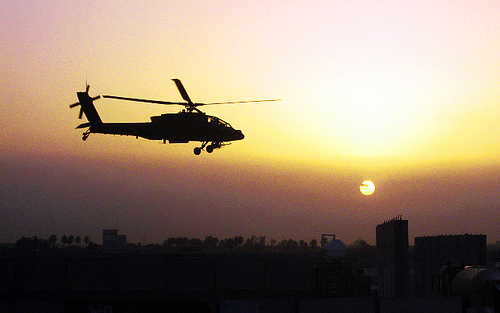
Photo provided by Flickr user The U.S. Army.



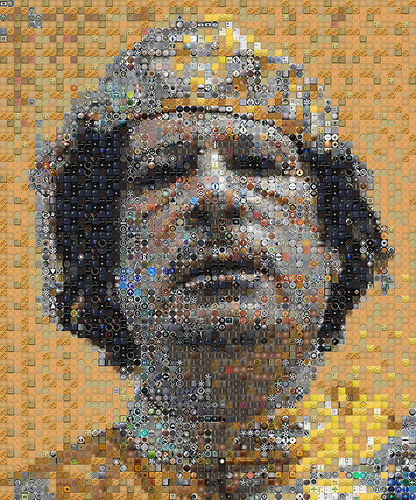 MEDIA ROOTS DISCLAIMER – The views and opinions expressed in this article are those of the author, Muammar Qaddafi, and do not necessarily reflect the position of Media Roots. The translation was undertaken with the intent of providing global youth with alternative opinions about so-called Western democracy. Youth may take bits and pieces from Qaddafi’s words and use them to form ideas regarding possible future forms of government.
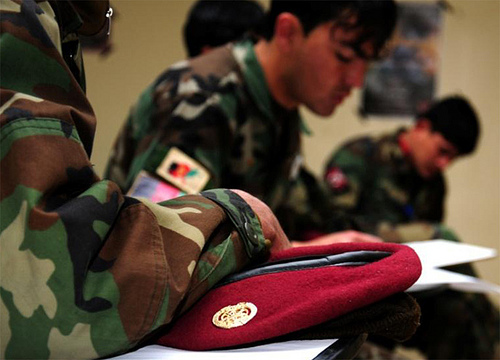 MEDIA ROOTS – The Pentagon disseminates propaganda through many different avenues:
  MEDIA ROOTS –