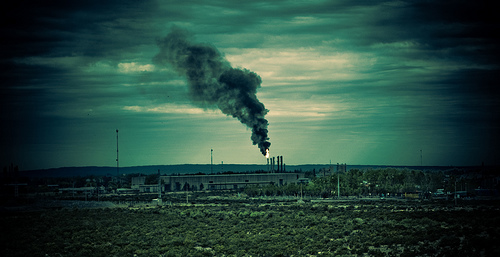
 WASHINGTON POST– On the west side of Anniston,
the poor side of Anniston, the
people ate dirt. They called it “Alabama
clay” and cooked it for extra flavor. They also grew berries in their
gardens, raised hogs in their back yards, caught bass in the murky streams
where their children swam and played and were baptized. They didn’t know their
dirt and yards and bass and kids — along with the acrid air they breathed —
were all contaminated with chemicals. They didn’t know they lived in one of the
most polluted patches of America.
WASHINGTON POST– On the west side of Anniston,
the poor side of Anniston, the
people ate dirt. They called it “Alabama
clay” and cooked it for extra flavor. They also grew berries in their
gardens, raised hogs in their back yards, caught bass in the murky streams
where their children swam and played and were baptized. They didn’t know their
dirt and yards and bass and kids — along with the acrid air they breathed —
were all contaminated with chemicals. They didn’t know they lived in one of the
most polluted patches of America.
Now they know. They also know that for nearly 40 years, while
producing the now-banned industrial coolants known as PCBs at a local factory,
Monsanto Co. routinely discharged toxic waste into a west Anniston
creek and dumped millions of pounds of PCBs into oozing open-pit landfills. And
thousands of pages of Monsanto documents — many emblazoned with warnings such
as “CONFIDENTIAL: Read and Destroy” — show that for decades, the
corporate giant concealed what it did and what it knew.
In 1966, Monsanto managers discovered that fish submerged in that creek
turned belly-up within 10 seconds, spurting blood and shedding skin as if
dunked into boiling water. They told no one. In 1969, they found fish in
another creek with 7,500 times the legal PCB levels. They decided “there
is little object in going to expensive extremes in limiting discharges.”
In 1975, a
company study found that PCBs caused tumors in rats. They ordered its
conclusion changed from “slightly tumorigenic” to “does not
appear to be carcinogenic.”
Monsanto enjoyed a lucrative four-decade monopoly on PCB production in the United
States, and battled to protect that monopoly
long after PCBs were confirmed as a global pollutant. “We can’t afford to
lose one dollar of business,” one internal memo concluded.
Lastmonth, the Environmental Protection Agency ordered General Electric Co.
to spend $460 million to dredge PCBs it had dumped into the Hudson
River in the past, perhaps the Bush administration’s boldest
environmental action to date. The decision was bitterly opposed by the company,
but hailed by national conservation groups and many prominent and prosperous
residents of the picturesque Hudson River
Valley.
In Anniston, far from the
national spotlight, the sins of the past are being addressed in a very
different way. Here, Monsanto and its corporate successors have avoided a
regulatory crackdown, spending just $40 million on cleanup efforts so far. But
they have spent $80 million more on legal settlements, and another lawsuit by
3,600 plaintiffs — one of every nine city residents — is scheduled for trial
next Monday. David Carpenter, an environmental health professor at the State
University of New York at Albany,
has been a leading advocate of the EPA’s plan to dredge the Hudson,
but he says the PCB problems in Anniston
are much worse.
“I’m looking out my window at the Hudson
right now, but the reality is that the people who live around the Monsanto
plant have higher PCB levels than any residential population I’ve ever
seen,” said Carpenter, an expert witness for the plaintiffs in Anniston.
“They’re 10 times higher than the people around the Hudson.”
The Anniston lawsuits have
uncovered a voluminous paper trail, revealing an unusually detailed story of
secret corporate machinations in the era before strict environmental
regulations and right-to-know laws. The documents — obtained by The Washington
Post from plaintiffs’ attorneys and the Environmental Working Group, a chemical
industry watchdog — date as far back as the 1930s, but they expose actions
with consequences that are still unfolding today.
Officials at Solutia Inc., the name given to Monsanto’s chemical operations
after they were spun off into a separate company in 1997, acknowledge that
Monsanto made mistakes. But they also said that for years, PCBs were hailed for
preventing fires and explosions in electrical equipment. Monsanto did stop
making PCBs in 1977, two years before a nationwide ban took effect. And the
current scientific consensus that PCBs are harmful, especially to the
environment, masks serious disputes over just how harmful they are to people.
Today, the old plant off Monsanto Road
here makes a chemical used in Tylenol. It has not reported a toxic release in
four years. Robert Kaley, the environmental affairs director for Solutia who
also serves as the PCB expert for the American Chemistry Council, said it is
unfair to judge the company’s behavior from the 1930s through 1970s by modern
standards.
“Did we do some things we wouldn’t do today? Of course. But that’s a
little piece of a big story,” he said. “If you put it all in context,
I think we’ve got nothing to be ashamed of.”
But Monsanto’s uncertain legacy is as embedded in west Anniston’s
psyche as it is in the town’s dirt. The EPA and the World Health Organization
classify PCBs as “probable carcinogens,” and while no one has
determined whether the people in Anniston
are sicker than average, Solutia has opposed proposals for comprehensive health
studies as unnecessary. And it has not apologized for any of its contamination
or deception.
In the absence of data, local residents seem to believe the worst. The
stories linger: The cancer cluster up the hill. The guy who burned the soles
off his boots while walking on Monsanto’s landfill. The dog that died after a
sip from Snow Creek, the long-abused drainage ditch that runs from the Monsanto
plant through the heart of west Anniston’s cinder-block cottages and shotgun
houses. Sylvester Harris, 63, an undertaker who lived across the street from
the plant, said he always thought he was burying too many young children.
“I knew something was wrong around here,” he said.
Opal Scruggs, 65, has spent her entire life in west Anniston,
the last few decades in a cottage in back of a Waffle House behind the plant.
But in recent years, Monsanto has bought and demolished about 100 PCB-tainted
homes and mom-and-pop businesses nearby, turning her neighborhood into a
virtual ghost town. Now she has elevated PCB levels in her blood — along with
Harris and many of their neighbors — and she believes she’s a “walking
time bomb.”
“Monsanto did a job on this city,” she said. “They thought we
were stupid and illiterate people, so nobody would notice what happens to
us.”
Continue reading about Monsanto Hiding Decades of Pollution.
© 2002 The Washington Post Company
Photo by flickr user A6U571N



 PALM BEACH POST
 WASHINGTON POST