Experiments Suggest Life Not One-Time Deal

HUFFINGTON POST– We think we die and rot into the ground, and thus must squeeze everything in before it’s too late. If life — yours, mine — is a just a one-time deal, then we’re as likely to be screwed as pampered. But experiments suggest this view of the world may be wrong.

The results of quantum physics confirm that observations can’t be predicted absolutely. Instead, there’s a range of possible observations each with a different probability. One mainstream explanation, the “many-worlds” interpretation, states that there are an infinite number of universes (the “multiverse”). Everything that can possibly happen occurs in some universe. The old mechanical — “we’re just a bunch of atoms” −- view of life loses its grip in these scenarios.

Biocentrism extends this idea, suggesting that life is a flowering and adventure that transcends our ordinary linear way of thinking. Although our individual bodies are destined to self-destruct, the “me” feeling is just energy operating in the brain. But this energy doesn’t go away at death. One of the surest principles of science is that energy never dies; it can neither be created nor destroyed. When we die, we do so not in the random billiard ball matrix but in the inescapable life matrix. Life has a non-linear dimensionality −- it’s like a perennial flower that returns to bloom in the multiverse.

A series of landmark experiments show that measurements an observer makes can influence events that have already happened in the past. One experiment (Science 315, 966, 2007) confirmed that flipping a switch could retroactively change a result that had happened before the switch was flipped. Regardless of the choice you, the observer, make, it’ll be you who will experience the outcomes −- the universes −- that will result.

Read more about Do You Only Live Once? Experiments Suggest Life Not One-Time Deal.

© 2011 Huffington Post

Photo by Flickr user Smithsonian
Could ‘Goldilocks’ Planet Be Just Right For Life?

THE HERALD SUN– Astronomers say they have for the first time spotted a planet beyond our own in what is sometimes called the Goldilocks Zone for life: Not too hot, not too cold. Juuuust right.

Not too far from its star, not too close. So it could contain liquid water. The planet itself is neither too big nor too small for the proper surface, gravity and atmosphere.

It’s just right. Just like Earth.

“This really is the first Goldilocks planet,” said co-discoverer R. Paul Butler of the Carnegie Institution of Washington.

The new planet sits smack in the middle of what astronomers refer to as the habitable zone, unlike any of the nearly 500 other planets astronomers have found outside our solar system. And it is in our galactic neighborhood, suggesting that plenty of Earth-like planets circle other stars.

Finding a planet that could potentially support life is a major step toward answering the timeless question: Are we alone?

Scientists have jumped the gun before on proclaiming that planets outside our solar system were habitable only to have them turn out to be not quite so conducive to life. But this one is so clearly in the right zone that five outside astronomers told The Associated Press it seems to be the real thing.

“This is the first one I’m truly excited about,” said Penn State University’s Jim Kasting. He said this planet is a “pretty prime candidate” for harboring life.

Continue reading about Could ‘Goldilocks’ Planet Be Just Right For Life?.

© AP, 2010

NASA: Asteroids Might Have Brought Water to Earth

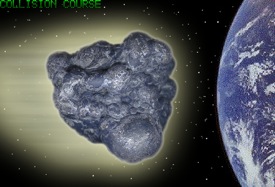
asteroidCOMPUTER WORLD– The discovery of water ice on the surface of an asteroid has NASA scientists conjecturing that asteroids and comets could have delivered enough water to a primordial Earth to fill its oceans.

A study of data compiled during six years of observing the asteroid 24 Themis through a NASA-funded telescope found evidence of water ice and carbon-based organic materials. The asteroid orbits the sun at a distance of 297 million miles, or between the planets of Jupiter and Mars.

The telescope, housed at NASA’s Infrared Telescope Facility on the summit of Mauna Kea in Hawaii, has constantly focused on 24 Themis asteroid.

“For a long time the thinking was that you couldn’t find a cup’s worth of water in the entire asteroid belt,” said Don Yeomans, manager of NASA’s Near-Earth Object Program Office, in a statement yesterday. “Today we know you not only could quench your thirst, but you just might be able to fill up every pool on Earth — and then some.”

According to NASA, this new research could help rewrite the book not just on the nature of asteroids but on how the solar system was formed as well.

Continue reading about NASA: Asteroids Might Have Brought Water to Earth.

© Computerworld, 2010 

Photo by flickr user andrewsrj

Mediterranean Microfossils Offer Hope for Finding Life On Mars

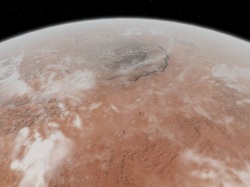
marsSCIENCE NEWS– Tiny fossils discovered on Earth in samples of sulfates, a class of minerals recently found to be common in some parts of Mars, bodes well for finding vestiges of life on the Red Planet, astrobiologists reported April 28 during a briefing held in conjunction with the Astrobiology Science Conference 2010 in League City, Texas.

Bill Schopf of the University of California, Los Angeles, and his colleagues discovered the fossils in deposits of gypsum, or calcium sulfate, that were deposited in the Mediterranean Sea 6 million years ago and then thrust up into the Alps.

The discovery, which included plankton and single-celled organisms such as cyanobacteria (pond scum), some filling areas tens of micrometers in diameter, was a surprise, he said. Schopf and other researchers had assumed that as sulfate crystals grow, they would crush and obliterate any microfossils that might have been trapped inside the minerals, “but that turned out not to be the case,” he said.

Continue reading about Mediterranean Microfossils Offer Hope for Finding Life On Mars.

© Science News, 2010

Photo by flickr user FlyingSinger

Life Discovered on Saturn’s Moon Titan

Jun 5, 2010

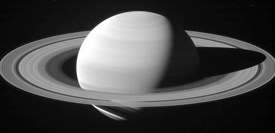
saturnTELEGRAPH– Evidence that life exists on Titan, one of Saturn’s biggest moons, appears to have been uncovered by Nasa scientists.

Researchers at the space agency believe they have discovered vital clues that appeared to indicate that primitive aliens could be living on the moon.

Data from Nasa’s Cassini probe has analysed the complex chemistry on the surface of Titan, which experts say is the only moon around the planet to have a dense atmosphere.

They suggest that life forms may have been breathing in the planet’s atmosphere and also feeding on its surface’s fuel.

Astronomers claim the moon is generally too cold to support even liquid water on its surface. The research has been detailed in two separate studies.

The first paper, in the journal Icarus, shows that hydrogen gas flowing throughout the planet’s atmosphere disappeared at the surface. This suggested that alien forms could in fact breathe.

The second paper, in the Journal of Geophysical Research, concluded that there was lack of the chemical on the surface.

Scientists were then led to believe it had been possibly consumed by life.

Continue reading about Life Discovered on Saturn’s Moon Titan.

© Telegraph, 2010

Photo by flickr user kokogiak